
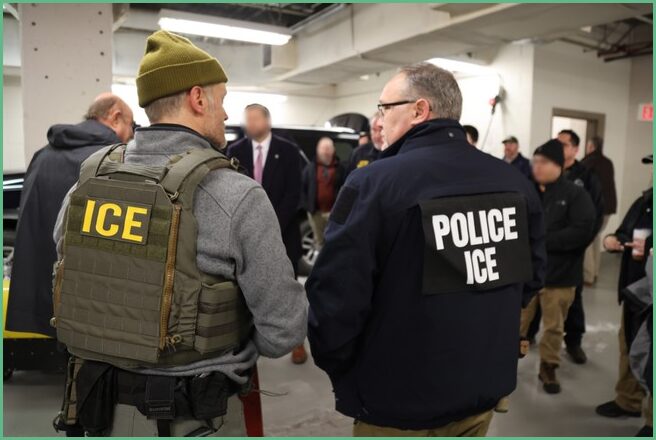
Apple pulled an app called ICEBlock from its store after pressure from the Department of Justice, and the move is a rare win for law enforcement safety over tech permissiveness. The app had allowed users to mark the locations of ICE agents on maps and share identifying details, and that capability created a real threat. Conservatives should applaud any step that protects federal officers doing dangerous work at the border and beyond.
ICEBlock was created by an individual who said he wanted to push back against immigration enforcement, but tools that help target federal agents cross a clear line. The app let users drop pins, attach photos, and note what agents were wearing and driving. That anonymity and crowd-sourced targeting is a recipe for violence and obstruction of justice.
“We reached out to Apple today demanding they remove the ICEBlock app from their App Store — and Apple did so,” Bondi said in a statement to Fox News Digital.
“ICEBlock is designed to put ICE agents at risk just for doing their jobs, and violence against law enforcement is an intolerable red line that cannot be crossed,” Bondi’s statement continued. “This Department of Justice will continue making every effort to protect our brave federal law enforcement officers, who risk their lives every day to keep Americans safe.”
That intervention by the DOJ was not just bureaucracy flexing its muscle, it was the responsible exercise of government to prevent foreseeable harm. When tech platforms become tools for targeting officers, private companies have to be held to basic standards. Apple taking the app down is the right call, even if some corners of the media spin it as censorship.
Public safety concerns escalated when an attacker opened fire at an ICE field office in Dallas, wounding staff and killing a detainee. Investigators later said the suspect had searched for tracking apps, including ICEBlock, in the days before the attack. The idea that a mobile utility could be used to find and assault officers makes the removal both urgent and necessary.
CNN ran a segment that helped popularize the app early on, and that attention had consequences. Platforms and outlets have influence, and promoting tools that enable targeted harassment or worse should prompt real scrutiny. Media outlets need to stop treating viral tech stunts as neutral curiosities when they can endanger human lives.
Joshua Aaron, the app’s developer, explained his motives in blunt terms in earlier interviews. “When I saw what was happening in this country, I wanted to do something to fight back,” he said. Motives like frustration do not excuse creating a tool that can put federal agents at risk.
Acting ICE Director Todd Lyons called out the media attention around the app, saying coverage had amplified danger to personnel. He said the promotion was “like inviting violence against them with a national megaphone.” He added, “Advertising an app that basically paints a target on federal law enforcement officers’ backs is sickening.”
There is a clear difference between peaceful protest and enabling violence, and ICEBlock straddled that line on the wrong side. Users could post tips on enforcement locations anonymously, while agents could be left exposed and identifiable. That imbalance should never be normalized in a society that depends on law and order.
Beyond the immediate threat to individual agents, the app posed a broader problem for enforcement operations. It could be used to obstruct investigations, compromise undercover work, and allow organized groups to ambush or harass officers. When tools weaponize public data and crowdsourcing against law enforcement, they undermine the rule of law.
Politically, the episode highlights a simple truth: not every technological possibility is a public good. Some innovations, no matter how clever, create vulnerabilities that must be closed. Republicans and conservatives who value public safety and order have to push back when tech enables chaos under the banner of activism.
The political left’s recent posture on law enforcement has been inconsistent, demanding mask rules for civilians while sometimes discouraging protections for officers during operations. That contradiction matters because policy should be coherent on safety and accountability. It is reasonable to insist that elected leaders and media treat threats to law enforcement seriously and without partisan caveats.
Apple’s decision was the narrowly tailored response needed to eliminate an immediate danger, but it also raises longer term questions. Platforms must build clear policies to prevent being exploited for violent ends while preserving legitimate free expression. If companies refuse to act, government must be prepared to step in where public safety is at stake.
The app’s existence and removal should also prompt law enforcement agencies to reassess how they share operational information and protect personnel. Training, operational security, and legal tools to prosecute those who use apps to target officers are all on the table. Protecting officers on the job is not optional, and that principle should guide tech policy.

1 Comment
Oh isn’t that considerate of the WOKE Illegal Alien pandering Apple!