
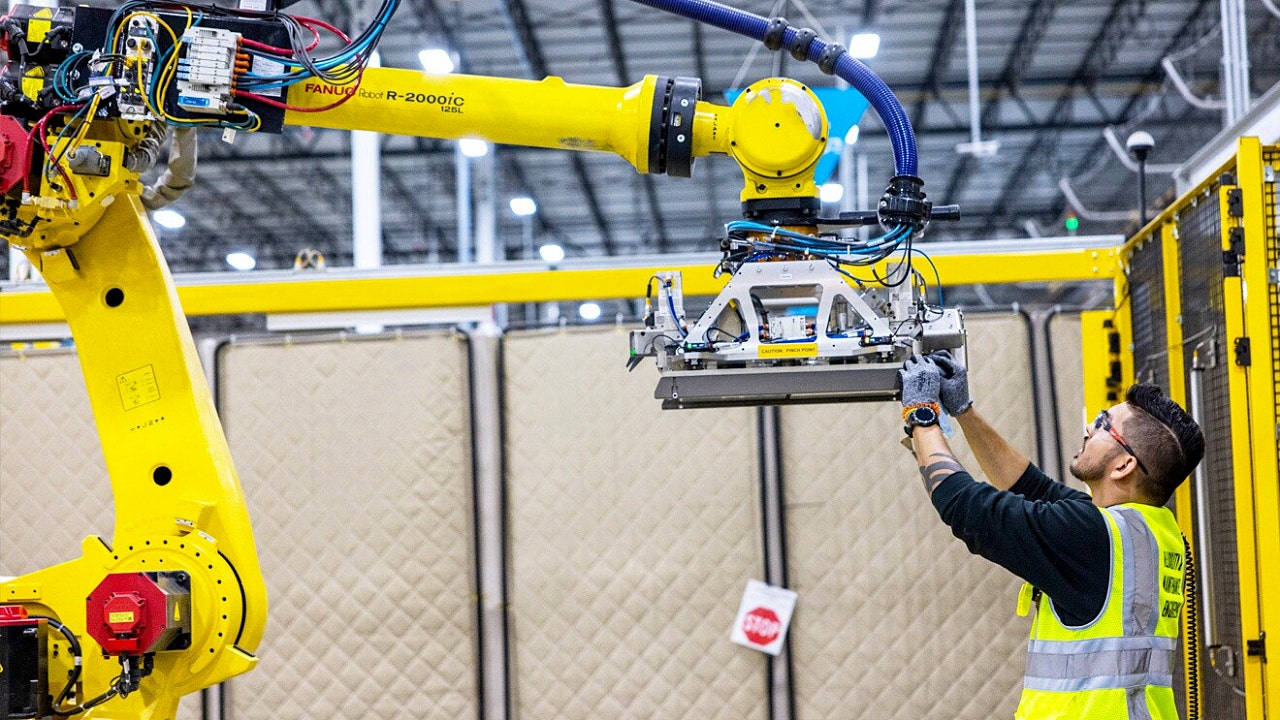
Amazon launched Blue Jay as a bold attempt to speed same-day deliveries with a ceiling-mounted, multi-armed sorter, then quietly shelved the program months later; the hardware is gone but elements of the system will live on in other projects, and the episode highlights the gap between AI breakthroughs in software and the hard realities of moving metal in busy warehouses.
Blue Jay was billed as more than a conveyor upgrade—it was a ceiling-mounted sorter meant to identify and handle many packages at once using AI-driven perception. Teams rushed the system from concept to prototype in under a year, aiming to cut handling time and ease physical strain on fulfillment workers. On paper, the promise was simple: faster local deliveries with less human wear and tear.
The design brought unique challenges because it lived in the building, not on the floor. Mounting arms to ceilings required precise structural work and integration into warehouse layouts that already functioned like machines themselves. Those tight fits left little wiggle room for retrofits, so any change meant heavy lifts, new mounts and serious downtime costs.
That inflexibility is one reason software-centric AI often looks further along than robotics in practice. A model update rolls out with a click; a physical redesign can mean replacing beams, motors and support infrastructure. The ledger for hardware mistakes adds up fast: installation, maintenance and the ripple effects in an operating hub that needs to keep shipments flowing.
Beyond installation, cost and complexity pushed back on scaling Blue Jay. Ceiling rigs demand specialized parts and installation crews, and they anchor a process around a fixed layout. In contrast, modular robots can move between aisles or be swapped out, which fits better with busy, evolving fulfillment environments that need flexibility more than fixed speed.
People who worked on the project have been redistributed to other robotics initiatives inside the company, and elements of Blue Jay’s perception and sorting algorithms will inform future builds. The program’s pause reads less like a defeat and more like a pivot: keep the promising software ideas, drop the hardware approach that made them expensive to deploy. Practical lessons stuck even when the device did not.
ROBOTS LEARN 1,000 TASKS IN ONE DAY FROM A SINGLE DEMO
The Blue Jay story underlines a growing split in the tech world: AI that lives in code moves fast, while any machine that has to grapple with gravity, heat and human unpredictability moves slower. Robots must tolerate dust, collision, odd-shaped parcels and workers walking past—the messiness of the real world. Each failure in that environment has a tangible cost that a buggy app update never faces.
That doesn’t kill automation. It reshapes it. The industry appears to be favoring modularity and adaptability over huge, building-sized machines that promise big gains but lock in a single approach. Companies are now asking whether a versatile fleet of smaller systems delivers more uptime and less capital risk than one monolithic installation.
WAYMO’S CHEAPER ROBOTAXI TECH COULD HELP EXPAND RIDES FAST
For customers, the headline remains attractive: quicker deliveries, more local inventory, better convenience. Behind the scenes, though, there’s a tough engineering conversation about where to invest and how fast to scale durable, adaptable robotics. The high-profile failure of one machine doesn’t stop progress, but it does force a rethink about which trade-offs really pay off when robots meet the real world.
Amazon’s recalibration of Blue Jay shows that industrial experimentation is messy and that breakthroughs often arrive after several dead ends. The firm’s continued work on warehouse automation suggests lessons learned will be folded into systems that are easier to install and maintain. The long game in logistics still favors designs that can bend with changing needs rather than ones that depend on fixed, expensive architecture.
If even the most capable logistics operator faces limits getting advanced robots into everyday use, the takeaway is clear: the AI revolution includes both flashy software wins and a slower, more deliberate hardware evolution. The road to reliable robotic helpers is winding, and the balance between ambition and practicality will shape how and when those helpers actually show up at your door.
