
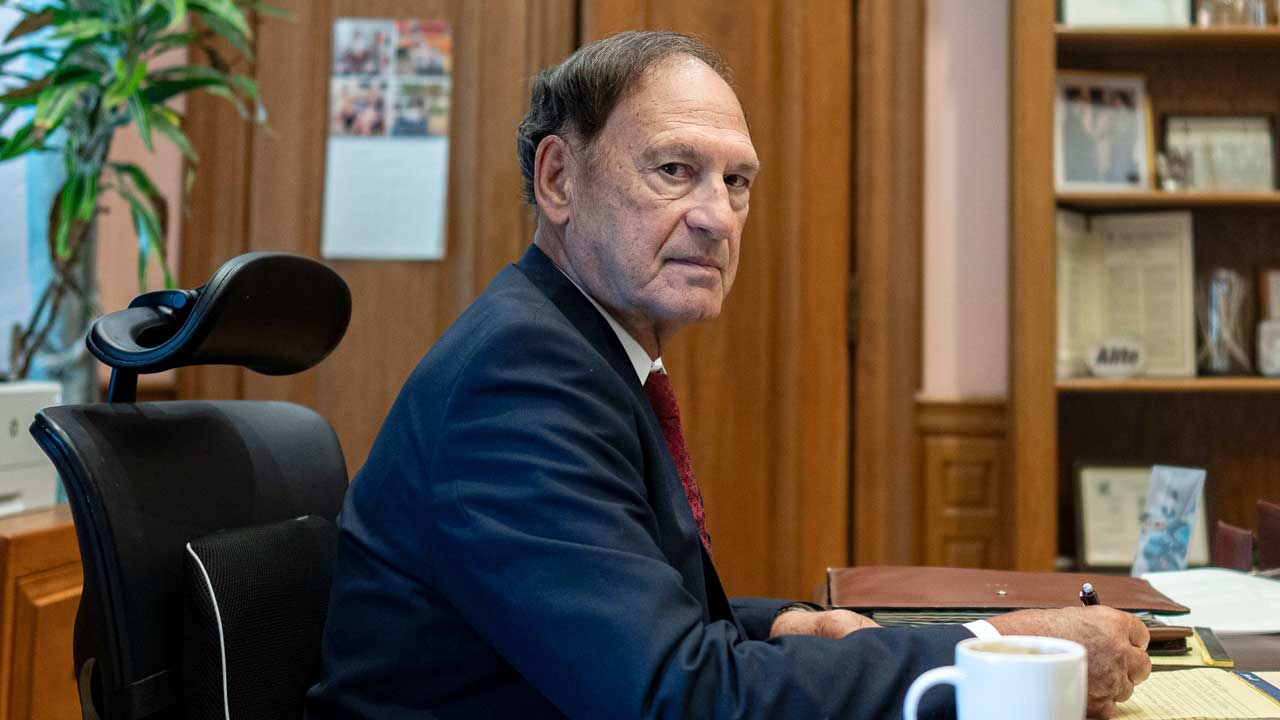
Justice Samuel Alito’s latest remarks landed with a thud and a warning shot. He raised fresh alarms about pressure on the Supreme Court, argued that Congress has real leverage over the institution’s operations, and said some lower court judges have drifted well beyond their lane.
Alito’s point was blunt: the court may sit at the top of the judicial system, but it still depends on Congress for funding. In his telling, lawmakers could cripple the court by pulling resources, even if they cannot erase the constitutional protections that shield a justice’s salary.
He framed that vulnerability as more than a budget fight. It goes to the heart of whether the judiciary stays independent or gets nudged around by political power whenever the rulings become inconvenient.
During remarks at the Federalist Society’s Antonin Scalia Memorial Dinner, Alito said, “Congress can turn off the lights at the Supreme Court and stop everything from happening if they want to defund their activities. And there are many, many, many other things that they can do, or at least try to do,”
He also pushed the constitutional argument, saying the independence of the judiciary has to hold if the nation wants the system designed in 1789 to remain recognizable. That idea sits at the center of the fight, because once the courts start looking like just another political branch, the whole balance starts to wobble.
The Constitution backs that up in plain language. Article III says federal judges hold their offices during good behavior and that their compensation cannot be reduced while they remain in office, a safeguard meant to keep the bench from becoming an arm of whoever happens to control Congress.
Alito did not stop with the Supreme Court’s own standing. He also took aim at some lower court rulings, suggesting that certain judges have issued orders that went far beyond proper bounds and interfered with executive policies in ways that should not be brushed off.
His critique was firm but not vague. He said judges are hardworking and capable, but not flawless, and then added that in some cases they have “gone far astray in abuse of their powers.”
That line taps into a broader conservative frustration with a judiciary that, in the eyes of many Republicans, has too often stepped into the middle of policy fights from the bench. When court orders start shaping national politics instead of applying the law, the backlash tends to come fast and hard.
Alito’s comments also arrive during a season when the Supreme Court sits under an unusually bright spotlight. Every major ruling seems to trigger another round of fury, and the justices are forced to defend not only their decisions but the legitimacy of the institution itself.
That is why his warning about congressional meddling matters so much. The court may be independent in theory, but independence can look pretty fragile when the pressure comes from appropriations, public attacks, and nonstop attempts to turn legal disputes into partisan bloodsport.
Alito, who joined the Supreme Court in 2006 after being nominated by President George W. Bush, has long been one of the bench’s most closely watched conservative voices. His latest comments fit that pattern, mixing constitutional caution with a sharp critique of judges who, in his view, have forgotten the limits of their role.
