
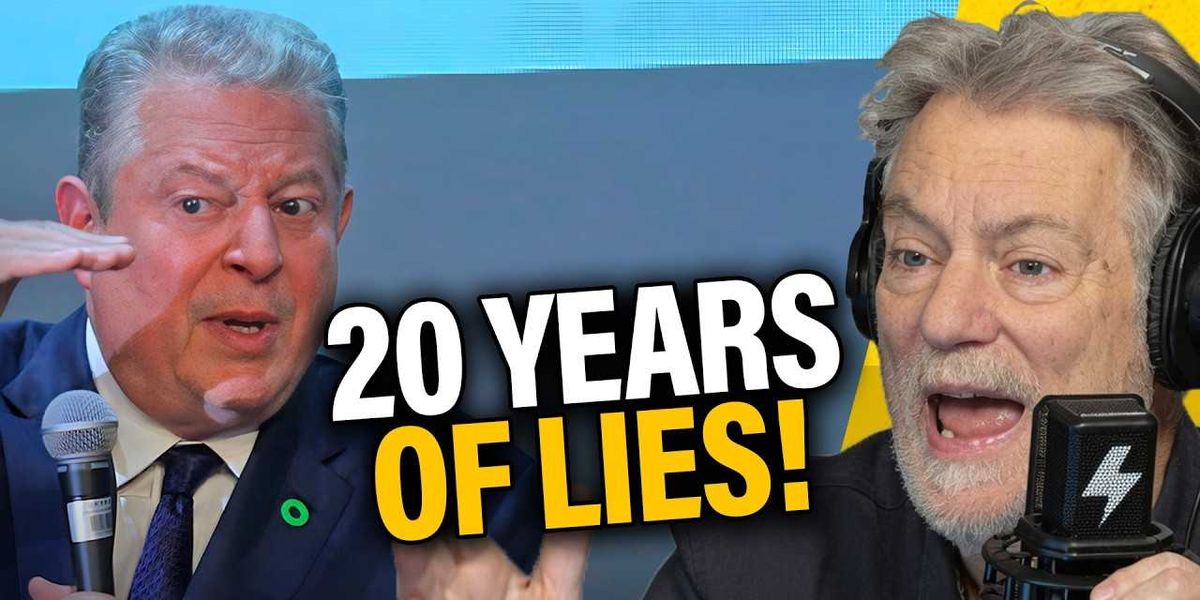
Two decades after Al Gore’s An Inconvenient Truth shook headlines, critics say the sweeping doomsday claims haven’t matched reality. This piece walks through those challenges, highlights Pat Gray’s blunt take, and revisits several high-profile predictions to see what actually happened.
When the documentary landed 20 years ago it painted a future of vanishing ice, runaway sea level rise, and a planet sliding toward catastrophe. That message drove headlines and policy debates, and it turned Gore into a leading figure for climate alarm. For many conservatives, the film became a symbol of media-fueled panic that demanded a closer look as the years rolled by.
BlazeTV host Pat Gray summed up the conservative reaction plainly, saying, “His predictions … none of them came true,” and he meant it as a total rejection of the film’s central claims. That line captures the frustration of skeptics who expected dramatic, visible changes to have taken place by now. For them, the mismatch between cinematic urgency and observable shifts matters politically and culturally.
Gray drills into specific forecasts, pointing at the Arctic fears and the imagery that stuck in people’s heads. “The Arctic sea ice, remember that? Supposed to be gone completely. … You might notice if you look, the polar ice caps in the Arctic are not gone. They have not disappeared. They are there,” he says, using plain language to push back on the narrative. Republicans and skeptics alike use that kind of on-the-ground observation to argue for a more measured conversation about climate policy.
Then there are the glaciers and iconic images like Kilimanjaro’s snows, which Gray brings up to make a point about accuracy versus alarm. “How about the melting glaciers and the snows of Kilimanjaro?” he asks, adding, “Still there.” He also mentions a curious detail about signs in Glacier National Park: “In fact, in Montana, where the park is, they used to have signs that read, ‘These are disappearing soon, so make sure you enjoy and take a picture.’ And they finally took the signs down in 2020 because it wasn’t happening,” Gray says. Those examples are used to question the timeline and tone Gore promoted.
Sea levels were another dramatic prediction in the film, with imagery that implied streets and coastlines would vanish under waves. Gray fires back: “The reality is the Westside Highway is still there. The sea levels have not risen 20 feet. In fact, global sea levels have risen nine inches since 1880,” Gray explains. He goes further with a provocative line: “But right now there’s gradual retreat occurring rather than rapid city sinking inundations of these places. In other words, what’s happening is the opposite of what he predicted. The opposite. The sea levels are actually receding now,” he continues, pressing the point that the fear-driven timeline didn’t pan out the way the film implied.
Gore also warned of runaway rises in atmospheric CO2 and a spike in hurricane violence tied to warming oceans. Critics point out that those dramatic thresholds, like CO2 leaping past 500 parts per million and an obvious uptick in hurricane frequency, did not materialize as described in the movie. That contrast — between cinematic urgency and the steady, complex reality of climate data — is central to the conservative critique.
Gray doesn’t hold back on the consequences for Gore’s credibility, calling out the awards and laurels the film earned while questioning its factual payoff. “He was hysterical about everything, and he won an Oscar for it, and he won a Nobel Prize for it in 2007, and he got virtually nothing right,” Gray says, emphasizing, “Nothing.” For skeptics, that sums up why the debate about climate policy needs clearer facts and less theatrical alarm.
This debate isn’t just about one film or one public figure; it’s about how urgent claims shape politics, spending, and trust. From a Republican perspective, the demand is for policies born of careful evidence, not headlines, and for honest accounting when predictions don’t land. That call for accountability drives the pushback you see from voices like Pat Gray today.
