
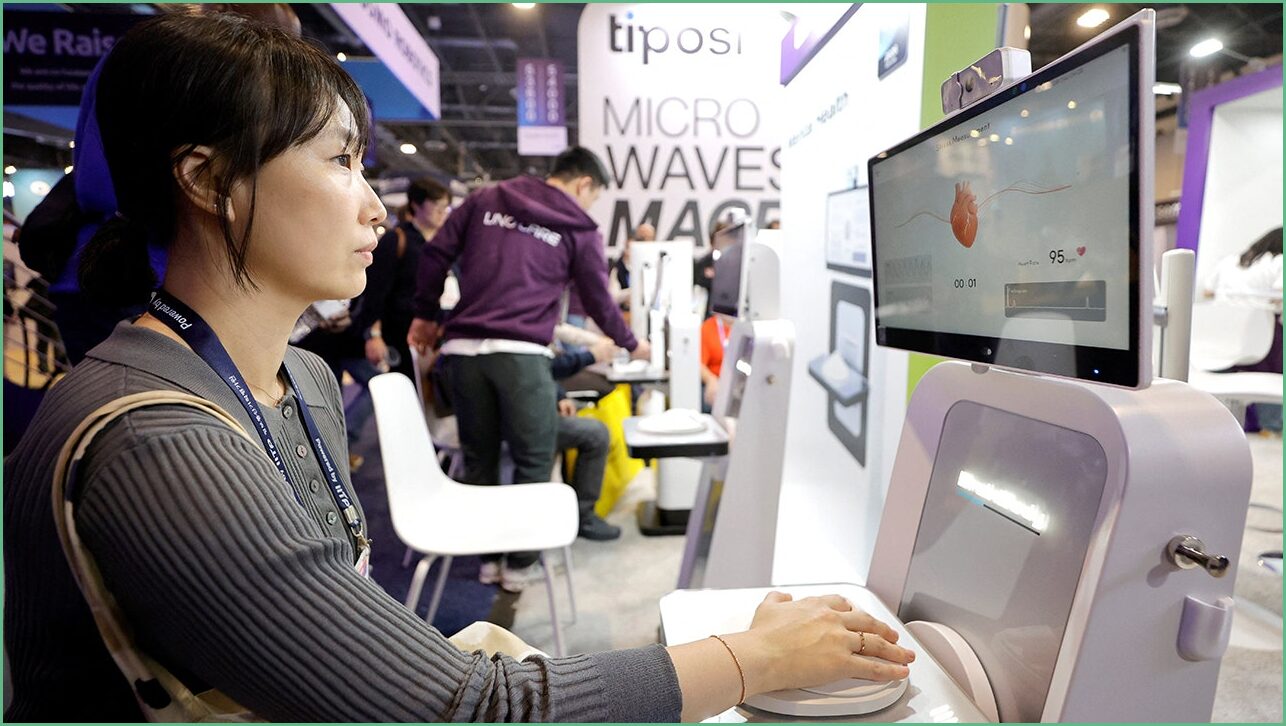
CES in Las Vegas turned its spotlight to health tech this year, with devices and services that aim to catch issues early, make recovery easier and fold wellness into everyday routines. The show floor was full of AI-driven diagnostics, mobility aids, light therapy tools and home safety tech that hint at where consumer health is headed next.
The big consumer tech expo still serves as a launch pad for what might show up in homes, clinics and gyms over the next few years. This year’s health offerings ranged from countertop mirrors that read your physiology to wearable-linked features that watch for cognitive change.
Among the most talked-about gadgets was a smart mirror that promises a fast health snapshot from a short selfie video. It analyzes facial blood flow patterns with AI, then scores metabolic health, heart health and physiological age on a zero-to-100 scale to give quick insights and practical recommendations.
The mirror supports multiple user profiles and aims to be a consumer-friendly entry to long-term monitoring, arriving with an initial price point near $899 and a subscription for ongoing insights. Optional concierge-style support connects users to nutrition and wellness pros for follow-up guidance.
Mobility tech showcased real-world wearability with a new lightweight walking exoskeleton designed for day-to-day use. The modular system uses AI to adapt assistance to the user’s gait and terrain, and a belt-based attachment keeps the hardware compact and easier to don for extended walks.
Stronger configurations and joint-specific models were also on display to support higher assistance needs, signaling that exoskeletons are moving from pure rehab gear toward everyday mobility tools. This shift could make powered support more practical outside clinic walls.
Pediatric mobility saw a notable entry with an overground exoskeleton built for young children with neurological conditions. The device offers active and passive gait modes that guide natural movement patterns, helping kids practice walking while reducing the secondary complications that can follow conditions like cerebral palsy.
For indoor wellness, a clip-on near-infrared lamp drew attention as a way to replace missing components of natural sunlight during long screen time. The gadget projects controlled near-infrared light while you work and tracks daily exposure, aiming for two to four hours of use to support energy and mood.
SMART RINGS THAT CAN TRACK YOUR SLEEP, FITNESS, AND COULD SAVE YOUR LIFE
Testing food for hidden allergens was tackled with a handheld mini-lab that analyzes a small meal sample in a sealed pouch and reports allergen or gluten presence in minutes. Built on laboratory-grade methods, the device automates analysis so nontechnical users can get fast, actionable results, a feature that attracted interest from demanding food-service environments.
A wearable-driven feature previewed by a major phone maker uses walking patterns, voice changes and sleep shifts to flag possible early signs of cognitive decline. The company emphasizes that the tool is not a diagnostic instrument but a nudge system to prompt earlier professional evaluation when deviations from baseline appear.
Bathroom scales got smarter with a next-gen model that captures ECG readings, arterial stiffness, metabolic efficiency and hypertension risk in under 90 seconds. The connected approach shifts focus away from weight alone and toward tracking early cardiometabolic signals that evolve with lifestyle changes.
A fitness brand highlighted a smartwatch with a new health status feature that watches heart rate variability, respiration and other metrics for meaningful drifts from personal baselines. Long battery life supports continuous monitoring, and lifestyle logging ties daily habits to sleep and stress outcomes for clearer context.
Home safety tech showed a public-facing angle with a camera-based feature that can opt in to detect smoke and flames, sharing alerts with a nonprofit network that distributes real-time updates during wildfires. It demonstrates how consumer devices can integrate with community-level response in environmental emergencies.
Rounding out the list was a compact robotic roller that delivers a guided full-body massage in about ten minutes, using interchangeable attachments and activity-specific programs. An app-driven body scan tailors pressure and target areas, offering a shortcut to recovery for sore muscles or long desk sessions.
Which of these CES health technologies would you try first, and what problem would you want it to solve in your daily life?
