
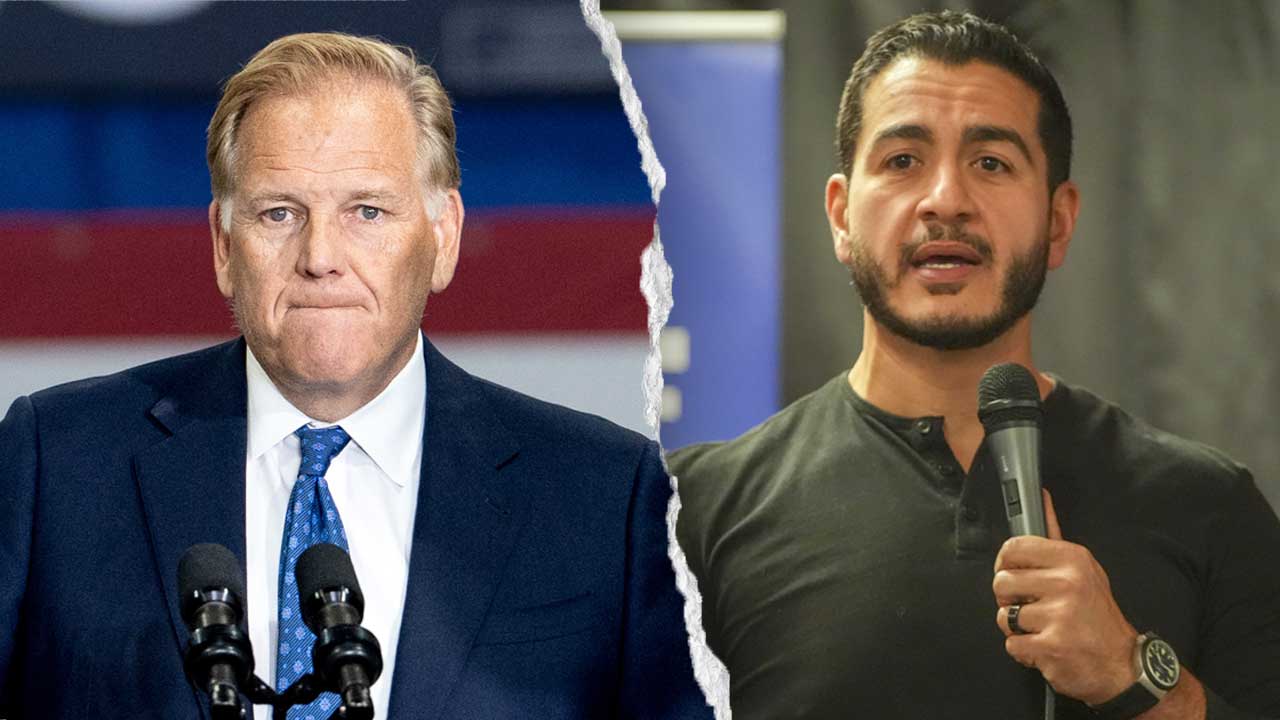
Justin Amash just dropped a sharp take into Michigan’s Senate fight, and it cuts against the usual partisan script. The former congressman said he did not vote for either Mike Rogers or Abdul El-Sayed, but still argued that Rogers would be the bigger problem in the U.S. Senate.
His comments landed in a race already packed with tension, surprise endorsements, and hard-fought crossover politics. Rogers, the Republican nominee backed by President Donald Trump, is facing El-Sayed in one of the country’s most closely watched contests.
Amash said his choice was shaped by principle, not party loyalty. In a post on X, he said he has “major disagreements” with both men and does not believe in picking “the lesser of two evils,” adding that he did not vote for either candidate.
Even so, he made clear where he sees the bigger risk. “It goes without saying that I have major disagreements with both Mike Rogers and Abdul El-Sayed, and neither one particularly likes me,” Amash wrote in a . “I also don’t vote for ‘the lesser of two evils.’ I believe you should support a candidate only if you truly want the person to hold that office. I’ve already voted, and consistent with the above principle, I didn’t vote for Rogers or El-Sayed. But I do know which one would be more dangerous in the U.S. Senate — and it’s not even close.”
Amash compared El-Sayed to Sen. Bernie Sanders of Vermont, saying Sanders is a rough stand-in for some of El-Sayed’s views. Sanders has already backed El-Sayed, which gave Amash another marker for judging the Democrat’s political lane.
He said Sanders represents ideas he believes would be harmful if they ever became law, but argued that the structure of government keeps those ideas from going very far. Rogers, in Amash’s view, is a different story because a single senator can help decide the outcome on issues that hit hard and fast.
https://x.com/justinamash/status/2117301998991430017
That’s where Amash drew his line. He said Rogers would be especially bad on war powers, surveillance, privacy, speech, criminal justice, and oversight. In his view, those are the kinds of issues where one senator can shape real-world outcomes, and that makes Rogers the more serious threat to liberty and the Constitution.
“In this world, the real world, not the imaginary one that partisan pundits on the right and left live in, Rogers poses a far greater threat to individual liberty and the Constitution than Sanders,” Amash wrote. He also said Sanders is actually better than the average member of Congress on those questions, which is a pretty blunt rebuke of Rogers by comparison.
Amash then went one step further and said El-Sayed would be “less dangerous” than Rogers. He added that El-Sayed would likely follow Sanders-style policy instincts, and while he said that would still produce many bad outcomes, he sees Rogers as the candidate with the sharper edge.
The race has only gotten messier in recent days, especially after Rep. Haley Stevens stunned a lot of Democrats by backing Rogers instead of her own party’s nominee. That move shook up the final stretch and fed the sense that Michigan’s Senate contest is bigger than a simple red-versus-blue fight.
Amash’s own political path gives extra weight to his remarks. He served in the House from 2011 through 2021, voted to impeach Trump in 2019, then left the Republican Party and later aligned with the Libertarians. He also ran in the 2024 Michigan GOP Senate primary and lost to Rogers, which makes his latest criticism of Rogers even more pointed.
Rogers went on to lose that general election to Elissa Slotkin, who was serving in the House at the time. Now he is back in another high-pressure Senate race, while El-Sayed is trying to ride Democratic support and hold together a coalition that has suddenly become a lot less predictable.
The Rogers and El-Sayed campaigns did not immediately respond to requests for comment, leaving Amash’s comments to hang out there on their own. In a race this tight, even a former lawmaker who says he voted for neither side can still throw a heavy punch.
