
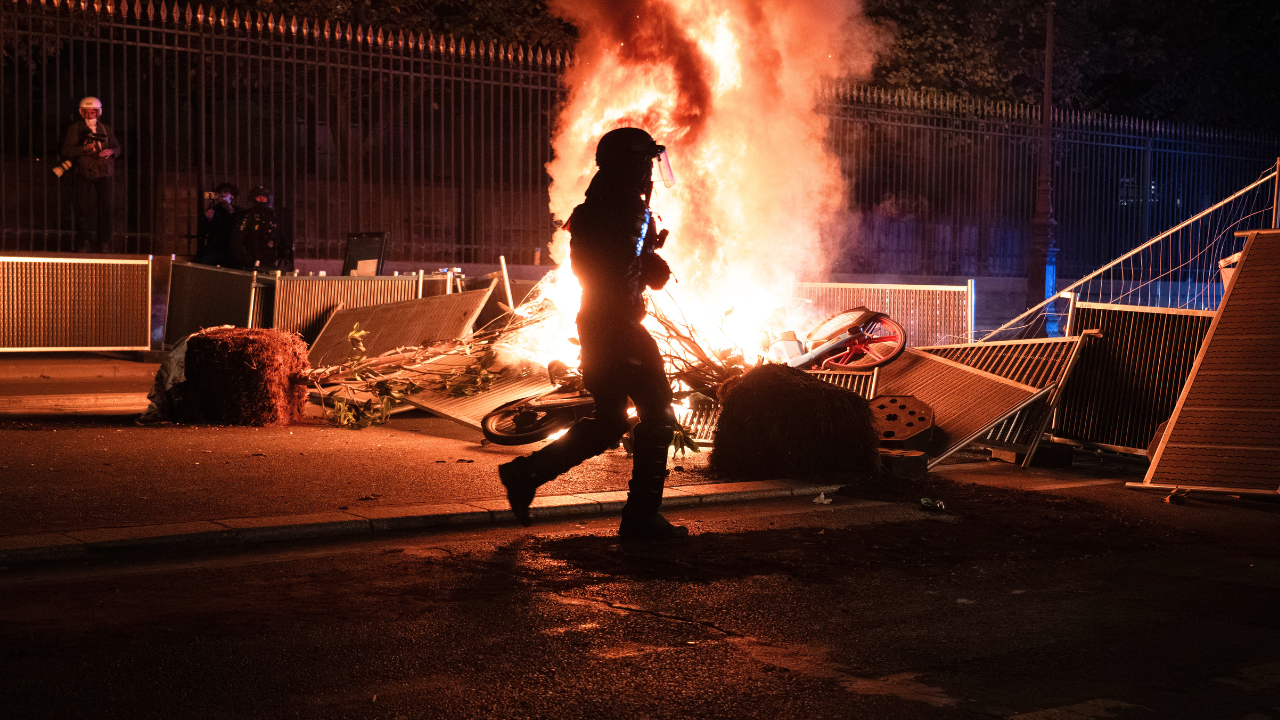
France spent Sunday picking through the wreckage after a wave of unrest left shop windows smashed, cars burned, and police posted across major streets. The scenes were especially stark in Paris, where clashes between masked groups and officers turned a day of protest into something far darker. Outside the capital, historic buildings, storefronts, and public spaces also took a beating.
The trouble started during nationwide demonstrations tied to rising living costs and frustration over schools, drawing huge crowds in cities across the country. Alongside the peaceful marchers were masked groups that moved in fast, targeting businesses, starting fires, and forcing police into repeated confrontations. Authorities said the crackdown was heavy, with 1,800 arrests across France and 855 of them in the Paris area.
Paris looked rough by dawn, with broken glass, charred vehicles, and debris scattered through streets that had been packed the night before. Fire crews were kept busy as tear gas hung in the air and police worked to keep order around hotspots that flared during the protests. What began as a broad show of anger over money and living standards quickly turned into a grim street-level mess.
The damage stretched well beyond the capital. In Limoges, a fire tore through the city’s town hall, a building dating to 1883 and listed as a historic landmark in 1975. Local prefect Maurice Barate said the roof had collapsed onto the lower floors and that about two-thirds of the exterior was gone, calling it “a catastrophe for heritage.”
That hit hard because the building was more than just office space. It was part of the city’s identity, the kind of place people pass every day without thinking about how fragile it really is until flames take hold. Once that kind of structure goes up in smoke, the loss feels bigger than a single headline.
French President Emmanuel Macron had urged “calm and respect” ahead of the demonstrations, saying the right to protest had to be exercised with care for people and property. That message, though, did little to slow the violence once the unrest spread through the streets. As things escalated, Macron and his wife, Brigitte, were later seen at a Celine Dion concert in Nanterre, west of Paris, which drew plenty of attention of its own.
The optics were messy, especially with the country still dealing with fresh damage and mounting anger. Macron had spent the previous days in Brussels for a European Council meeting, and his appearance at the concert became another flashpoint in a week already overloaded with tension. In a country already on edge, even an evening out can land like a provocation.
By Monday, the evidence was everywhere. In Paris, businesses were left with boarded or shattered fronts, graffiti-covered entrances, and burned-out vehicles still sitting where they had been abandoned after the violence. Cafes and restaurants along damaged streets had the look of places trying to reopen while also trying to make sense of how quickly the night had gone sideways.
Donald Trump also jumped into the debate on Sunday, tying the unrest to immigration in a Truth Social post and calling on France to tighten control at the border. He wrote, “The immigration of people from an entirely different world, people with hatred in their hearts, has shattered that once great country,” and added, “Close your borders and take control, before it is too late!”
For many people in France, the raw frustration on display was impossible to miss, but so was the cost of letting chaos spill over into fire and looting. The morning after left a country staring at scorched pavement, damaged landmarks, and neighborhoods trying to reset after a night that kept getting uglier as it went on.
