
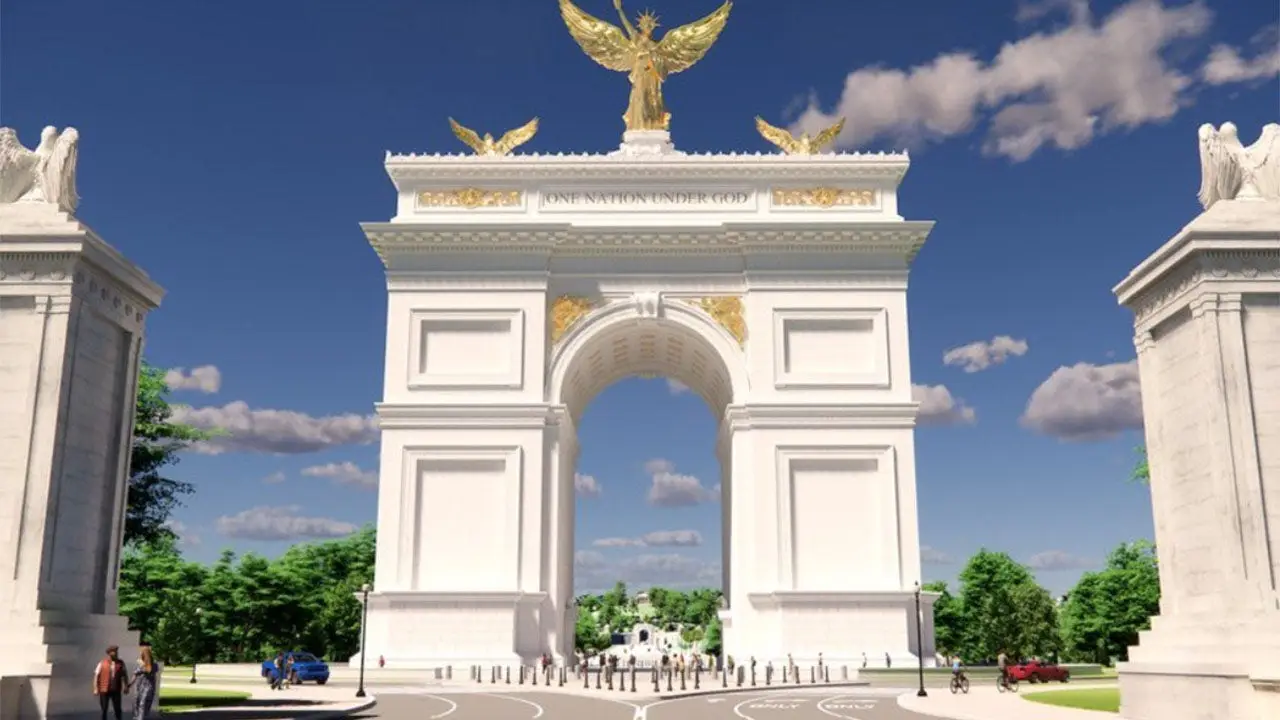
Donald Trump’s planned arch near Arlington Memorial Bridge is now being pitched as more than a monument. It is set to become a military-minded structure with drones, rooftop snipers, and ammunition storage, all tied to the White House’s push to frame the project as a national security asset as well as a landmark.
Trump said the change came after a direct request from the U.S. military, and he made clear he was on board. In a post on Truth Social, he described it as a “top grade Military Complex/Triumphal Arch,” turning what started as a ceremonial idea into something far more aggressive and unusual.
The monument is meant to echo Paris’ Arc de Triomphe and serve as a dramatic welcome point for people crossing the Memorial Bridge from Arlington National Cemetery into Washington. The design calls for a 250-foot granite arch with three golden statues on top, giving it the kind of scale that is hard to ignore and even harder to miss from a distance.
That scale is exactly why the project has stirred up so much pushback. Preservationists, lawmakers, and veterans have raised alarms about what the arch could do to the view of the Lincoln Memorial and Arlington National Cemetery, two of the most symbolic sites in the capital.
There is also a legal fight simmering underneath the design debate. Critics have questioned whether the project needs congressional approval under federal law, and that question has become a major pressure point as the administration continues to move it forward.
The National Capital Planning Commission has already approved the site and preliminary plans, which gave the project a real boost. Even so, more review is still ahead, and the original expectation that construction would begin this month has only added to the sense that the timeline is moving faster than the debate around it.
The arch is also part of a bigger Trump makeover in Washington. The administration has already launched a 90,000-square-foot White House ballroom project that is expected to seat about 650 guests and follow the classical style associated with the White House complex.
That ballroom is no small side project. It is expected to replace the East Wing, carry an estimated price tag of $200 million, and be funded by Trump and private donors, a setup that has drawn plenty of attention on its own.
Inside the White House, the changes have been just as noticeable. Gold accents now show up in the Oval Office and Cabinet Room, the “walk of fame” features portraits of former presidents, and the Rose Garden has been fitted with stone pavers instead of the old lawn.
Trump has also installed two 88-foot flagpoles, adding another visible layer to the redesign. Taken together, the arch, the ballroom, and the interior changes make it clear that this is not a small styling update but a broad effort to put a new stamp on the capital’s most recognizable spaces.
The arch itself still has to survive the next rounds of scrutiny, and the arguments around it are not slowing down. Supporters see a bold monument tied to America’s 250th anniversary, while opponents see a project that could reshape a historic corridor in ways that may be hard to undo.
The White House did not immediately respond to requests for additional comment, which leaves the spotlight on the plans already on the table. For now, the idea of a triumphal arch with military uses has put a sharp edge on a project that was already designed to stand out.
