
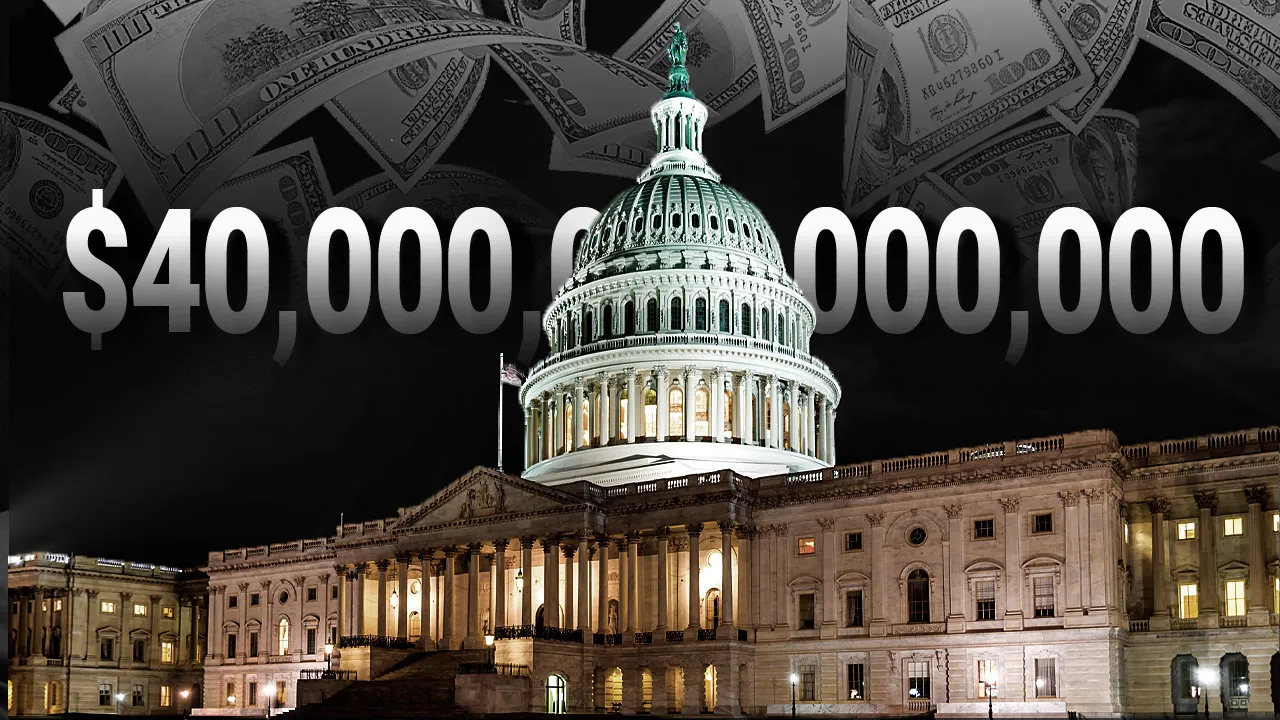
America’s debt problem has crossed a line that is hard to ignore, and the bill keeps getting bigger. With the total national debt now above $40 trillion, the pressure is no longer some distant warning. It is already shaping borrowing costs, economic confidence, and the financial future of ordinary households.
The number itself is stunning, but the deeper problem is what it means. When debt races faster than the economy, the country’s ability to manage its obligations weakens, and that weakness starts to ripple outward in messy, expensive ways.
One of the clearest ways to judge the damage is the debt-to-GDP ratio, which compares what the nation owes to what it produces. By that measure, the United States has moved into troubling territory, with debt now exceeding 124% of GDP. That puts America in an ugly club no serious economic power wants to join.
Even the debt held by the public is hovering near the size of the economy itself. Projections from the Congressional Budget Office show that the path does not improve on its own, which is exactly why the situation feels less like a warning and more like a slow-motion squeeze.
The pain is not abstract. Heavy debt pushes up pressure on interest rates, raises the odds of inflation, and makes investors more cautious about where they put their money. When confidence slips, the dollar can lose some of the strength that has made it the world’s go-to currency.
There is also the crowding-out effect, and it is as blunt as it sounds. When Washington borrows heavily, it absorbs money that could have gone into private businesses, local investment, new hiring, and expansion. That leaves less room for the private sector to breathe.
For families and small businesses, that means borrowing gets harder and more expensive. Loans for equipment, homes, or growth become tougher to secure, and the economy ends up rewarding federal overspending while punishing the people trying to build something productive.
The damage compounds over time, which is what makes debt so sneaky. A budget mess does not always hit like a headline-grabbing crash. Instead, it slowly drains growth, chips away at capital formation, and leaves future workers stuck paying for today’s political habits.
That burden is already showing up in the math. Interest payments are climbing fast, and at some point they start crowding out real priorities. The government can spend more and more just to service old borrowing, while less of the budget is available for anything useful or durable.
Some voices still pretend the country can spend without limit. That idea leans on Modern Monetary Theory, which argues that a sovereign currency issuer can always keep the money flowing. The problem is that real-world economies are not magic tricks, and money still depends on trust, production, and restraint.
When leaders act like deficits do not matter, they invite inflation, weakened confidence, and a deeper loss of fiscal credibility. The promise of painless spending sounds appealing in the short run, but it usually ends with ordinary Americans paying more at the store and getting less in return.
There is no clean way around it: the budget has to move back toward balance. That means reining in spending, especially the programs that create long-term pressure, and letting the private sector do more of the heavy lifting again.
Lawmakers also need to stop treating deficits like a free political tool. Every extra trillion in debt narrows the room to maneuver later, and every delay makes the fix more painful. The longer the government waits, the harder it becomes to reverse the damage without a brutal reset.
America still has the economic strength to recover some discipline, but that window does not stay open forever. The question now is whether Washington will take the debt seriously before it starts dictating even more of daily life, from higher rates to weaker growth to a future built on borrowing nobody can truly afford.
