
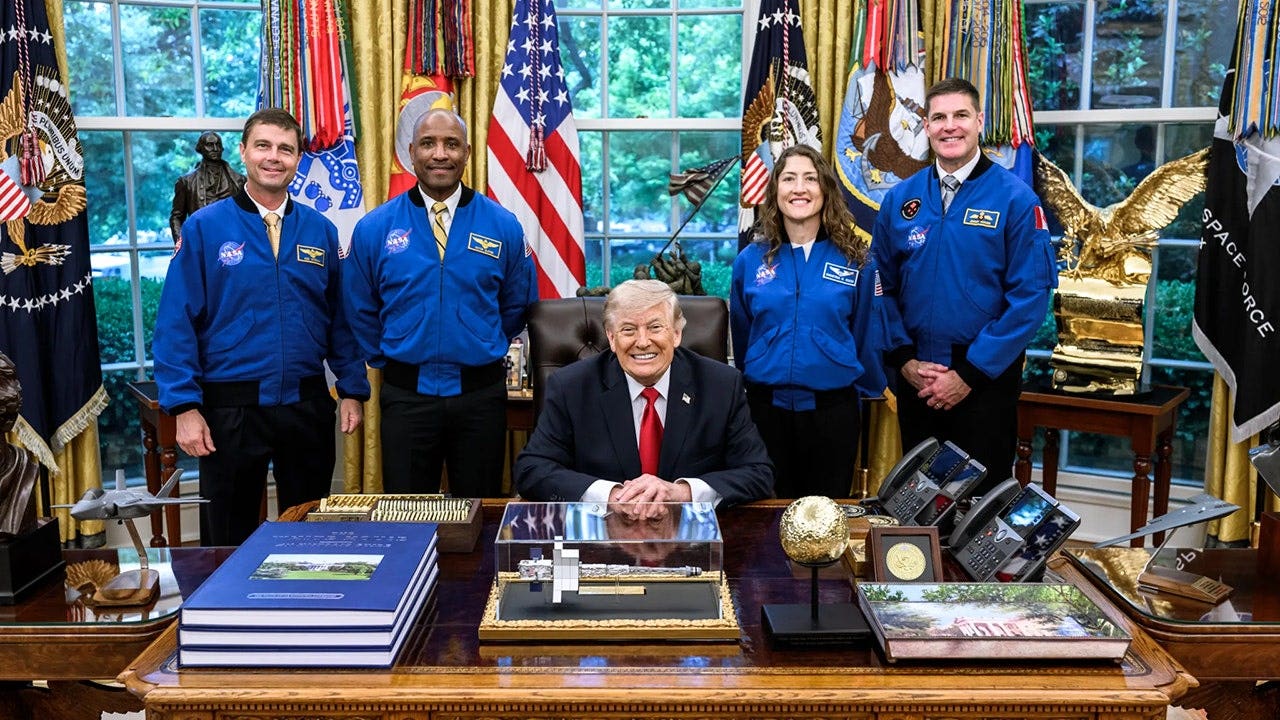
NASA’s Artemis II crew is set to get a major honor after a mission that pushed human spaceflight into fresh territory and put four astronauts farther from Earth than anyone has ever been. The flight blended hard science, nerve, and old-school exploration, with a lunar flyby, deep-space testing, and a record-setting distance that edged past Apollo 13. The award ceremony ties that achievement to a long tradition of recognizing astronauts who take on serious risk in the name of discovery.
Reid Wiseman, Victor Glover, Christina Koch, and Jeremy Hansen reached a point 252,756 miles from Earth, according to NASA, which put them beyond the previous distance mark set during Apollo 13 in 1970. Over the course of nearly 10 days, the crew covered 695,081 miles while Orion carried them through a mission built to stress-test systems that future lunar flyers will depend on.
The trip began with a powerful launch from Kennedy Space Center on April 1, when NASA’s Space Launch System rocket roared off the pad with 8.8 million pounds of thrust. From there, the crew put Orion through its paces, then swung toward the moon and came within 4,067 miles of the surface during the April 6 flyby.
That close pass was more than just a photo op. It gave NASA a live look at how the spacecraft handled the long haul, and it gave the astronauts a chance to operate in the kind of environment that future lunar and deep-space missions will face head-on.
Along the way, the crew turned the mission into a visual treasure chest, collecting more than 7,000 images. Those shots included earthrise, earthset, cratered lunar terrain, ancient lava flows, and even a solar eclipse viewed from Orion, while NASA also said the astronauts reported meteoroid impact flashes on the moon’s night side.
Orion came back to Earth on April 10, reentering the atmosphere at about 25,000 mph before splashing down in the Pacific Ocean off California. The return marked the end of a mission that was as much about proving systems as it was about stretching the map of human reach.
The medal waiting for the crew has serious history behind it. Congress created the Congressional Space Medal of Honor in 1969, describing America’s space effort as dependent on the “intelligence, the dedication, the bravery, and the self-sacrifice” of astronauts who head into the “hostile environment of space.”
Under the law, the president can award the medal in the name of Congress to astronauts who stand out through exceptional merit and service to the country and humanity. NASA says the honor has gone to only a small group over the years, with names like Neil Armstrong, John Glenn, Alan Shepard, and Apollo 13 commander Jim Lovell already on the list.
If the Artemis II crew is added, the total number of recipients would rise to 34. That puts their achievement in rare company, which fits a mission that was built to do more than circle the moon and come home.
Artemis II also serves a bigger purpose in NASA’s long game. The flight was designed to test Orion’s life-support systems, give the crew manual control of the spacecraft, and feed data into the next steps toward returning astronauts to the lunar surface.
NASA’s broader plan keeps pushing forward from there, with commercial lunar lander operations expected to be tested during Artemis III in low Earth orbit in 2027 and a first lunar landing targeted for Artemis IV in 2028. The agency says the end goal is an enduring human presence on the moon, with Mars in the crosshairs after that.
NASA Administrator Jared Isaacman said the crew accepted “significant risk” in order to prove out the systems needed for what comes next. He also said the mission crossed a historic threshold and helped build the confidence to keep pressing toward a permanent foothold on the moon.
“The NASA leadership team was in Mission Control, alongside the flight control team, watching as the Artemis II crew crossed that historic threshold and became the explorers that ventured farthest from Earth,” Isaacman said in a statement. “Certainly, the astronauts were aware and monitoring their spacecraft systems. Under President Trump’s leadership, Artemis II captivated the world, inspired a generation, and gave us the confidence to press on as America returns to the Moon to build a base and to stay. Artemis III is the next mission up in that campaign, but it will be in 2028 during Artemis IV, when NASA astronauts will once again walk on the Moon.”
The White House has not commented publicly on the matter, but the spotlight is already fixed on the four astronauts and the hardware that carried them. The mission put Artemis on the map in a big way, and the next steps are moving fast enough to keep the pressure on every piece of the program.
