
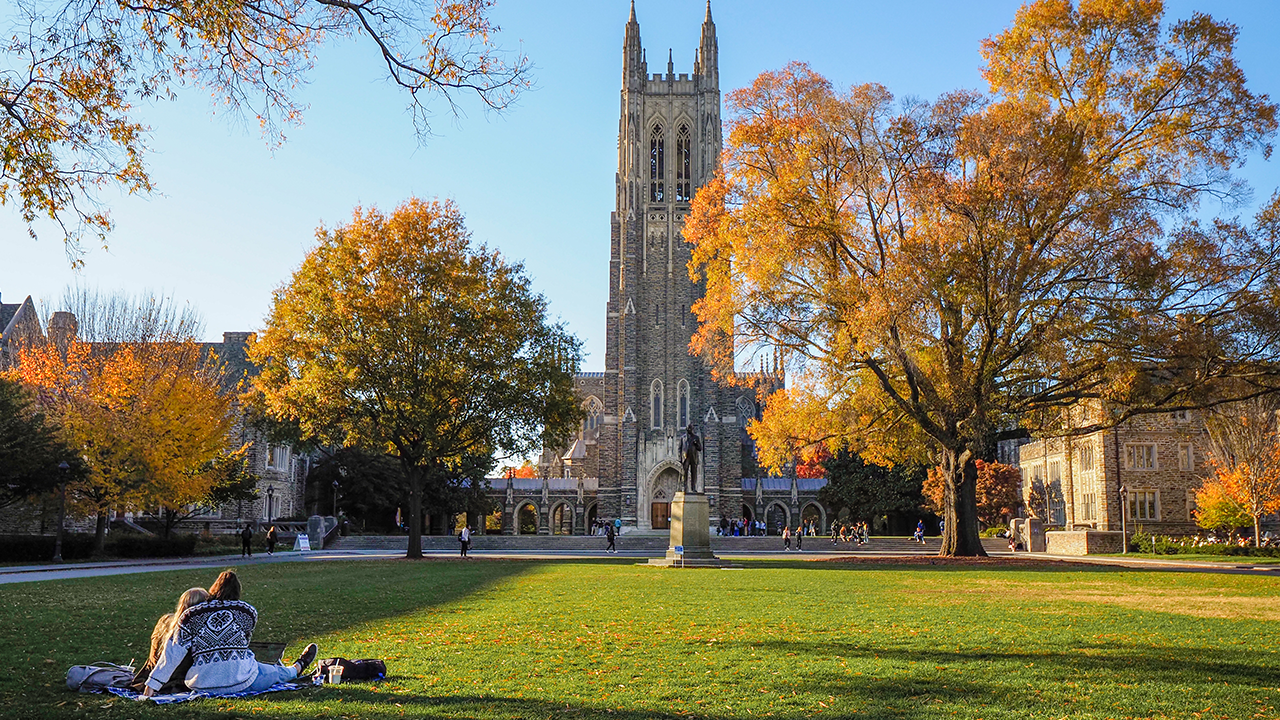
Federal officials say Duke Law may have crossed a bright legal line in admissions, keeping race in the mix even after the Supreme Court shut that door. The Justice Department argues the school gave Black and Hispanic applicants an advantage over White and Asian students with similar credentials, all while claiming to pursue diversity in a race-neutral way.
The clash lands in the middle of a much bigger fight over how elite schools choose students. Since the Supreme Court’s 2023 ruling in Students for Fair Admissions v. Harvard, universities have faced pressure to prove that admissions decisions are no longer built on racial preferences, not just renamed and repackaged.
Assistant Attorney General Harmeet Dhillon put the accusation in blunt terms, saying, “Duke Law School doesn’t get a free pass to discriminate against white and Asian students simply because it thinks it has good intentions,”. That kind of language signals a hard line from the Trump administration, which has been digging through admissions practices at schools across the country.
According to the Justice Department’s findings, the Civil Rights Division began looking at Duke Law in April 2025 and spotted a pattern that raised alarms. Black applicants in 2025 allegedly had about 3.5 times the odds of admission compared with Asian applicants who had the same academic profile, and the median LSAT score for accepted Black applicants was lower than the median for rejected Asian and White applicants.
That gap is not being treated as a small statistical blip. The department’s letter says the differences were too steady, too large, and too persistent across multiple admissions cycles to be brushed off as chance, especially after the Supreme Court said race could not be used as an admissions factor.
The more the internal paperwork gets examined, the messier this looks for Duke Law. Investigators say school officials started preparing for the SFFA decision in advance, while still trying to preserve what they called a broadly diverse student body, which critics see as a sign that the school was looking for a workaround instead of a reset.
One flash point is the use of essay prompts that invite applicants to discuss how race shaped their lives, whether through discrimination, inspiration, or something else. The DOJ says those responses could then be tagged and used to give context to weaker academic records, which makes the whole process sound less like neutral review and more like a coded preference system.
Duke Law publicly describes its admissions approach in softer language, saying it values students with a wide range of experiences, backgrounds, and interests that may not be directly related to legal ambitions. But in this fight, broad language is exactly what critics are challenging, because words like “diversity” can end up masking racial sorting if the actual decisions still tilt that way.
Dhillon’s office says the problem is bigger than one campus and bigger than one law school. “Using ‘diversity’ essay questions to identify preferred races for admission is still illegal discrimination based on race, and this Department is committed to eliminating it everywhere we find it, including in our nation’s law schools,” she said in a statement.
After the Supreme Court ruling, Duke Law continued publishing reports that highlighted the racial makeup of incoming classes and described its effort to keep admissions race-neutral. In one review, administrators pointed to the diversity of the fall 2023 class, and in another memo they even suggested that diversity could be judged by observing students on campus instead of relying on formal statistics.
The university says it is paying attention and taking the DOJ’s letter seriously. A Duke University spokesperson said, “The Department of Justice’s Civil Rights Division issued a letter of findings related to Duke Law’s admissions practices. We are reviewing the letter and its conclusions carefully. Duke is committed to complying with the law and will continue to do so in a manner that is consistent with our academic mission,”
That leaves a familiar but uncomfortable question hanging over higher education: when a school says it is following the law while still chasing the same racial outcome, what exactly changed? For Duke Law, the answer may depend on whether federal investigators think the school was adapting to the Supreme Court or trying to sidestep it.
