
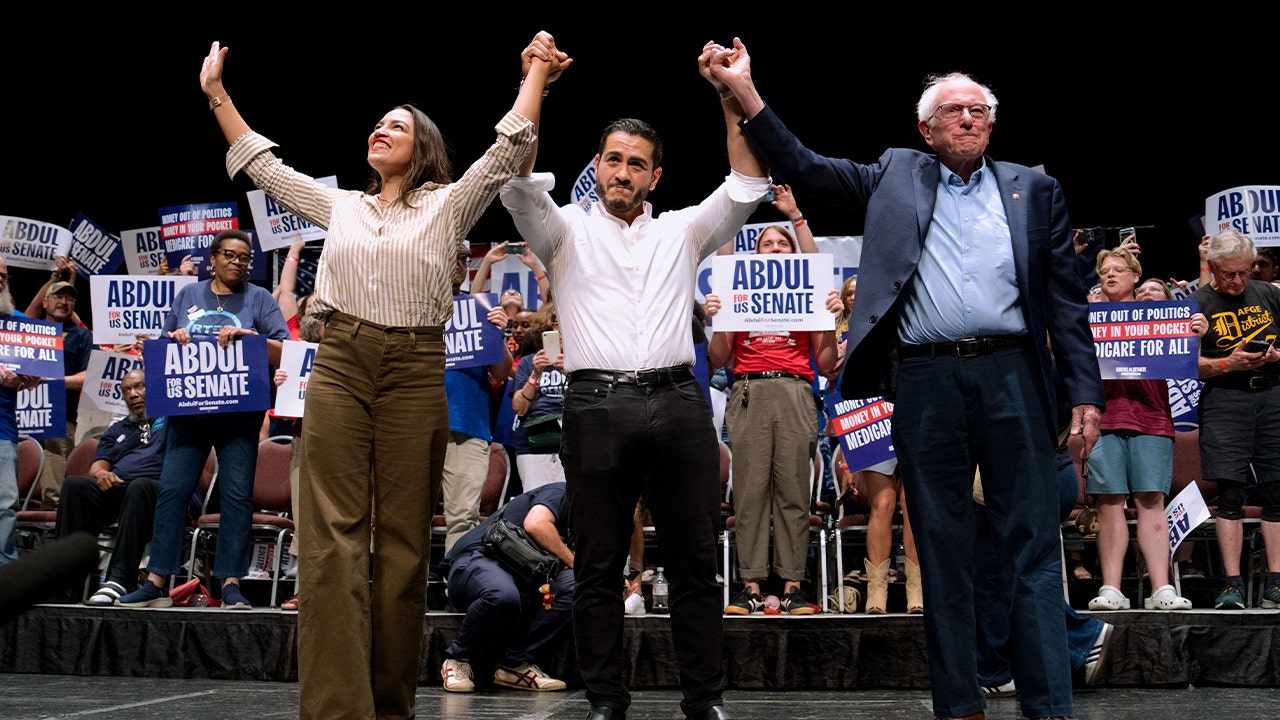
House Speaker Mike Johnson is sharpening a warning Republicans expect to lean on hard as the 2026 midterms draw closer: the rise of socialist candidates inside the Democratic Party is not just a party fight, but a sign of how far left Democrats are willing to go. With Republicans trying to hang on to a slim House majority, those primary results are becoming a political gift that keeps on giving.
Johnson and other GOP leaders are framing the battle in plain, loud terms. They are telling voters that Democrats are drifting away from common sense and toward policies most Americans want no part of, while Republicans stand for growth, opportunity, and a more familiar version of the country’s future.
“Right now, it’s a contrast election for everybody,” Johnson said during a campaign stop in Arizona. “They’ve got to make a decision that they want to continue with common sense, growth and opportunity, or they want to go to this dark down, dangerous, deadly road of communism.”
That kind of line is made for the campaign trail, and Republicans are using it that way. In district after district, the party is hammering the idea that Democratic primaries are being pulled off center by candidates tied to the Democratic Socialists of America, and that the fallout could hurt Democrats in the general election.
The message got a fresh boost after far-left candidates picked up major wins earlier this week. In Michigan, Abdul El-Sayed defeated establishment-backed Rep. Haley Stevens for the Democratic nomination for an open Senate seat, giving Republicans another example of what they see as a party losing control of its own left flank.
That wasn’t the only surprise coming out of Michigan. Sunrise Movement co-founder William Lawrence also beat former U.S. ambassador to Ukraine Bridget Brink in a race that will help shape one of the most watched battleground contests of November, with Lawrence now set to face Rep. Tom Barrett, R-Mich.
Republicans are especially interested in that kind of result because it gives them a simple argument on the road: Democrats are nominating candidates far outside the mainstream, and the GOP says voters will notice once the general election campaign gets rolling. Johnson has made clear he sees the left’s momentum as more than a one-off, and more like a trend with real consequences.
“Could we’ve imagined even 10 years ago, if somebody told us that on the two hundred and fiftieth anniversary of the greatest nation in the history of the world, in the midterm, in the fall of 2026, we’d be in a contest to determine whether we’re going to maintain our constitutional republic — the greatest nation in history — or go down this dark, dangerous, deadly road to communism?” Johnson said.
That kind of rhetoric is not subtle, and that is exactly the point. Republicans want the 2026 map to feel like a direct choice between a familiar conservative pitch and a Democratic Party they say is drifting into radical territory.
Johnson has been crisscrossing the country with that message, showing up in vulnerable districts and in places where Republicans think they can still steal a win. He recently delivered a similar warning during a town hall for Rep. Andy Ogles, R-Tenn., where the political temperature was already high because of a tough primary fight.
For House Republicans, the hope is that every far-left primary victory makes the general election a little easier to frame. The more Democrats elevate socialist-backed nominees, the more GOP strategists believe they can turn those races into a referendum on extremism rather than a simple contest over local issues.
That is why Michigan matters so much. It is one of the clearest examples of the party clash playing out in real time, with Democrats facing pressure from the left and Republicans eager to say the results prove their case about where the other side is headed.
Republicans also point to the policy ideas tied to the DSA wing as proof that this is not just a branding exercise. Among the positions highlighted by GOP leaders is a call to eliminate the U.S. Senate and expand voting rights to noncitizens and felons nationwide, the sort of proposals that can sound jarring to voters outside activist circles.
Even with those advantages, the fight is still uphill for Republicans. The party is trying to defend a razor-thin House majority while also squeezing out gains in key battlegrounds, and that means every message has to hit fast and hard.
Johnson’s answer is to keep hammering the same contrast, because the contrast is what Republicans believe can save them. As the campaign season heats up, the fight over Democratic primaries is becoming part warning, part talking point, and part opening for the GOP to make its case in front of voters who may not have been paying close attention before.

1 Comment
Can we counter for 2028??