
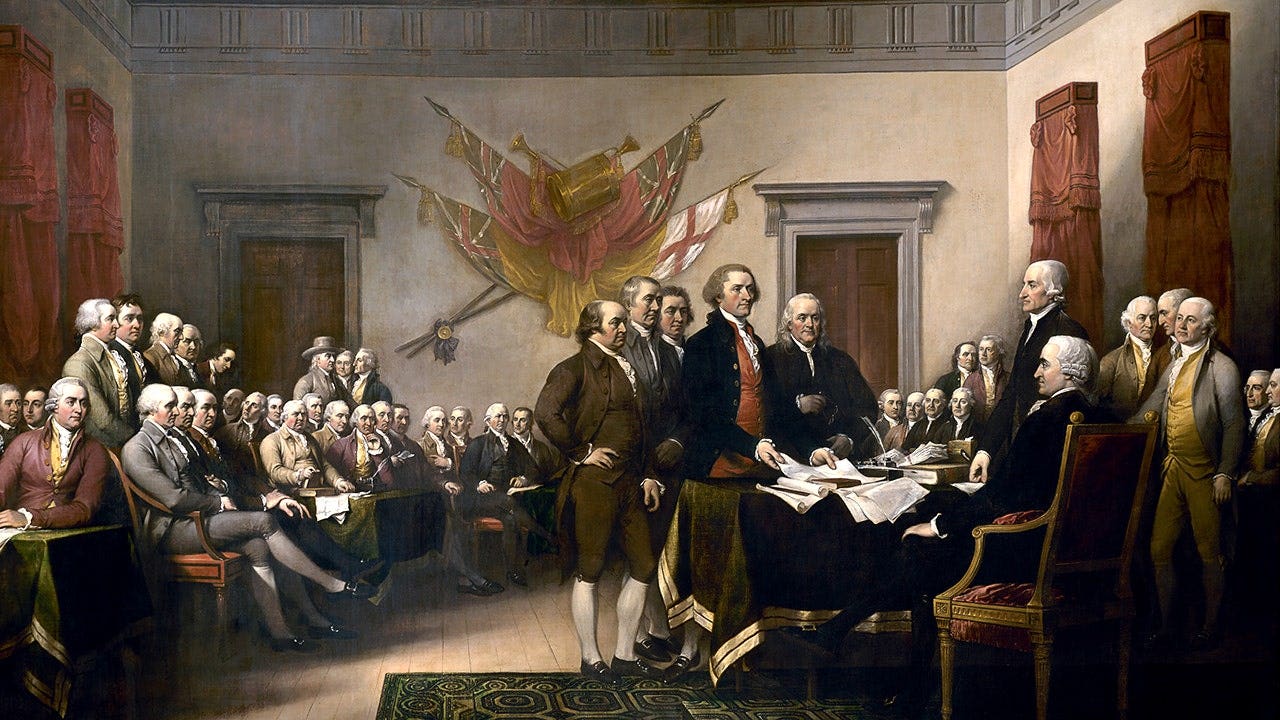
This piece looks back at the founding moments of the United States, the fierce choices that birthed a self-governing nation, the unlikely companions who stood in that fight, and why those sacrifices still call for courage, duty and passing a strong civic faith to the next generation.
There is a mindset that forged this country: risking everything for promises you may never live to see. The founders called that virtue and used it to justify the most dangerous civic gamble in history. They pledged lives, fortunes and honor, betting on a principle rather than a crown.
On the other side of that gamble stood an empire at the height of its power, with disciplined soldiers, heavy artillery and a dominant navy. Against that force rose ordinary Americans who were mostly farmers and tradesmen, not professional fighters. Their victory was not inevitable; it required daring leadership and an unbreakable will to self-rule.
George Washington is the name people remember, and rightly so, for moments like the crossing of the Delaware and the surprise at Trenton. But the story includes others who scarcely get a line in our textbooks. Billy Lee was one of those figures, an enslaved Black man who rode with Washington into battle and became a trusted companion through campaign after campaign.
Washington was a slaveholder, a fact that sits uneasily with his legacy, yet he made a decision few other founders did by freeing the people he held in his will. Billy Lee was among those freed, and given a lifetime stipend. Lee chose to remain at Mount Vernon, a personal bond that complicates how we think about relationships and power in that era.
AMERICA’S NEXT 250 YEARS DEPEND ON PASSING FAITH AND FREEDOM TO OUR CHILDREN captures a tension at the heart of our history. The republic was built on an idea more than on institutions: that people could govern themselves and that no king had a divine right to command them. That idea demanded faith in citizens and in the future they would shape.
The country has not been without deep contradictions. Slavery tore at the union and produced a civil war that tested the survival of the republic itself. At Gettysburg, Abraham Lincoln framed the battle as a chance to renew the original promise that “all men are created equal” and to recommit the nation to living up to it.
History shows us how fragile liberty can be and how resilient it must become. Times of crisis have required leaders who combine competence with moral courage and citizens willing to shoulder duty beyond their own comfort. Those moments matter because they decide whether freedom is preserved as a living reality or left to fade into rhetoric.
Remembering the founders does not mean ignoring their flaws. It means recognizing the extraordinary risk they took and the conversation they opened about freedom, equality and responsibility. The best tribute is not nostalgia but active stewardship of the principles that allowed this experiment to work in the first place.
Patriotism that lasts is not a slogan; it is a practice that demands passing knowledge, habits and respect for institutions to the next generation. That includes teaching the messy truths alongside the victories so young people can understand why self-government requires both courage and constant effort. If we fail to hand down that civic muscle, the experiment will erode from neglect, not from a single dramatic collapse.
So on days of national remembrance, recall those who risked everything to give us self-rule rather than a monarch. Think about the cost, the courage and the complicated human stories behind the monuments and the speeches. Resolve to be worthy of the inheritance by making a small but steady contribution to its preservation in how we raise our kids, run our towns and choose our leaders.
