
The Trinity often sounds like a theological curveball for outsiders: the label itself isn’t in the Bible, so why accept it? This piece traces the argument most Christians make — that the Trinity flows from Scripture’s portrait of one God revealed in Father, Son, and Spirit — and it sketches the early disputes that shaped the doctrine. The goal is to show how the Bible’s language about Jesus and the Spirit forces questions that the doctrine answers.
Many people point out that the precise word Trinity never appears in Scripture, and they use that to dismiss the whole idea. That objection misses how theology works: Christians derive doctrines by putting together what Scripture repeatedly says about God, Christ, and the Spirit. Seeing a consistent pattern in those statements is what led the church to the Trinity.
The story begins with Israel’s radical claim that God is not another local deity among many but the creator of heaven and earth. Ancient pagan religions treated gods as limited players inside the world; the Hebrew Scriptures insist God sits outside the system and made the system. That distinction set Israel apart and sharpened the question of how God could reveal himself without becoming one more thing in the world.
Because Israel insisted on one eternal, immaterial God, the attributes ascribed to him are striking: eternal existence, immateriality, presence everywhere, knowledge without limit, power without limit, and moral perfection. Those are not traits you can assign to a statue or a river god. They point to a single transcendent being who alone deserves worship.
In Isaiah the claim is blunt and exclusive: “I am the LORD, and there is no other; apart from me there is no God.” That stubborn monotheism raises the question: if there is only one God, how do we account for the claims about Christ and the Spirit found in the New Testament? The answer appears when the New Testament names roles and identities that overlap with what only God can be.
John opens his Gospel with the arresting sentence, “In the beginning was the Word, and the Word was with God, and the Word was God.” That line both distinguishes the Word from God and calls the Word God. It creates a theological tension that demands resolution: how can the Word be both with God and be God at the same time?
John then adds that all things came into being through the Word, which rules out treating the Word as a created being. If everything created was made through him, the Word must be uncreated. Later John makes the most dramatic move: “The Word became flesh and made his dwelling among us.” That is the claim of incarnation — the eternal Word assumed human nature as Jesus.

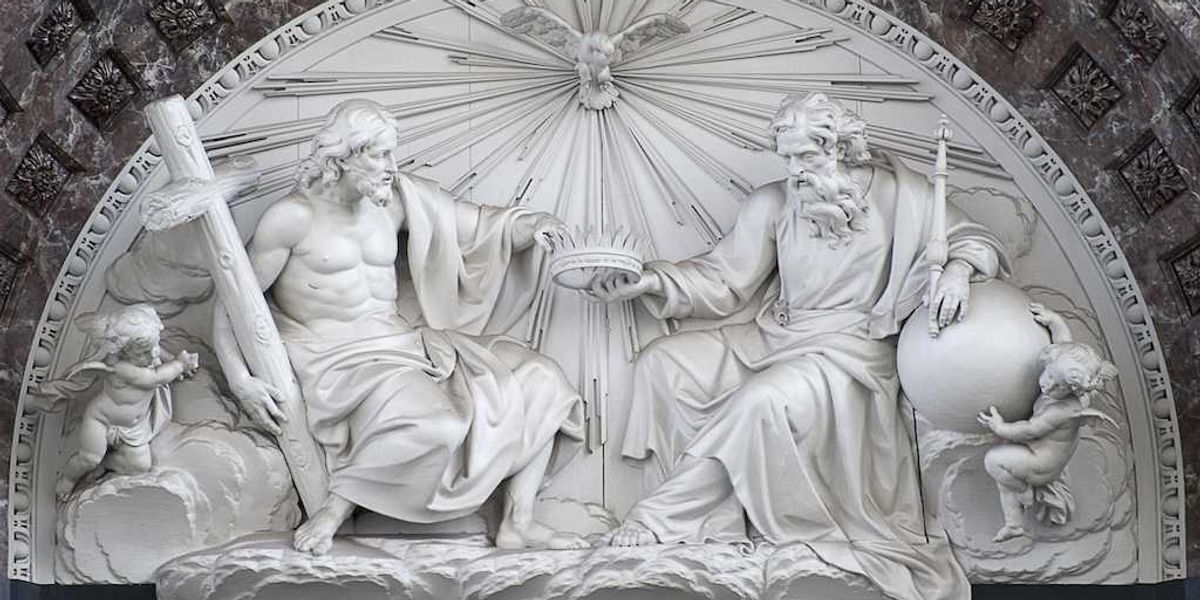
The New Testament repeatedly sets Father, Son, and Spirit in relation to one another. At Jesus’ baptism the Son stands in the water, the Spirit descends like a dove, and the Father speaks from heaven. Jesus told his followers to baptize “in the name of the Father and of the Son and of the Holy Spirit,” and the apostles use Trinitarian formulas in their worship and blessings.
Jesus also spoke in language that identified him with the God of Israel: “Before Abraham was, I am.” That claim echoed the divine name revealed to Moses, and his hearers understood its force. Their reaction — accusing him of making himself equal with God — shows why early Christians had to reckon seriously with the identity of Jesus.
The Spirit gets personal verbs and actions in Scripture: he teaches, convicts, guides, gives life, and can be grieved. Those are not the behaviors of an impersonal force. The New Testament treats the Spirit as a person who participates in divine work alongside Father and Son.
- There is only one God.
- The Father is God, the Son is God, and the Holy Spirit is God.
- The Father, Son, and Holy Spirit are distinct from one another.
Those three claims create a tight circle: deny any one and you conflict with passages throughout Scripture. Early controversies pressed these tensions hard. Gnostic teachers denied the real humanity of Jesus, Sabellius collapsed the three persons into mere modes, and Arius reduced the Son to the highest creature rather than true deity. Each error failed to account for the full range of biblical data.
The church’s response refined language without inventing a foreign system: the Father is eternally unbegotten, the Son is eternally begotten of the Father, and the Spirit proceeds from the Father (and, in Western formulations, the Father and the Son). The summary formula became plain: one divine what and three distinct whos — one essence, three persons.

Far from being a concession to polytheism, the doctrine was developed to protect monotheism while taking seriously the Bible’s declarations about Jesus and the Spirit. Modern groups that drift from orthodox Christianity tend to repeat old mistakes: denying Christ’s full deity, collapsing distinctions, or denying his full humanity. Those patterns remind us why the debates mattered.
Belief in Jesus is not merely about warm feeling or sincere devotion; it is about who you are talking about. A person can call someone “Jesus” yet hold a view of him that the Bible would not recognize. So the church’s historical arguments were not academic hair-splitting but attempts to answer the core question every person must face: Who is Jesus Christ in the Bible?
