
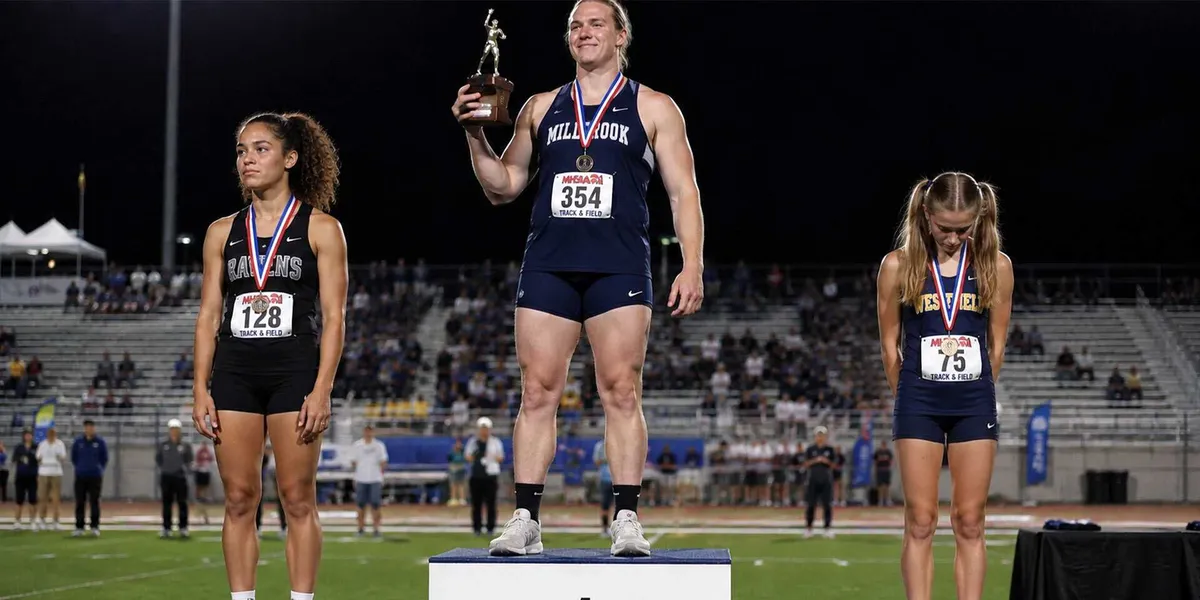
Jennifer Sey joined Steve Deace to push back on a trend reshaping girls’ sports, using a recent California high school case as a warning that wins in court won’t finish the fight. They focus on how policies that let biological males compete in girls’ events are hurting athletes, why a pending Supreme Court ruling matters only in some states, and why the real battle is cultural. The conversation leans on practical steps: legal fixes, tougher conversations at the local level, and getting more men to show up and defend fairness.
The starting point of the piece is a clear example out of California where a biological male athlete has taken top spots in girls’ high jump and triple jump, prompting rules that force displaced girls into awkward co-champion positions. That sort of outcome isn’t abstract; it’s a visible, humiliating consequence for young women who train and compete. The problem is political, legal, and cultural all at once, and Sey says it’s a front-line fight.
Deace asks, “You’re on the front lines of this battle. What do you think?”
Sey is blunt: the transgender agenda has been “pushed back,” but it is not defeated. She points to the patchwork of laws across the country — 27 states have protections keeping women’s sports for biological females, while 23 allow gender identity to decide eligibility. That split means any favorable Supreme Court decision will help only where state lawmakers already acted to protect female competition.
She puts it plainly: even if SCOTUS rules in favor of sex-based protections, “So we still have a ton of work to do.” The ruling would be important, but it won’t erase policy choices in states that prioritize gender identity over biological sex. In practice, that means young women in nearly half the country remain vulnerable to being pushed aside by biological males in competition.
Sey says the next phase is less about courtrooms and more about culture: “[changing] the culture.” That’s about getting people who already agree to stop shrinking from confrontation and actually speak up. She argues that when the majority feels free to say what they believe, legal victories stick and policies follow.
She points to public opinion: “Seventy to 80% of Americans agree … that women’s sports should be for women … but I don’t think we’ve made meaningful progress in getting that 80% to stand up and say what they believe,” says Sey. That gulf between belief and action is the tactical problem; law and policy often trail culture rather than lead it. Sey wants to press the advantage by creating content and pressure to turn private agreement into public courage.
Deace presses the practical question: “All right, so how do we do that?” Sey answers with a media and social strategy: keep producing material, keep calling out commonsense distinctions between men and women, and normalize speaking plainly. She wants to change the “permission structure” so ordinary people feel authorized to protect girls’ sports without being canceled.
She also stresses that laws matter: “Yes, we need legislation. We need state legislation; we need national legislation to reify Title IX. But I think when we win the cultural battle is when we actually win,” she tells Deace. Legal fixes are necessary to lock down fairness, yet they will be fragile unless backed by a culture ready to enforce them locally. That means school boards, coaches, parents, and communities must be willing to hold the line.
Deace notes that public pressure takes guts — sometimes parents must show up to school board meetings and young women must be willing to refuse a charade. Sey says men are missing from the fight: “We need way more men in this fight. … We need moms to do it too, but dads have been particularly absent in this fight.” She argues male voices carry weight where it matters most and can blunt accusations of ideological bias.
Still, Sey won’t ask teenage girls to sacrifice their competitive chances to make a point, especially when elite athletes with power and big endorsements stay silent. “How do I tell a 14-year-old girl that she needs to do it when a professional athlete with all the money in the world won’t do it because she’s afraid of losing endorsements?” she asks. “I want to put the pressure on them more than these 14-year-old girls. They’re the leaders.”
