
Nokia is popping up as the under-the-radar AI networking play while Cisco soaks up all the headlines. This piece walks through why Cisco’s rally feels crowded and why Nokia deserves a closer look, laying out the technical edge, strategic backing, and the corporate cleanup that could matter to long-term investors. I’ll point out the specific bottlenecks Nokia addresses, what Nvidia’s move signals, and the key risks to watch next. Read on for a direct take on where the asymmetric opportunity may sit in AI networking.
Cisco grabbed attention after raising an FY26 AI infrastructure order target to $9 billion, sending the stock up sharply this year and putting it squarely in the consensus spotlight. That popularity shows in the math: the shares trade at a lofty multiple on forward earnings, with valuation ratios that suggest a lot of optimism is already baked in. When a name becomes the default AI networking exposure, new capital faces a tough job of finding extra upside.
The fundamentals behind Cisco’s rally are mixed. Revenue and networking growth have been solid and AI orders are meaningful, but operating cash flow has slipped and services revenue is softening, while management flagged significant restructuring charges ahead. Retail chatter and meme attention have also crept in, which is a warning sign when momentum bids up an otherwise mature networking company.
That crowding is exactly why some investors should be looking at Nokia instead of joining the Cisco rush. Institutional perception still boxes Nokia into legacy telecom gear, but the business has evolved and now owns pieces of the physical networking layer that matter for scaling AI. Treating it like an old telecom supplier misses the role it can play in the backhaul and optical plumbing of data center clusters.
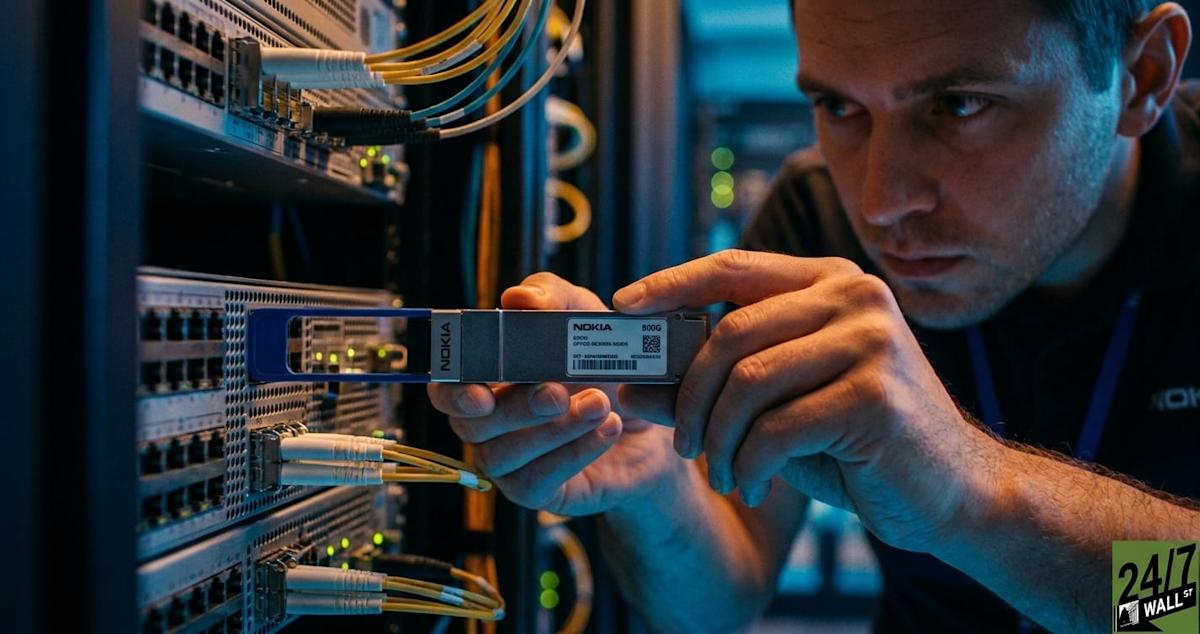
First, optical transport is suddenly a core constraint for massive AI farms. Nokia’s Optical Networks business reported year‑over‑year growth and a healthy book‑to‑bill, and the Infinera acquisition added significant transport scale. Nokia is shipping 800G ZR and ZR+ pluggables to major hyperscalers and is expanding capacity with a second Indium Phosphide fab planned in San Jose before the end of 2026, which speaks to durable demand for high‑capacity links.
Second, a major strategic vote of confidence landed when Jensen Huang and Nvidia put real capital and partnership weight behind Nokia. Nvidia made a $1.0 billion equity investment and formed an AI‑RAN partnership, while naming Nokia a preferred networking vendor for the Nscale data center buildout. That alignment changes the competitive picture when a leading AI platform provider anchors network supply choices.
Third, Nokia’s corporate reset is aiming at profitability and margin improvement under new leadership. The company simplified into two reporting segments at the start of 2026 and put out guidance for comparable operating profit in the €2.0 billion to €2.5 billion range for 2026, rising toward €2.7 billion to €3.2 billion by 2028. Q4 2025 showed wider comparable gross margins, enterprise sales strength, and a dividend uptick; and as Hotard put it, “The AI supercycle is accelerating demand for providers of advanced and trusted connectivity. Nokia is uniquely positioned to be a leader in this market transition.”
Risk is real and immediate. Nokia’s shares have already rallied hard, more than doubling year to date and trading above analyst consensus targets, which pushes trailing multiples into premium territory. Forward multiples try to capture future operating leverage, but upcoming earnings events will be the test of whether the market’s expectations hold. A disappointing beat or weaker guidance could leave the stock vulnerable given how much optimism is priced in.
For investors tired of paying top dollar for the consensus AI name, Nokia offers a different asymmetry: exposure to the physical network layer and a strategic partnership with a dominant AI supplier. It is not a stealth play without volatility, but on a disciplined pullback it deserves a place on the watchlist for anyone building long‑term AI infrastructure exposure. Do your homework, watch the next quarterly prints closely, and size any position against the clear execution and valuation risks.
