
Panthalassa, a startup backed by major investors, is betting that wave power and seawater cooling can host AI computing at sea, and it has raised new funding to prove the idea with pilot floating nodes designed to run AI inference far from shore.
Artificial intelligence already lives on our phones and in cloud servers, but Panthalassa wants to move some of the compute out to the ocean. The company announced a $140 million Series B that brings total funding to $210 million, with support from Peter Thiel. The plan includes finishing a pilot manufacturing site near Portland, Oregon, and launching Ocean-3 pilot nodes in the northern Pacific in 2026.
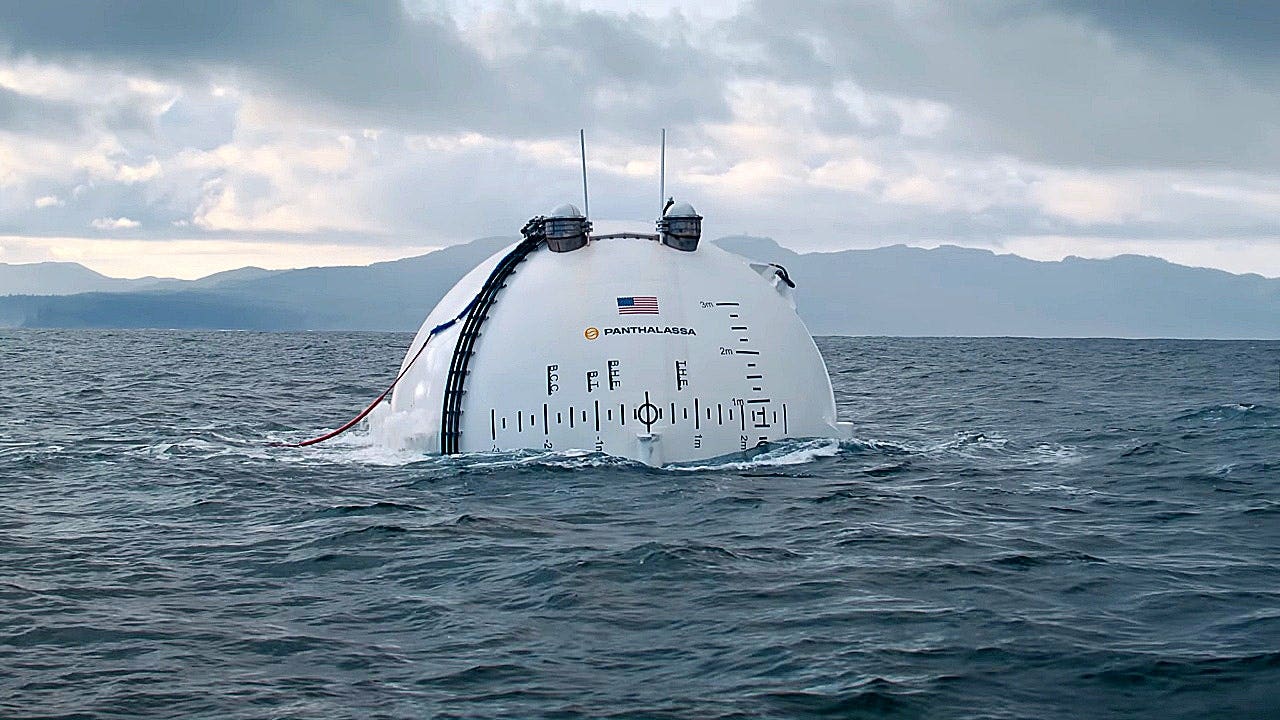
The core idea is straightforward: harvest wave motion to generate electricity, use seawater for cooling, and run AI workloads onboard. Instead of building another land data center that needs massive grid power and local support, each floating unit would be a self-contained compute and power platform. Results would be delivered back to shore via low-Earth-orbit satellites rather than fiber cables.
Panthalassa says it spent about a decade iterating on power generation, onboard compute and autonomous ocean operations, testing prototypes called Ocean-1, Ocean-2 and Wavehopper in 2021 and 2024. Each node is described as a floating power station housing AI hardware, where mechanical motion feeds generators and the generated power runs the chips. That approach aims to turn a natural resource into on-site energy instead of pulling from coastal grids.
The company plans to use the nodes primarily for AI inference, which is when a trained model responds to a user prompt. Training big models demands huge bandwidth and tight coordination, so it usually stays on land. Hosting inference at sea is a more achievable first step because it can reduce the need to constantly move massive datasets.
Cold ocean water helps solve one of the toughest problems for AI hardware, which is heat. Panthalassa argues that wave-rich regions far from shore are energy dense enough to produce reliable power. “We’ve built a technology platform that operates in the planet’s most energy-dense wave regions, far from shore, and turns that resource into reliable clean power,” said Garth Sheldon-Coulson, Panthalassa’s co-founder and CEO.
Still, the ocean brings hard trade-offs. Fast, high-capacity fiber is the backbone of traditional data centers, and satellite links are slower with more latency and less bandwidth. Coordinating many floating units that must talk to each other over satellite presents architectural limits, so ocean nodes may be best for workloads that can live mostly on a single platform or need only small result transfers.
Maintenance and durability add another layer of complexity. Repairs for a floating node in rough seas require vessels, special gear and a suitable weather window, and saltwater corrosion and constant motion stress hardware in ways land servers do not face. Panthalassa says it is building autonomous systems for harsh conditions and will use Ocean-3 testing to demonstrate inference and manufacturing readiness before aiming for commercial deployments in 2027.
Underwater and floating data center work has precedent, from Microsoft’s Project Natick to experiments by companies in Asia and firms exploring designs where land is scarce. Panthalassa’s twist is the mix of wave-driven power, onboard AI chips and satellite return links designed for remote deployment. That combination is interesting, but it also explains why skeptics point to durability, connectivity and logistics as major hurdles.
This is not a consumer-facing switch that will slap an “ocean powered” badge on your apps tomorrow. But the idea touches wider questions about how to supply AI’s growing electricity appetite, how communities handle new infrastructure, and how environmental oversight will work for computing platforms in international waters. If these floating nodes scale, they will bring fresh regulatory and operational debates about marine maintenance, environmental impacts and who controls critical compute at sea.
