
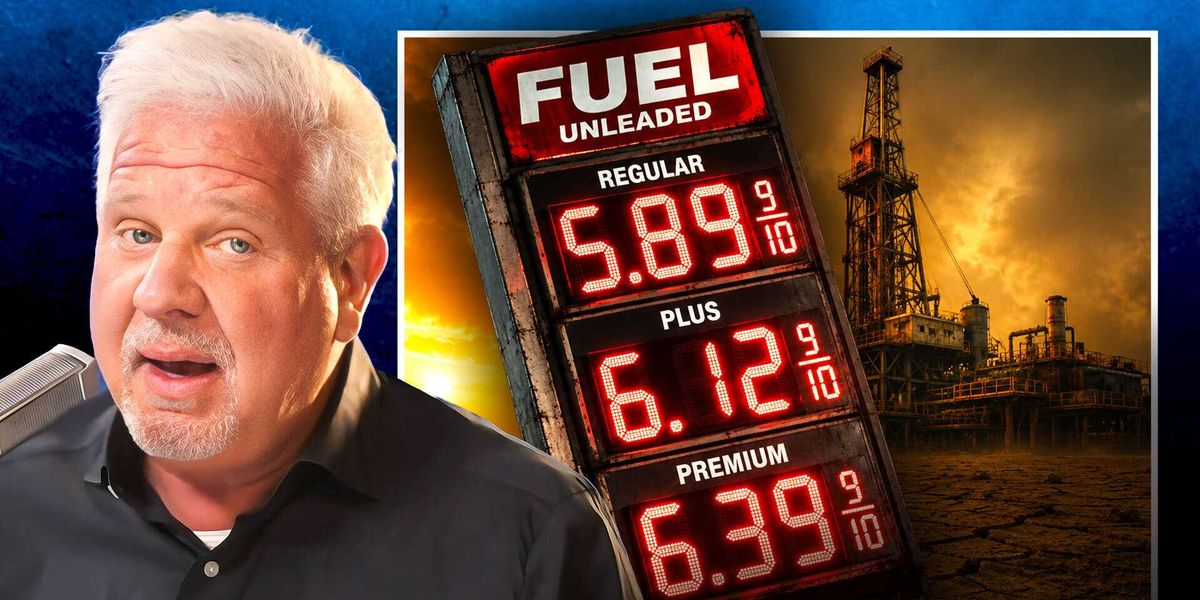
Iran is burning its own oil and hauling crude in pickup trucks while Americans pay sky-high gasoline prices, and that contradiction is testing global energy markets and U.S. security. This piece looks at how Iran’s blockade of the Strait of Hormuz is forcing painful short-term moves that may leave long-term damage to its fields, while the United States tries to turn domestic production into reliable, affordable fuel for Americans. The stakes are clear: energy independence, market stability, and whether policymakers will act to protect consumers.
At home, drivers feel the squeeze every time they pull into a station, while in Iran oil is essentially being given away at absurdly low local prices. Reports of crude being burned at wellheads and shuttled in buckets across fields underline the desperation — a bizarre, wasteful response to a logistics crisis that can’t last. Eventually the arithmetic forces a halt or a big drop in production.
That’s the question Glenn Beck put to oil and gas expert Tim Stewart: how long before Iran is forced to shut down operations. “From what we gather, they are almost there,” says Stewart. His short answer is blunt: the system they rely on to move and store oil is collapsing under the stress of the blockade.
Stewart breaks down how oil needs to flow to work — across tanks, pipelines, trucks, and ships — calling it “a constant moving process.” But the current blockade has left “floating storage” “shut down,” and that “puts intense pressure” on every other part of the system. When the buffers vanish, the only practical response is to throttle wells back to avoid catastrophic spills or unsafe conditions.
“And that’s what the Iranians actually did,” says Stewart, and once wells are turned down they don’t snap back like a faucet. The nation’s biggest producing areas are older fields with fragile systems, and running them outside of designed parameters kicks up serious maintenance and integrity problems. Slowdowns now can mean years to recover full capacity.
Those older assets are literally worn out. Stewart calls them “legacy fields,” and warns they suffer from a mix of problems that get worse when production patterns warp. “Those fields have water issues; they have pressure issues; they have migration issues,” says Stewart. That technical reality translates into political leverage: Iran can hurt markets short term, but it pays a long-term price.
“The [current slowdown] is going to have a long-term impact on their ability to ramp up to another three million barrels a day,” he tells Glenn. That makes Tehran’s current brinkmanship a poor long-term strategy, even if it looks like a short-term win domestically. The likely outcome is permanent lost capacity rather than a quick bounce-back.
For the U.S., the conversation switches from crisis watching to strategy. America now tops the charts as the world’s largest oil producer, yet much of that output is “light sweet crude” and our refineries were built for heavy sour grades imported from abroad. That mismatch left the country playing swaps and trading barrels instead of directly turning homegrown crude into affordable gasoline for Americans.
But markets and investment are shifting. Firms are putting money into refineries that can process light sweet crude, Wall Street has signaled that fossil fuels remain central to energy security, and cracks in OPEC are appearing as members rethink alliances. Still, Stewart says the world faces a roughly 450 million barrel shortfall and that won’t vanish overnight.
Glenn applauds the America First push that has prioritized domestic production, but he presses the political angle every leader should hear: people are paying too much at the pump. “Has anyone ever said … ‘Hey, is there a way to give the American people a break here and maybe turn our profits down just a little bit?”’ he asks. That blunt public question forces oil executives and politicians to confront a painful truth about profits and pocketbooks.
Stewart pushes back with an industry reality, saying many producers are small operators. “It’s like when you send the cows to auction, you don’t set the auction price. The auction does.” The sector wants predictability, not swings, because planners and smaller firms can’t survive boom-and-bust whiplash for long.
“We prefer stable prices more than anything,” says Stewart, “and those prices need to be in that $67 to $85 a barrel range. … It allows us to do long-term planning.” That stability trickles down: “The Goldilocks zone is in that $70 to $90 [per barrel range], which that translates to that $2.95, $3.15 a gallon for gas, and that’s where people seem to be able to to function well,” he adds. Those are the numbers that keep the economy humming.
Short-term relief, Stewart says, is actually in state hands. “Have the states themselves look at what they’re charging and adjust those fees, adjust those taxes or waive them or do a holiday or something like that,” he says. That’s targeted action people will feel immediately, though it won’t survive a sudden crude spike.
“The problem is that relief only lasts as long as we don’t get a $20 spike in crude the next day because of a tweet or because of a drone strike,” he warns. If the Strait reopens and supply normalizes, Stewart expects relief to show up in U.S. pumps this summer, with plausible prices in the $2.85 to $3.15 range that support both growth and affordability. “You want a growing economy, which then needs energy to be able to fuel it. You don’t want demand collapse where gas is cheap but nobody’s working, right?” he says. “And so again, it’s this Goldilocks zone we’re trying to get in.”
