
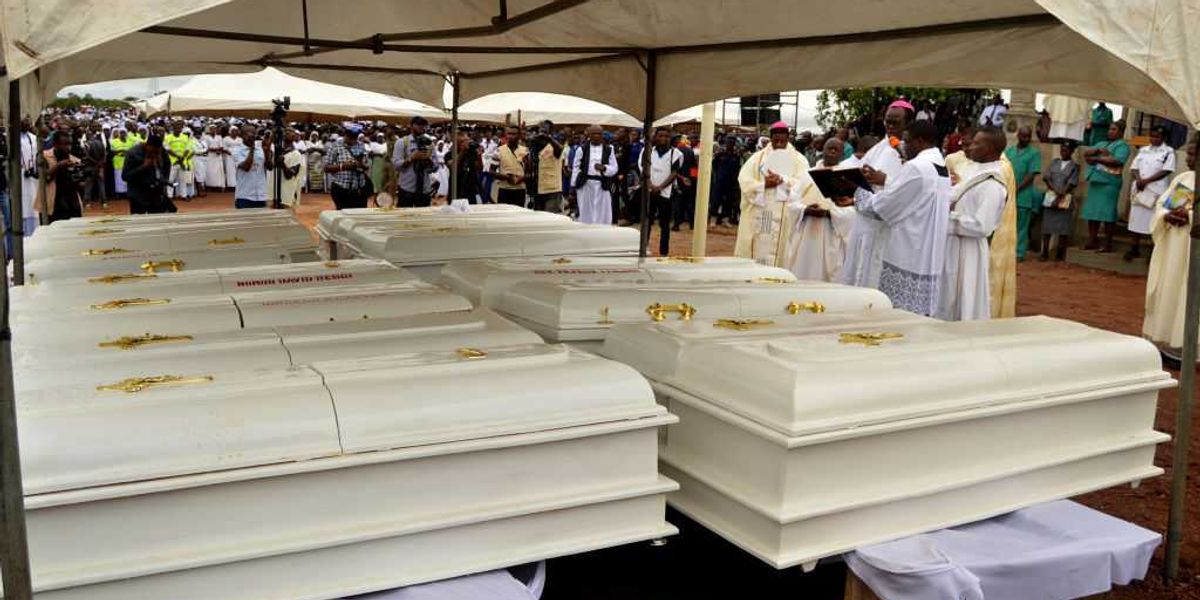
I lay out what the scenes in Nigeria show, why Britain’s experience matters, the warning signs that are already visible here, and why a firm, practical response is necessary now to defend our communities and civic order.
I have watched the footage others described and it leaves a mark you cannot erase. Men celebrate killings, crowds raise trophies of brutality, and the chant “Allahu Akbar.” echoes over scenes designed to terrorize and recruit. These are not secondhand reports; they are the perpetrators’ own recordings shared with pride.
I’ve spent years working on the ground in West Africa, building schools and meeting survivors, and what I saw was not isolated chaos. It was a long-running campaign of violence and displacement that has destroyed millions of lives and permanently altered communities. Those first-hand encounters make this more than headline horror — they are a template for what can spread if unchecked.
The human cost is vast and ongoing: millions killed, millions more enslaved, and whole populations uprooted over generations. This violence is not episodic; it is an ideological movement with continuity stretching back centuries, and it adapts to modern tools and tactics. Treating it like isolated criminality misses the scope and stops any chance of a lasting solution.
Where the state should be protecting people, too often the institutions meant to stop atrocities are captured, corrupted, or cowed into silence. When officials prioritize optics over enforcement and when systems meant to protect are hollowed out, the result is the expansion of parallel power structures that answer to different rules. That erosion of civic authority is the breeding ground for violence and lawlessness on a large scale.
Western democracies have watched this rot happen in slow stages before. First comes a narrative that critiques of an ideology are immoral or bigoted, which silences debate and shields dangerous elements. Then come alternative social structures that operate side by side with established law, creating enclaves where different rules apply and accountability vanishes. This is how local tragedies become national crises.
When civic institutions stop doing their jobs because they fear political labels, ordinary people pay the price. In one British scandal, 1,400 children were groomed and abused over many years while authorities turned away from the truth because of the cost of looking intolerant. That failure shows the human cost of reflexive silence.
Crime and public danger follow when law enforcement loses its focus. Cities that once felt safe now report spikes in knife attacks and assaults that change daily life and reshape neighborhoods. When authorities prioritize PR over protection, the neighborhood’s peace is the first casualty.
The same warning signs are visible here at home. In Dearborn crowds have chanted “Death to America” in public demonstrations, and some street protests around radical causes have involved violence and intimidation. When public demonstrations cross into mob behavior and officials respond with equivocation, the rule of law loses ground.
There is also a troubling political alignment that needs to be named plainly. Elements within our own cultural movements have sided with ideologies whose track record on basic human rights is brutal. History offers stark lessons — revolutions that promised liberation have sometimes delivered systematic persecution instead, often including violent targeting of vulnerable groups.
This is not a problem solved with feel-good dialogue alone. When an ideology behaves like an aggressive, metastatic disease, you don’t bargain with it; you mobilize every appropriate tool to contain and eliminate its lethal threat. That means enforcing our laws, shoring up civic institutions, and refusing to let political correctness become cover for cruelty.
What we face is not abstract. It is a concrete clash over who governs public life and what rules will hold. If America values freedom and safety, we must identify the threat accurately and respond decisively. The choice is practical: defend our institutions or watch the same slow collapse play out here.
