
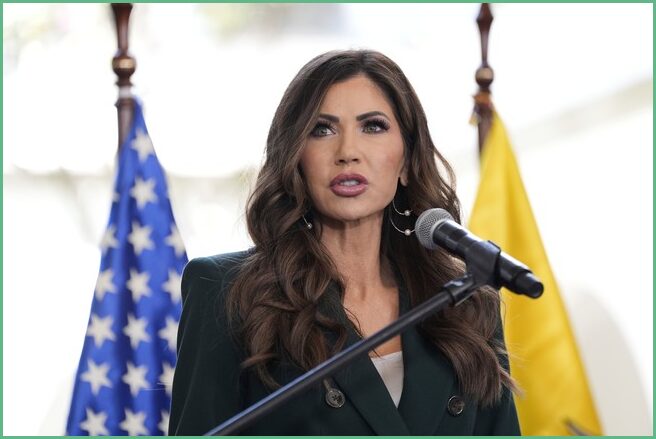
The 9th Circuit just gave the Trump administration a win on Temporary Protected Status, pausing a lower court’s decision that had undone Secretary Kristi Noem’s moves on TPS for Nepal, Honduras, and Nicaragua. The ruling signals that the appellate court sees a real chance the government will prevail on the lawfulness of terminating TPS, and it leans on recent Supreme Court stays to justify pausing the lower-court order while the appeal proceeds.
This case centers on Noem’s decision in summer 2025 to end TPS for Nepal, Honduras, and Nicaragua, and the ensuing legal fight. Plaintiffs asked the courts to block the terminations, and a district judge sided with them late last year, vacating the actions under the Administrative Procedure Act. The administration appealed, arguing the district court was wrong on jurisdiction and legal standards, and the 9th Circuit stepped in with a stay pending appeal.
The 9th Circuit didn’t merely pause the lower court’s order; it explained why the government likely wins on the merits or on jurisdictional grounds. That doesn’t mean the case is over, but it does mean the appellate court found the government’s legal arguments strong enough to justify halting the district judge’s vacatur. For Republicans and conservatives who prioritize enforcement of immigration laws, this is a meaningful judicial check on what critics called unchecked lower-court activism.
We conclude that the government is likely to succeed on the merits of its appeal either by showing that the district court lacked jurisdiction or by prevailing on plaintiffs’ arbitrary-and-capricious APA challenge.
The court drew a clear line between termination and vacatur of TPS in its reasoning, and that distinction matters. According to the panel, the statute plainly allows the DHS Secretary to terminate a designation, even if a different action—vacating a designation—might raise separate concerns. That reading gives the executive branch breathing room to manage foreign-country designations without courts instantly undoing those policy judgments.
One panel judge dissented from reaching the APA merits but still agreed a stay was appropriate, showing that the outcome was a blend of law and judicial caution. The other two judges joined the full analysis, and the panel explicitly noted appointments across administrations, underscoring that this isn’t merely partisan claptrap but a legal question with real statutory text at issue. The bottom line from their view: the government’s position is strong enough to pause the lower-court result while the appeal goes forward.
The 9th Circuit also leaned on the Supreme Court’s recent stays in related matters to shape its equitable decisionmaking. Those high court stays, even without extended reasoning, signaled that aggressive district-court orders blocking federal immigration actions can be subject to reversal or pause at the highest level. The appellate court treated those stays as part of the landscape it must weight when deciding whether to keep its own stay in place.
We are not writing on a blank slate, however, because the Supreme Court has twice stayed district court orders blocking the Secretary’s vacatur of TPS for Venezuela. See Noem v. National TPS All., 146 S. Ct. 23 (2025); Noem v. National TPS All., 145 S. Ct. 2728 (2025). Those orders contained no reasoning, so they do not inform our analysis of the legal issues in this case, and the issues in any event are not identical. But the stay applications involved similar assertions of harm by both parties, and we have been admonished that the Court’s stay orders must inform “how [we] should exercise [our] equitable discretion in like cases.” Trump v. Boyle, 145 S. Ct. 2653, 2654 (2025). We therefore conclude that the equitable factors favor a stay.
Plaintiffs can still seek rehearing en banc and ultimately take their case to the Supreme Court, so the fight is far from resolved. But the 9th Circuit’s move gives the administration valuable time to press its legal interpretation and to prevent immediate changes to TPS policy while litigation continues. Expect more filings, more briefings, and a sustained legal battle that will test how much deference courts give to the executive on immigration designations.
Beyond the courtroom, this ruling matters politically: it reinforces the argument that elected officials and their appointees should have the latitude to make and unmake foreign-country TPS designations. Conservatives who favor clear enforcement authority will view the 9th Circuit’s decision as a signal that the judiciary may not be the default backstop against policy shifts by the executive branch.
