
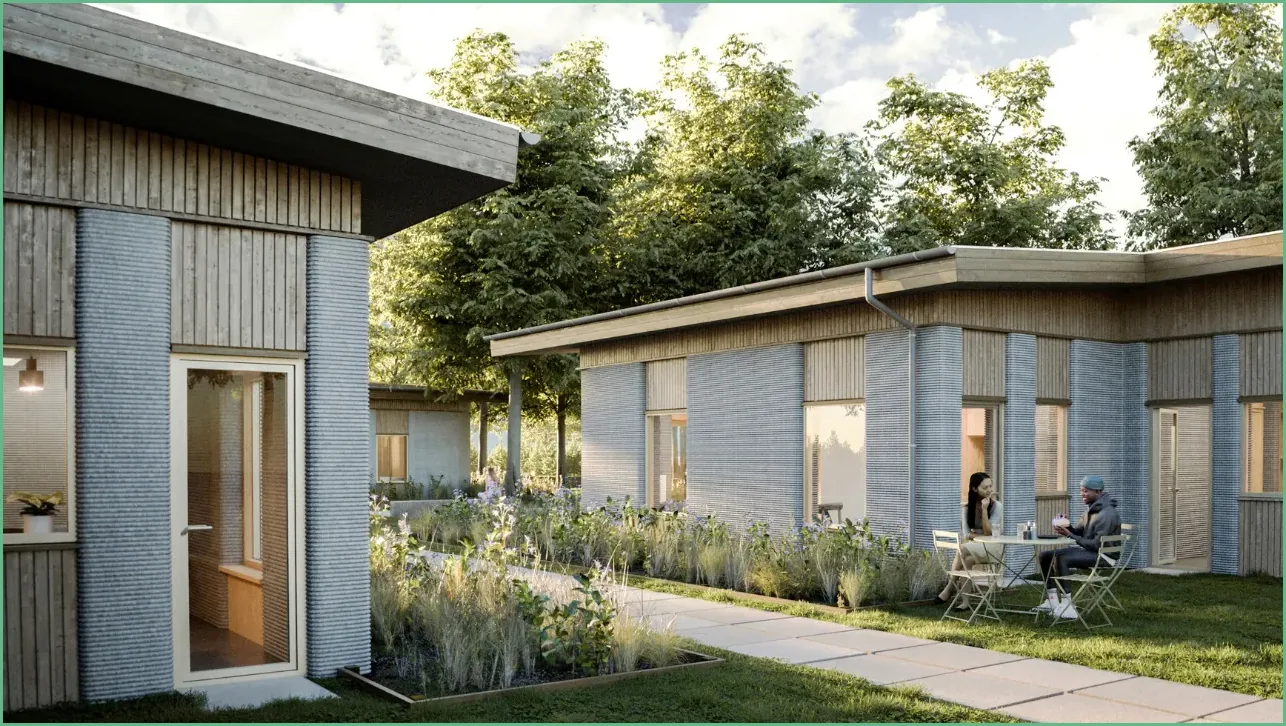
Skovsporet, a 36-unit student housing project in Holstebro, Denmark, is using large-scale 3D printing to test faster, cleaner and more repeatable ways to build multiunit homes, blending digital design, automated printing and low-carbon materials to deliver functional apartments with a small on-site crew.
Located near VIA University College, the development is commissioned by NordVestBo and designed by SAGA Space Architects with technical partners including 3DCP Group and COBOD. The scheme comprises six buildings, each holding six ground-level student apartments, all printed on site rather than assembled from traditional masonry or timber methods. This approach aimed to shave time and labor off conventional schedules while keeping quality and livability front and center.
The structures were printed using the COBOD BOD3 construction printer, a ground-based system that extrudes a cement-like mix layer by layer according to a precise digital model. Early buildings took several weeks to print, but the team sharpened workflows fast, and the final block wrapped printing in just five days. That pace translated to more than one finished apartment on average per day during the peak run.
Only a small crew was needed to run the printer, which shifted the work from heavy manual labor to machine-led production with human oversight. Three operators handled the machine while other trades prepared for follow-up tasks like roofing, windows and services. The result is a model that reduces on-site workforce while concentrating skilled labor on finishing and quality control.
Apartment footprints range from about 431 to 538 square feet, and interiors are organized to feel open despite compact dimensions. Each unit includes a full kitchen, a living and study zone, a bathroom with shower and a bedroom fitted for a double bed, with large roof windows and slanted ceilings drawing daylight deep into the rooms. Warm plywood panels and glass details temper the concrete surfaces so the places feel like homes rather than bare test cases.
Repeatability is the real technical promise demonstrated here: the printer’s track system allows uninterrupted wall printing, so long runs and consistent elements are easier to produce at scale. As teams moved from building to building, cycle times shortened and tolerances tightened without dropping finish standards. For municipalities and developers wrestling with housing shortfalls, that consistency and speed could make a tangible difference.
Sustainability was baked into the build chemistry and site decisions. Walls were printed with a D.fab concrete mix incorporating FUTURECEM, a low-carbon binder developed locally, and the printer lays material only where structurally necessary, cutting waste versus traditional formwork methods. On-site planning also saved the landscape: print beds were positioned to protect roughly 95 percent of existing trees, which kept the site’s green structure largely intact.
With the mechanical printing phase complete, human teams have moved in to install roofs, windows, interiors, utilities and furnishings, while landscaping, paths and bicycle parking are being added to knit the six blocks into a shared student village. The project remains on schedule for residents to begin moving in by August 2026, showing that experimental techniques can still meet real-world delivery timetables.
Skovsporet offers a concrete example of how digital fabrication, automated workflows and greener materials can combine at a neighborhood scale. It does not replace traditional construction overnight, but it does highlight a pathway for multiunit housing that uses fewer workers, creates less waste and compresses schedules—features that could ease pressure in crowded cities and make student housing more accessible without compromising design or comfort.
