
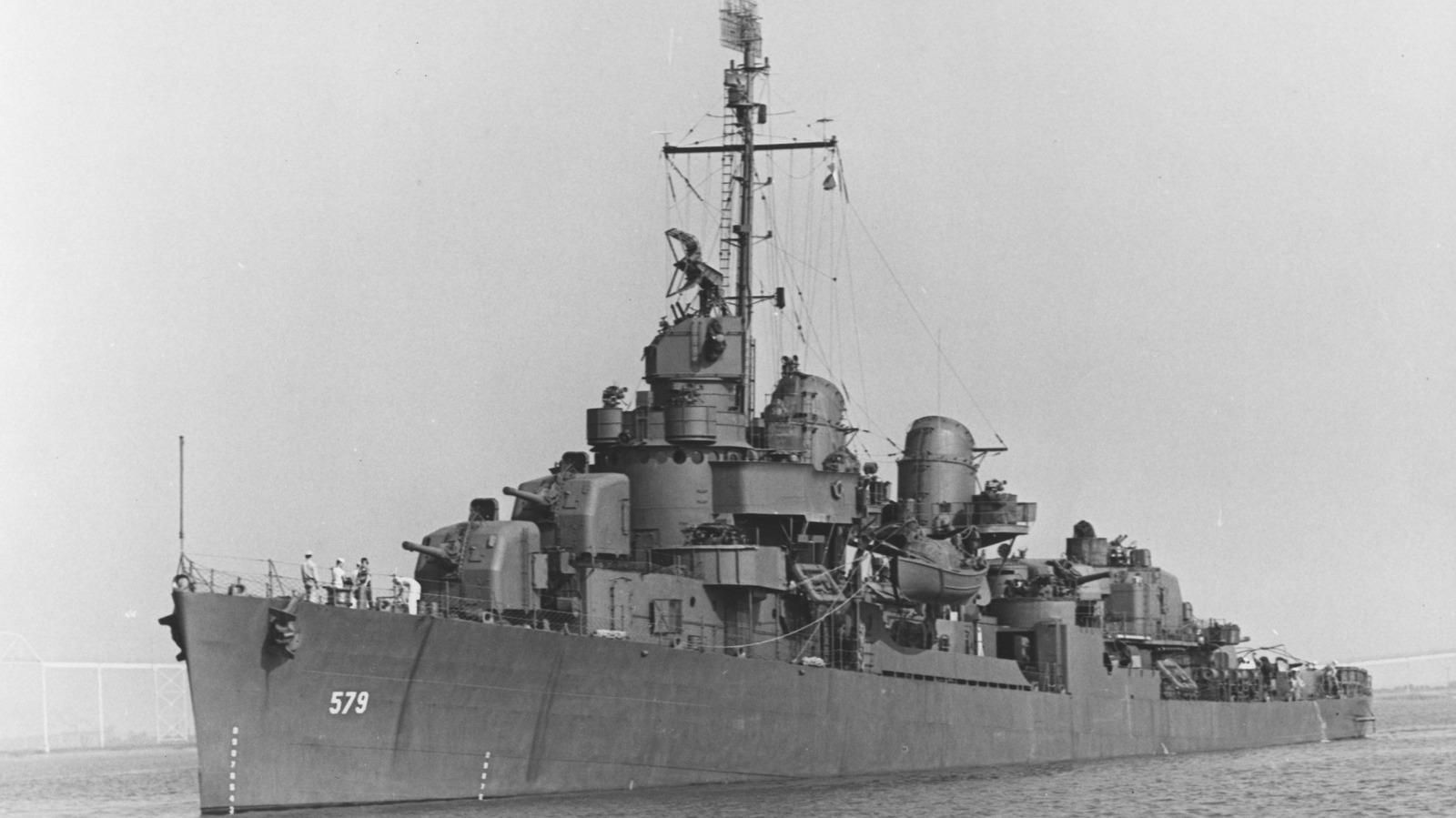
The USS William D. Porter built a reputation for bad luck so fast it almost felt supernatural. A Fletcher-class destroyer that served in both the Atlantic and Pacific, it picked up a string of bizarre accidents, protocol blunders, and near disasters that turned an ordinary warship into a floating legend.
Its trouble really came into focus during the voyage that carried President Franklin D. Roosevelt to Europe aboard the USS Iowa. What should have been a serious, tightly controlled escort mission instead became a parade of mistakes, starting with an anchor problem and rolling straight into a depth charge that went off when it was never supposed to. Before long, the Porter was also breaking radio silence, which only made the whole situation look even more chaotic.
One of the strangest moments came when the destroyer almost hit the Iowa with a torpedo of its own. That kind of mistake, especially on a mission involving the president, was the sort of thing that could wreck careers and shake confidence across the fleet. The ship was sent to Bermuda for an inquiry, and the incident sealed its image as a vessel that simply could not catch a break.
The bad luck started early and kept piling up. On its shakedown cruise, the Porter left Norfolk and immediately ran into trouble when the anchor was raised incorrectly, ripping across another destroyer’s deck and taking railings and lifeboats with it. The next day, a depth charge rolled overboard and exploded underwater because no one had set the safety, proving the ship had a talent for turning routine tasks into headline-worthy accidents.
Then came the rough weather and the kind of maritime chaos that no crew wants to remember. A huge wave knocked a sailor overboard, killing him, and flooded one of the boilers, slowing the ship down for repairs. The crew radioed the Iowa to explain the delay, which broke radio silence again and drew the fury of Adm. Ernest J. King, who was not in the mood for excuses.
Even the torpedo drill went off the rails. The Porter was practicing a simulated attack on the Iowa with the primer charges removed, but one torpedo somehow got launched for real. Lt. Cdr. Wilfred Walter tried signaling the danger by lamp, then broke radio silence yet again when that failed, and the Iowa only escaped because the warning finally got through in time.
After that mess, the Navy dug in and found the source of the near catastrophe. Chief Torpedoman Lawton Dawson had forgotten to remove the primer, which led to a harsh sentence that was later waived by the president. The whole episode made the Porter look less like a warship and more like a rolling cautionary tale, and it was pushed onward to Dutch Harbor in Alaska after the dust settled.
The Pacific did not magically improve things. During a New Year’s Day party in 1944, a drunk sailor fired one of the ship’s 5-inch guns, and the shell landed in the base commander’s backyard. Nobody was hurt, but by that point the Porter had already developed the kind of reputation that makes every crewman watch the next small mistake with dread.
For months, the destroyer kept working, patrolling the Kuril Islands and later joining the brutal fighting around Leyte Gulf and Okinawa. There, it actually performed well, shooting down six aircraft and firing on land targets while covering the Marines during the landing. For a brief stretch, it looked like the ship might finally be shaking off its curse.
That hope did not last long. On June 10, 1945, a Japanese dive bomber attacked, missed, and still managed to explode beneath the ship after hitting the water, blasting the destroyer upward with deadly force. The crew fought to save the Porter for hours, but eventually everyone had to abandon ship, leaving the battered destroyer to sink while every sailor got out alive.
