
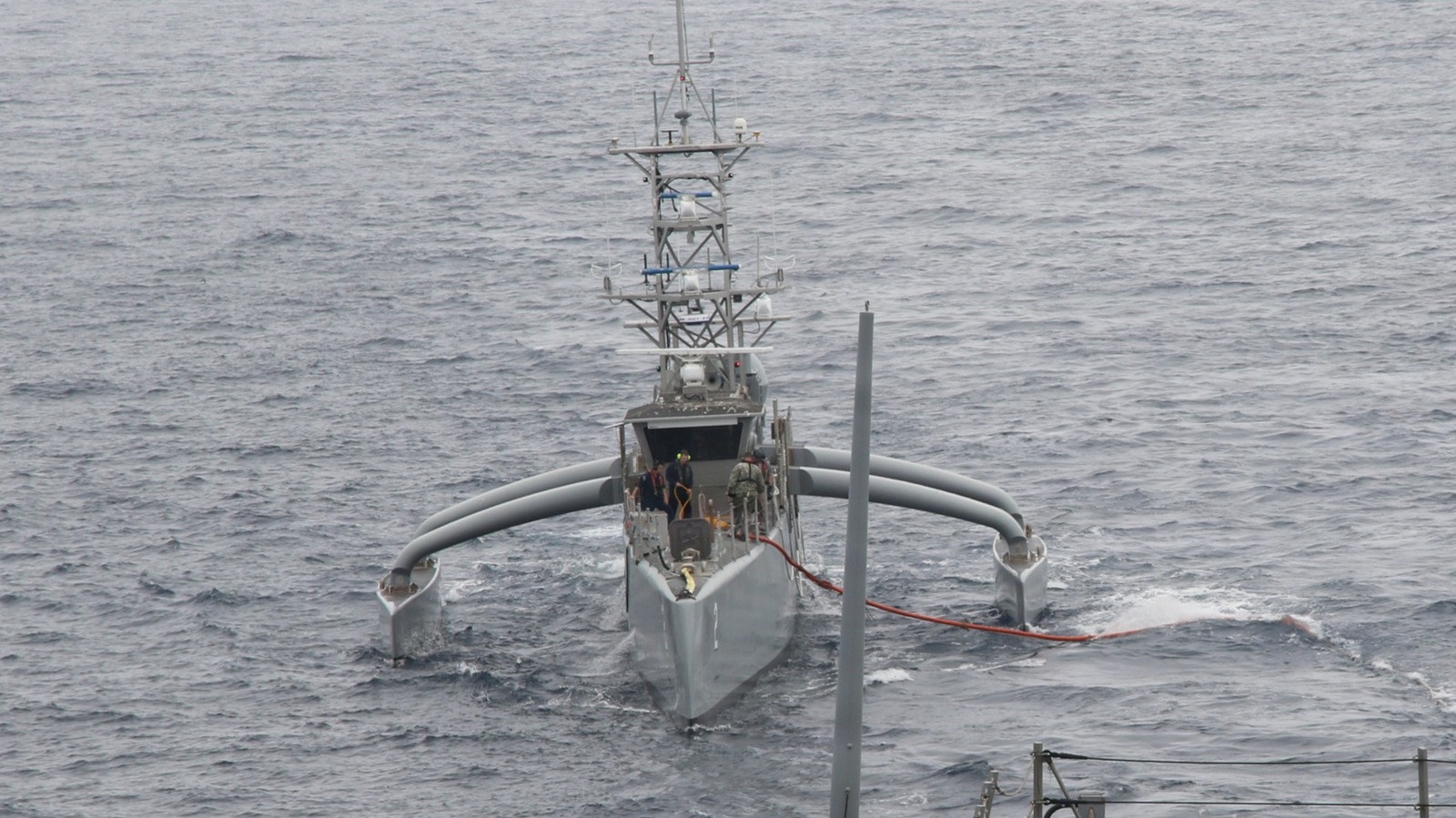
The Navy has pushed drones into more corners of the fleet for years, but this latest move feels like a bigger shift. A carrier strike group has now headed out with a large uncrewed surface vessel in the mix, and that puts a new kind of hardware into the center of naval operations. The platform is built for long endurance, wide-open seas, and missions that can stretch far beyond the usual short-range drone jobs.
Uncrewed systems have already proven useful in combat support, rescue work, and surveillance, so the jump to a strike group is not coming out of nowhere. What makes this deployment stand out is scale, because this is the first time a carrier strike group has sailed with a large USV attached to it. That matters because the strike group is the Navy’s showcase formation, the kind of force built to project power fast and far.
During a briefing on the deployment, acting Navy Secretary Hung Cao made the Navy’s thinking pretty plain: “This is the first carrier strike group to ever deploy with a large sized unmanned surface vessel, and this is a force multiplier. Imagine having more guns out there.” The line points to the real appeal of the platform, which is not just novelty but extra reach, extra sensors, and extra firepower without putting more sailors in the line of fire.
The vessel in question is the Seahawk, a medium uncrewed surface vessel developed by Leidos. It is an upgraded version of the earlier Sea Hunter and was designed from the start to run on its own for months at a time, which is a very different lane from the small drones most people picture. At 135 feet long with a transoceanic range, it is built to stay in the fight and keep moving through rough water without needing constant babysitting.
Its size gives it room to do more than scout. The Seahawk can support intelligence work, help launch and recover smaller drones, and carry weapons for offensive or defensive use, depending on the mission. That kind of flexibility is exactly why the Navy has been leaning harder into autonomous systems, especially as the service looks for ways to spread risk across more platforms instead of depending so heavily on a few big ships.
The hull design is another quiet but important detail. Built with composites, the Seahawk is meant to resist the kind of saltwater corrosion that chews through metal over time, which is no small thing for a ship expected to spend long stretches at sea. Navy crews know what rust can do after a deployment, and a platform that can shrug off some of that damage has an obvious advantage when maintenance time is limited.
Both the Seahawk and its predecessor were taken on by the Navy in August 2025, then quickly folded into research and experimentation. That timing suggests the service is still figuring out the sweet spot for these vessels, whether as scouts, escorts, weapons carriers, or something even broader. The fact that one is already sailing with a carrier strike group shows the Navy is moving from theory toward practical use.
That practical turn could matter even more as CSG-9 prepares for Keen Sword 2027, the regular joint exercise with Japan’s Self-Defense Forces. The exercise should give the Seahawk a chance to operate around larger ships in a busy, realistic environment, where autonomy and coordination matter just as much as raw capability. For a platform like this, that kind of test can say a lot without the Navy having to spell everything out.
