
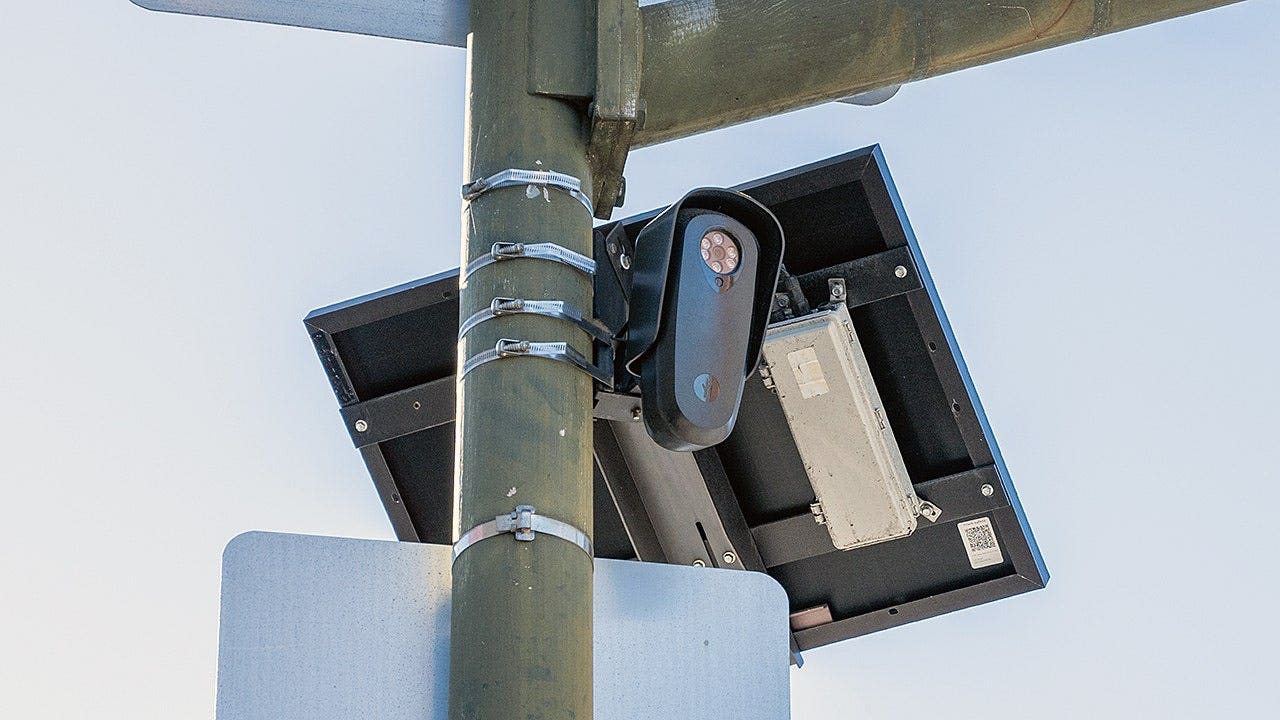
License plate readers have moved from a niche police tool to something far more common, and that shift is stirring up a real privacy fight. Cameras mounted along roads, near neighborhoods, and in parking lots are quietly recording vehicles, building searchable logs, and giving agencies a way to trace where a car has been without ever stopping the driver.
Community maps have already spotted more than 119,000 roadside readers across the United States, though that number is not a perfect count because it depends on public reports. Most of those mapped cameras are tied to Flock Safety, and California stands out with the biggest concentration. Police say the systems help recover stolen cars and identify vehicles tied to serious crimes, which is a big part of why departments keep signing on.
The hardware itself is easy to miss. A small camera on a pole, sometimes paired with a solar panel, snaps a vehicle as it passes and turns that image into data that can be searched later. What starts as a single plate scan can also include the make, model, color, body type, location, and a timestamp, plus visible details like a roof rack or bumper sticker.
That is where the privacy concerns start to hit hard. Privacy advocates say the technology can quietly build a detailed driving history for ordinary people who have nothing to do with a crime. A series of camera hits can show where someone lives, works, shops, or even visits a doctor, and that makes the system feel a lot less like a crime-fighting shortcut and a lot more like nonstop tracking.
Supporters argue the tradeoff is worth it because the cameras do not just sit there collecting dust. Departments can flag stolen vehicles, search for partial plate matches, and compare earlier sightings to newer ones when they are trying to solve an urgent case. In one recent review by the Los Angeles Police Department, more than 210 million plate scans produced both useful recoveries and some wrong flags, which is exactly why the debate refuses to go away.
The rules around all this are messy, and that matters. These cameras are not limited to police departments, since businesses and homeowners associations can install them too, and the access rules can change depending on who owns the system and who gets to search the data. Flock says its default retention period is 30 days and that searches are logged, but critics still worry about how wide the access can get once the data is sitting in the cloud.
California has tried to put up guardrails by limiting how local agencies share ALPR data. State law blocks local law enforcement from passing it to federal or out-of-state agencies, but enforcement has been a different story, and that has triggered legal action over alleged unauthorized sharing. The bigger issue is simple enough: a written rule does not mean much if the system still makes it easy to share what should have stayed local.
In Los Angeles, the city also ran into trouble with its own arrangement. The police department let a three-year agreement with Flock expire after concerns grew around data ownership, privacy, and security, even though the 138 cameras kept operating. Officials were still negotiating over tighter safeguards, including limits on how the company could store, share, or use the information.
For drivers, the practical worry is not just whether a camera exists, but what happens after it captures a plate. A record can be searched later by plate number, vehicle description, or even a partial match, and that gives investigators a lot of reach. That same reach can be helpful in a missing-person case or a stolen-car investigation, but it also means a routine drive can become part of a long paper trail without the person behind the wheel ever knowing.
There have already been cases where the technology pointed police in the wrong direction. One Colorado woman reportedly had to dig up location data, camera footage, and other evidence to prove she was nowhere near a porch theft tied to her truck’s plate record. That kind of mistake is why critics keep saying these systems need real oversight, not just promises and policy binders.
People who want to know whether these cameras are nearby can start by checking public camera maps and local government records. City council agendas, police policies, and contract documents can reveal where the cameras are going, how long records are kept, and who else can search them. If a community is going to live with this kind of surveillance, residents deserve clear answers before the network gets even bigger.
