
Uber Eats is edging closer to a future where dinner does not need a car at all. A new deal with Zipline aims to bring autonomous drone delivery into U.S. cities, with early launches expected in existing markets before the service spreads wider.
Uber and Zipline say the first food drops could start later this year, then expand into dozens of cities if the rollout goes smoothly. The long-range goal is even bigger: 1 million drone deliveries a day by the end of 2029. That kind of number sounds wild, but the companies are betting that speed, convenience, and automation can make it real.
The initial rollout will not be universal. Zipline already operates in places such as Dallas and Houston, so those areas are among the first likely to see Uber Eats drone delivery in action. The setup gives the partnership a built-in head start because the company is not starting from zero.
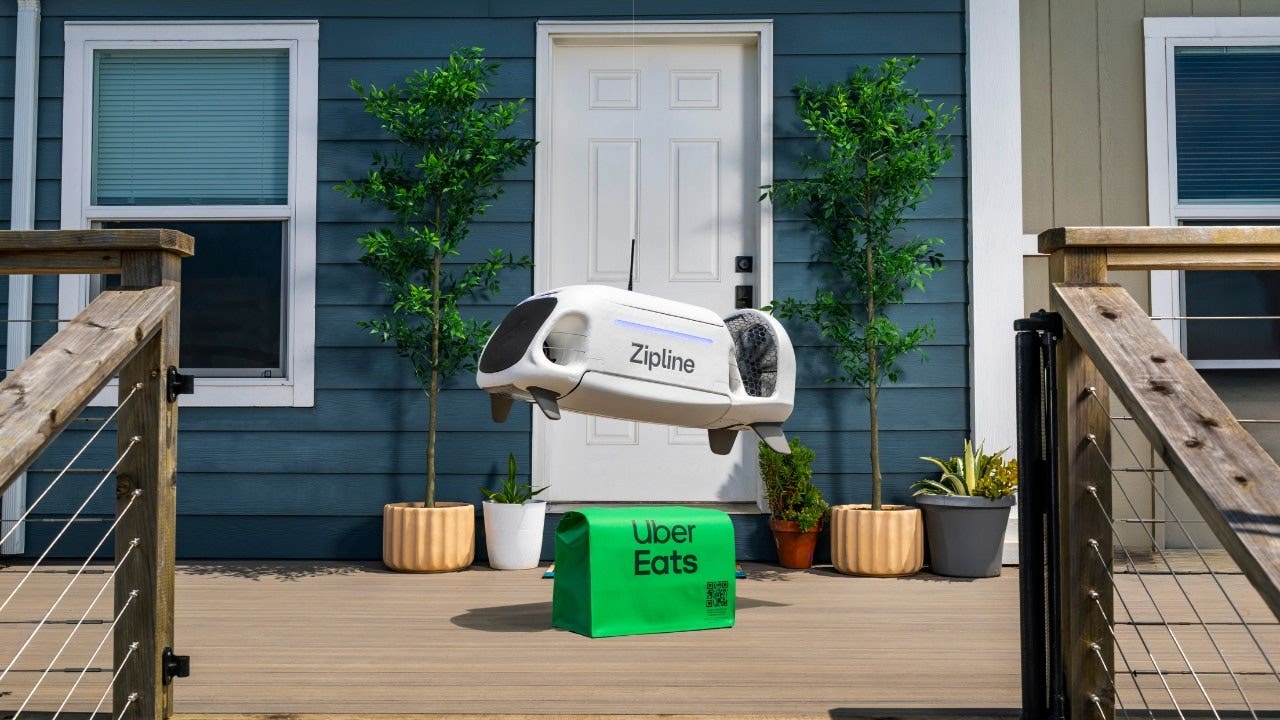
For customers, the experience is meant to feel familiar. Instead of a car pulling up, the order would be prepared by the restaurant, loaded into Zipline’s autonomous system, and flown to an approved drop-off point. In Zipline’s current home delivery model, the aircraft stays overhead while a smaller unit lowers the package on a tether.
The aircraft behind the service is Zipline’s Platform 2, also called P2. It can carry up to 8 pounds, cover a 10-mile service radius, and complete some trips in about 10 minutes. Zipline says the drone cruises at around 70 mph and flies about 300 feet above the ground during delivery.
That high flight path matters for more than just speed. Zipline says its system is designed to keep the larger aircraft out of the way while the smaller delivery unit handles the final drop. The company also says the process happens autonomously, so there is no need for a landing pad in the yard or driveway.
Zipline is not new to this game. The company says it has already completed more than 2.7 million commercial deliveries and flown more than 135 million autonomous commercial miles. It also says it now makes a delivery somewhere in the world every 20 seconds, which gives the Uber partnership some serious credibility.
In the U.S., Zipline’s home delivery service already operates with Walmart and restaurant partners. Its fact sheet says the program launched in Pea Ridge, Arkansas, and expanded to more than 20 communities around Dallas-Fort Worth. That means the technology is not just a demo on a test track, it is already reaching real homes.
Uber sees more than one kind of delivery future. The company is building a network that can mix human couriers with autonomous tools, including sidewalk robots and drones. It has already invested in drone company Flytrex, and now Zipline is part of the picture too.
The appeal is easy to understand. A drone can take a more direct route than a car stuck in traffic, and it does not have to circle around looking for parking near a restaurant. That could shave time off the trip and help food arrive less soggy, less cold, and a lot less frustrating.
Still, not every order will be a smooth sky-high success. Restaurants still need time to cook the meal, and weather can affect whether a drone flight makes sense. Local conditions and operational limits will also matter, so the service will not be available everywhere or all the time.
Noise may become the next big question. A single drone overhead may not bother many people, but repeated flights could change the feel of a neighborhood fast. Zipline says it has worked for years to make the aircraft quieter, while keeping the main drone high enough above the ground to reduce what people hear below.
Safety will matter just as much as convenience. Zipline’s aircraft operate autonomously and have received FAA approval for certain beyond visual line of sight flights, which helps open the door to wider use. The company says it tested the system heavily before home deliveries began, with tens of millions of simulated flights and more than 150,000 test deliveries.
Money is behind the push too. Uber is making a strategic investment in Zipline as part of the agreement, though the companies have not said how large it is. Zipline has also raised more than $600 million and says it is now valued at $7.6 billion, which shows plenty of confidence in where this market could go next.
For now, most Uber Eats orders will still arrive the old-fashioned way. But if drone delivery lands in more cities, customers may soon be choosing between ground traffic and a machine in the sky. The big questions will be simple ones: how fast is it really, how much does it cost, and whether a meal arriving by drone feels normal after the first few times.
