
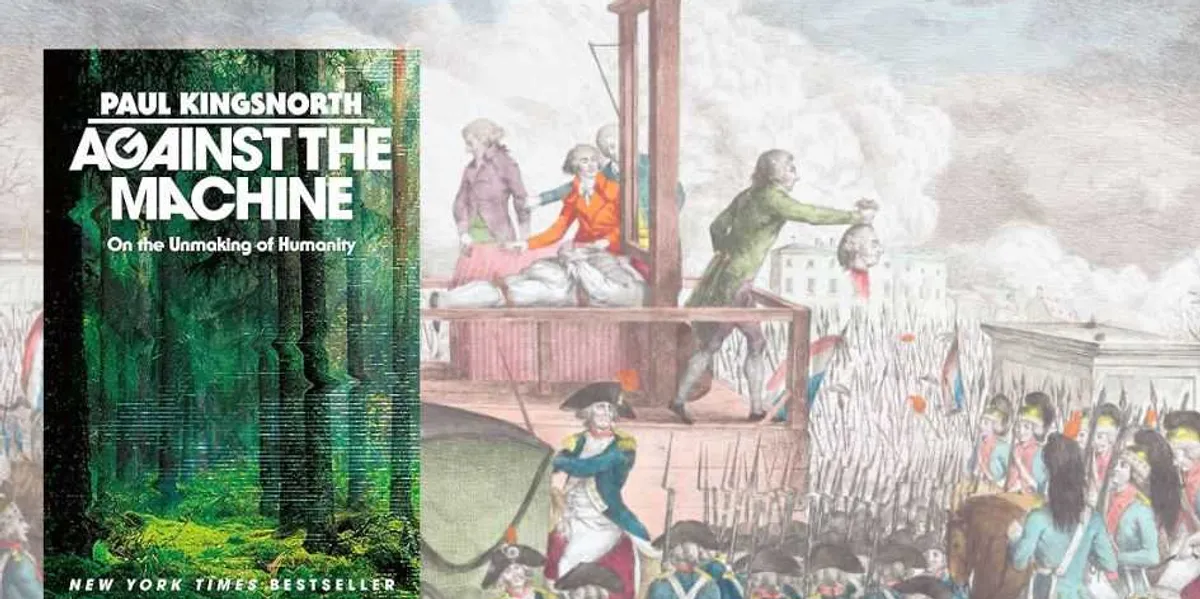
The piece examines Paul Kingsnorth’s diagnosis of modern cultural collapse, tracing the problem to a long-lived force he calls the Machine and outlining how a recovery centered on family, faith, and local life can resist it. It explains the Machine’s values, contrasts them with older civic habits, and surveys Kingsnorth’s proposal of “reactionary radicalism” as a way to rebuild moral communities. The article argues that meaningful resistance requires personal and institutional changes, not platform skirmishes or fresh ideologies.
Erik von Kuehnelt-Leddihn is invoked to show how different thinkers push the origin story of our crisis farther back than late 20th-century politics. Many point to the two world wars as turning points; more probing accounts reach back to the French Revolution as the birth of ideological modernity. Kingsnorth joins that older line, arguing the problem is rooted in a cultural and spiritual rupture that long predates our current battles.
Kingsnorth names the force driving this rupture the Machine, a cultural engine grown from revolutions and industrial change that now shapes how we see the world. He argues that the Machine flattens complex human realities into metrics, markets, and utilities, making everything legible only inside its logic. Once you adopt its frame, beauty, mystery, and spiritual truth become hard to see or are dismissed as irrational.
The Machine’s moral template prizes progress, openness, borderless markets, and therapeutic individualism, turning these tendencies into unquestioned assumptions. Kingsnorth distills this dominant creed into four pillars: science, self, sex, and the screen, which together reorder meaning and community. Against them stand the older habits of past, place, people, and prayer, habits that protect inheritance and local obligations.
These two sets of values collide in policy and culture. Where the Machine dissolves duties and loyalties, the older order depends on them. When civic life is reduced to choice and consumption, practices like family formation, neighborhood ties, and religious practice slide from habit to dissidence.
This tension explains why critics of liberal modernity are often dismissed or absorbed into the very system they oppose. As one example of elite contempt, the former president observed the anxieties of working-class voters with the line: “It’s not surprising, then, that they get bitter, they cling to guns or religion …” That quote captures the Machine’s tendency to write off rooted citizens as backward rather than reckon with their grievances.
Kingsnorth doesn’t simply diagnose; he turns to the limits of mainstream conservatism as well. Conservatism, he says, often fights within the Machine’s rules and therefore ends up defending the aftermath of revolution rather than the inheritance it displaced. Chesterton put it bluntly: “Even when the revolutionist might himself repent of his revolution, the traditionalist is already defending it as part of his tradition.”
To move beyond that impasse, Kingsnorth borrows a label that refuses left-right boxes: reactionary radicalism. This is not a call to tear down society but to rebuild civic life at a human scale, privileging local ties and moral ordering over abstract utopian projects. The goal is to limit needs, cherish the particular, and treat large agglomerations of power with suspicion.
aims to defend or build a moral economy at the human scale, which rejects the atomized individualism of the liberal era and understands that materialism as a world view. A politics which embraces family and home and place, loving the particular without excluding the outsider, and which looks on all great agglomerations of power with suspicion. … A politics which aims to limit rather than multiply our needs, which strategically opposes any technology which threatens the moral economy and which, finally, seeks a moral order to society which is based on love of neighbor rather than competition with everyone.
Kingsnorth emphasizes that meaningful resistance will not be won on social feeds or by founding another platform. “This battle will not be won on social media, through new platforms, or by means of yet another ideology.” Those are the Machine’s native terrain; skirmishes there can be absorbed and repurposed.
Instead, he highlights practical acts of refusal: homeschooling as an example, a revival of apprenticeship and local institutions, and a critical stance toward technologies that promise liberation while increasing dependence. The aim is not Luddism for its own sake but strategic refusal of systems that hollow out moral life. Building parallel institutions and practices creates resilience against cultural capture.
Kingsnorth frames the cultural struggle in stark human terms: what kind of person will you become under pressure from the Machine? He offers two endings for those who resist: the “raw” barbarian who withdraws outright, and the “cooked” barbarian who remains inside and quietly undermines the Machine. Both paths share the refusal to be fully assimilated.
For those of a conservative bent, this is a call to act where politics cannot fully reach: to strengthen families, religious practice, local economies, and schools that form character. It is a sober reminder that preserving a free, ordered society requires more than elections or media battles; it requires institutions and habits that outlast trends. Pick a scale—home, parish, town—and invest in the practices that make people accountable to one another.
