
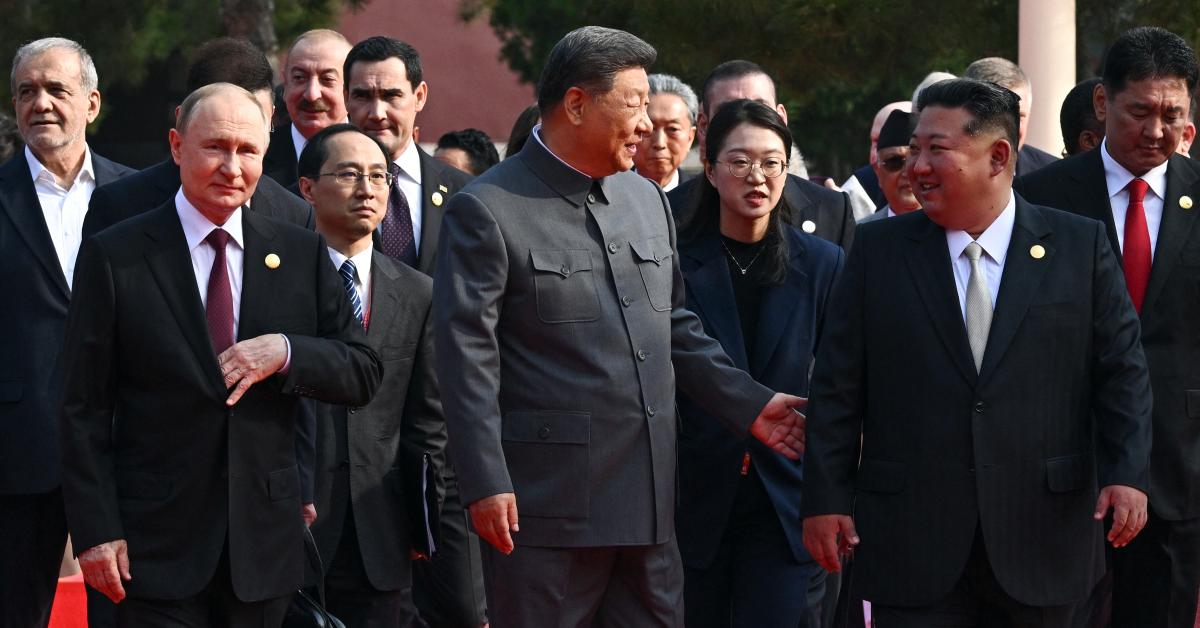
Russian President Vladimir Putin, North Korean leader Kim Jong Un, and Chinese President Xi Jinping gathered in Beijing for China’s “Victory Day” parade. This event celebrated Japan’s surrender in World War II. Their meeting followed President Donald Trump’s discussions with Putin and European leaders to resolve Russia’s conflict with Ukraine.
The gathering coincided with the Shanghai Cooperation Organization summit, which featured leaders from over 20 countries. Notably, Iran’s Masoud Pezeshkian was among other anti-American figures present. In recent months, China, Iran, North Korea, and Russia have strengthened their ties, forming what some call an “axis of upheaval.”
For Kim Jong Un, the visit was significant as he seldom leaves North Korea. The sight of these three leaders together in public for the first time captured global attention. According to NBC News, their public appearance is indeed a rare occurrence.
President Trump expressed his concerns on Truth Social, accusing Xi, Putin, and Kim of plotting against the U.S. He questioned if the parade would acknowledge America’s role in aiding China during World War II. Trump highlighted the sacrifices Americans made to help China in its struggle for freedom.
Trump’s statement read: “The big question to be answered is whether or not President Xi of China will mention the massive amount of support and ‘blood’ that The United States of America gave to China.” He emphasized the bravery of Americans who died in pursuit of victory. Trump also wished the Chinese people a memorable day of celebration.
The close relationship between Putin and Xi is well-documented, having met over 40 times in the last ten years. Their cooperation has raised eyebrows in Western circles. The presence of Kim Jong Un adds another dimension to this alliance.
Fox News and Newsmax have reported on the growing concern about this coalition. The so-called “CRINK” alliance—China, Russia, Iran, and North Korea—poses a potential challenge to U.S. interests. This partnership is seen as a strategic counter to Western influence.
The Victory Day parade itself was a grand display of military might. It showcased China’s military advancements and its historical achievements. Yet, the underlying political dynamics were the real story of the day.
The cooperation among these nations is framed as a challenge to American global leadership. As these countries strengthen their ties, the implications for international diplomacy are significant. The strategic alliances formed could shift global power balances.
Despite these developments, President Trump remains vocal about protecting U.S. interests. His statements underscore a commitment to American values and alliances. Trump’s rhetoric is a reminder of the ongoing geopolitical tensions.
The meeting in Beijing and the display of unity among these leaders highlight the complex nature of international relations today. For many, it signals a shift in global alliances. As always, the U.S. remains vigilant in safeguarding its national security.
In the backdrop of this event, the world watches closely. The dynamics between these nations could shape future international policies. Observers and analysts continue to assess the potential impact on global stability.
