
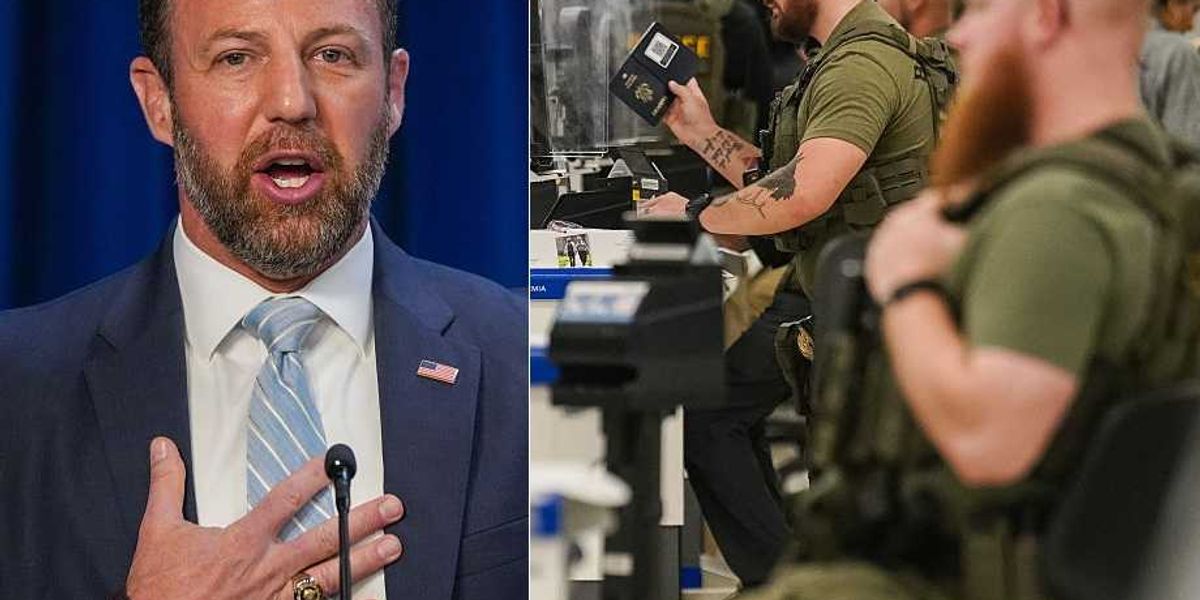
Homeland Security Secretary Markwayne Mullin told Fox News he and aides are “currently drawing up plans” to stop international processing at airports that feed sanctuary jurisdictions, framing it as a direct response to local officials who block federal immigration enforcement. The move has set off sharp warnings from the travel industry and some mixed signals inside the administration, and it forces a straightforward question about whether federal law or local politics gets priority when borders and airports are involved. This article lays out what Mullin said, why he argues the step is warranted, how airlines and trade groups reacted, and where other leaders stand on the idea.
On Fox News, Mullin made the announcement during an appearance with Sean Hannity on Fox News Tuesday night, saying he and others are “currently drawing up plans” to halt international passenger and cargo processing at airports near sanctuary cities. He presented the plan as a remedy to what he sees as obstruction by local leaders who prevent federal officers from doing their jobs at detention sites, and he mentioned interference even at facilities in Newark, New Jersey.
Mullin pointed at a core contradiction and asked it bluntly: “They don’t want us to enforce immigration, but they want us to process immigration at their facilities?” That question is paired with his broader charge that “Local, radical left Democrats aren’t allowing us to do our job and enforce federal laws,” Mullin claimed, so “we shouldn’t be processing international flights into their cities.” The tone was clear: if a city will not respect federal authority on immigration, it should not get the federal services that facilitate new arrivals.
https://x.com/EricLDaugh/status/2059633424181215725
He did not nominate specific airports by name, and that ambiguity matters because practical implementation would vary by hub. Federal lists have already flagged a range of jurisdictions under the “sanctuary” label, including entire states and major metros, and that patchwork is precisely the problem Republicans are highlighting. From the party perspective, Washington cannot selectively accept liability for processing people while local leaders refuse to cooperate on enforcement and detention.
Business groups in the travel world reacted quickly and loudly, warning of dire operational and economic fallout. Major trade associations and airline groups said removing or reducing Customs and Border Protection presence at airports would disrupt passenger itineraries, cargo flows, and the tourism dollars on which cities rely. Those are real concerns, but Republicans arguing for law-and-order solutions see them as the predictable costs of enforcing clear federal standards instead of allowing political resistance to dictate border policy.
Customs and Border Protection do more than stamp passports; they manage cargo manifests and ensure security chains that keep planes moving and goods flowing. Shrinking that footprint could ripple through logistics networks and spur higher costs for shippers and customers alike. Still, for conservatives who favor strict enforcement, operational pain is a secondary consideration to restoring the rule that federal immigration responsibilities are handled by federal agents, not overridden by local political posturing.
Not everyone in the administration is sold on the idea, which makes this a live policy fight rather than a done deal. Transportation Secretary Sean Duffy admitted doubts at a congressional hearing and said, “We have people from around the world and around the country that need to be able to fly into all different kinds of places,” Duffy told Rep. Adriano Espaillat (D-N.Y.). “We shouldn’t shut down air travel in a state that doesn’t agree with our politics.” That caution reflects a worry about collateral damage to ordinary travelers and businesses.
The larger debate is straightforward: should the federal government let local politics limit federal enforcement or should federal agencies adjust how they operate when localities obstruct enforcement? Supporters of Mullin’s approach argue the Constitution gives the federal government the authority to control entry and immigration processing, and that principle should not be undercut by sanctuary policies. Opponents warn of economic fallout and practical headaches, but the Republican message driving this proposal is plain and unapologetic—if a city blocks federal law, it should not benefit from the federal services that facilitate the movement and processing of people.
