
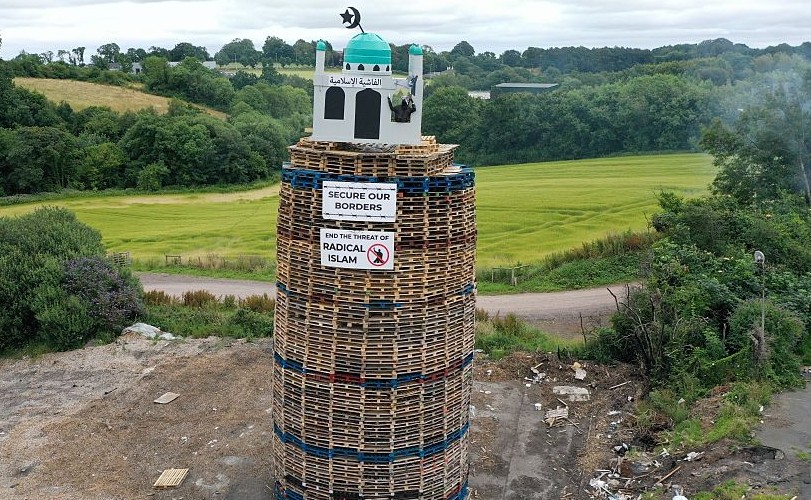
The annual Moygashel bonfire in Northern Ireland once again landed at the center of a fierce political and cultural fight, this time with a sharper focus on radical Islam and immigration. The display mixed old tradition with a new message, drawing fast condemnation from officials while supporters framed it as a raw protest against border policy and public safety concerns.
The event featured a mosque replica burned atop the towering pyre, along with banners that read “Secure Our Borders” and “End the threat of Radical Islam.” That image was enough to set off a wave of outrage, and police quickly moved into damage-control mode after the bonfire was lit and the display went up in flames.
Brian Neill, a 56-year-old man connected to the display, has been charged with incitement to hatred and denied the accusation. He was reportedly seen on the structure before the fire, alongside masked men, and said he had only stepped in because of his experience as a tree surgeon and his ability to help straighten the bonfire.
The Moygashel blaze is part of the wider Eleventh Night tradition in Northern Ireland, which dates back to celebrations tied to King William III’s victory over King James II at the Battle of the Boyne in 1690. Over the years, these bonfires have often carried a political edge, sometimes targeting the Republic of Ireland with burned Tricolor flags or other symbols tied to Catholic identity.
Police Service of Northern Ireland chief superintendent Norman Haslett made clear that officers were prepared to remove the material before the fire if the bonfire had not gone ahead. “Hate crime has no place in our society and will not be tolerated.”
That response did little to cool the broader argument around the bonfire, which this year leaned hard into immigration and the fear of radical Islam. Last year’s version carried a different warning, with a model boat full of mannequin migrants and signs reading “Stop the Boats” and “Veterans Before Refugees.”
The Moygashel Bonfire Association has stood its ground, insisting the display falls under its legal right to protest, even if it is offensive to many people. “Our display may well shock, offend or outrage others, but nonetheless it is an exercise in our rights under Article 10 of the ECHR, and we note with some irony that it is the ECHR which has so often paved the way for mass illegal immigration and a failure to deport foreign criminals who have come here unlawfully, that also now protects our right to protest in robust terms against that,” the group wrote in a statement.
The association has also pointed to violent incidents in Northern Ireland involving immigrants, including what it described as an African migrant’s savage knife attack of a 40-year-old man on a Belfast street. That attack was used to argue that immigration policy has drifted so far from common sense that ordinary people are now paying the price in their own neighborhoods.
“This is not an isolated crime, it is the inevitable outcome of a broken immigration policy that has ignored the safety of its people in favour of open borders,” the Moygashel Bonfire Association wrote after the attack.
For supporters of the display, the fire is not just a symbol, but a blunt warning that frustration over immigration, law enforcement, and cultural change is boiling over. For critics, it is an ugly stunt that crosses a line and turns a historic public gathering into a flashpoint for hate, fear, and a deeper clash over who gets to define public life in Northern Ireland.

3 Comments
Symbolic Justice Ireland Yes do more
The Irish and the rest of the British Isles are fed up with a govt that will do the kow-tow to foreigners and suppress its own people. The Moslems are invaders just as their piratical ancestors plundered and enslaved the Irish. Stand and fight!
Many immigrants come-to a country with no respect for the culture and laws for citizens living there. If a person were to come to one’s home and disrespect that individual he or she would have every right to throw them out. How is this any different?