
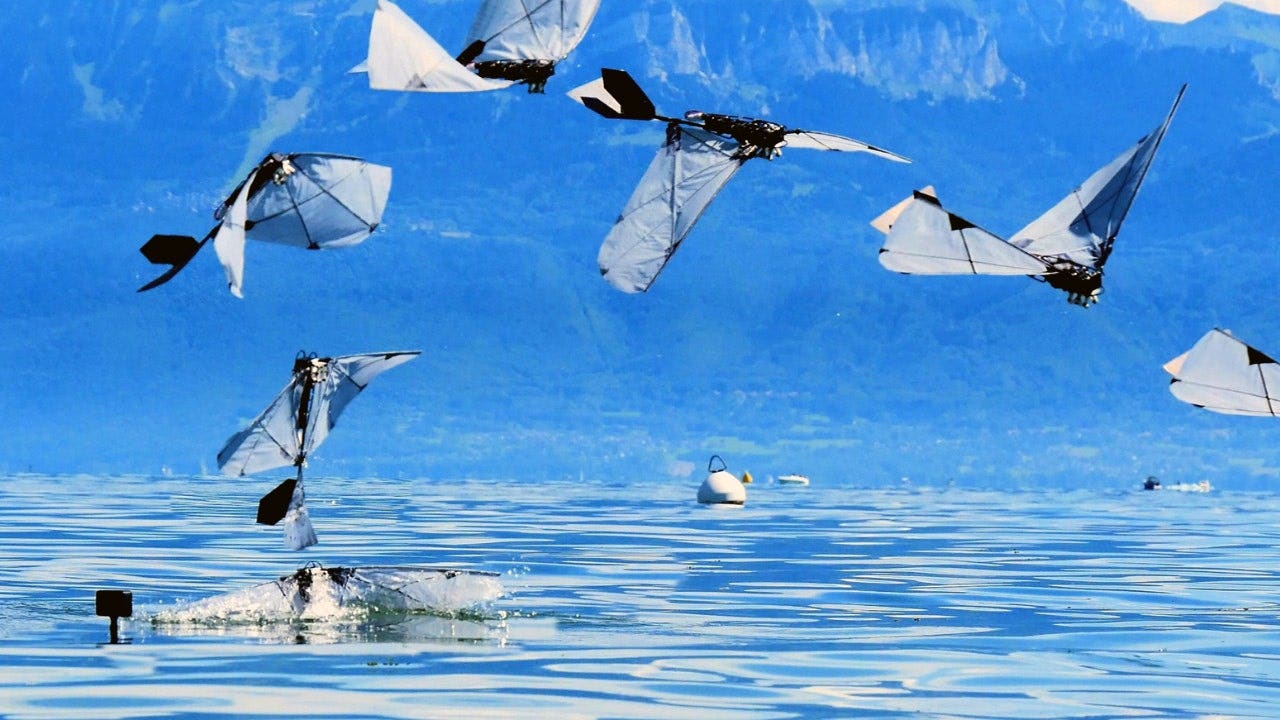
Researchers have built a tiny robotic bird that can do something that still feels a little sci-fi: fly through the air, dive into water, swim below the surface, and then launch back out again. Developed by teams at MIT and EPFL, the 8.8-ounce machine uses the same flapping wings for every part of the trip, which makes the design both elegant and surprisingly tough. It is also cheap by robotics standards, coming in at around $300 in materials.
That matters because moving between air and water is no small trick. Nature has already solved it in a few specialized bird species, but copying that behavior in a small robot is a huge engineering challenge. The problem is simple to describe and hard to beat: water pushes back far harder than air, so a machine has to adapt fast or get dragged under.
The robot’s trick is to stay simple instead of piling on extra hardware. Many amphibious machines use separate systems for flying and swimming, or they rely on propellers and legs to handle the switch. This bird-inspired device skips all that and keeps one set of flexible wings doing the work, which helps reduce weight, complexity, and power loss.
Flexibility is the real secret sauce. In air, the wings can flap as many as 11 times per second, but underwater the motion slows way down, sometimes to just a fraction of a beat per second. Pressure bends the wings by as much as 90%, and that bend shortens the stroke enough to keep the motor from getting overwhelmed.
The robot is also tuned to stay neutrally buoyant, which means it does not naturally rise or sink while underwater. That gives it a better shot at conserving battery life instead of wasting energy just trying to hold position. Small design choices like that can make the difference between a flashy demo and a tool that could actually work in the field.
The hardest part of the whole sequence is getting back into the air. The robot has to exit the water in under a second, using only about eight to 10 wingbeats, and the angle of takeoff turns out to be critical. Too flat and the tail drags, too vertical and the robot risks tipping backward into the water.
Researchers found that moderately flexible wings gave the best balance. A stiff wing does not adapt well underwater, while an overly soft one loses the force needed to break free at the surface. The tail also has to stay short and tucked close, because extra drag can sabotage the whole launch.
The work also gives scientists a handy way to study real diving birds without guessing too much about what is happening beneath the waves. With a robot, they can change one variable at a time and see how it affects speed, efficiency, and lift. That kind of controlled testing is almost impossible to do cleanly with living animals in open water.
One interesting result is that the robot suggests shorter underwater strokes may help with speed rather than just saving energy. The team also compared its motion with that of real birds and found efficiency numbers that land in the same general range. That gives the project a nice blend of engineering and biology, with each side teaching the other something useful.
There is also a practical side to all this. If the robot eventually becomes more autonomous, it could be sent out for tasks like monitoring waterways, checking conditions near ice, or observing marine life from a safer distance. A machine that can fly to a site, dip below the surface, and return with data could be a very useful scouting tool.
The current version still needs work before it can operate on its own. Human operators handle key steps during testing, and the prototype has mostly been tested in fresh water, so saltwater protection remains a big hurdle. Even so, the open design and low cost make it a promising base for other labs, especially those looking for a compact platform that can do more than one job without switching vehicles.
What makes this project stand out is not just that it looks cool, but that it solves a real mobility problem in a very direct way. Instead of forcing the machine to choose between flying and swimming, the researchers made one body handle both, and that gives the whole concept a lot of room to grow. As battery life, sensing, and autonomy improve, this little bird could end up doing work in places where bigger machines would be clumsy, loud, or just plain out of their depth.
