
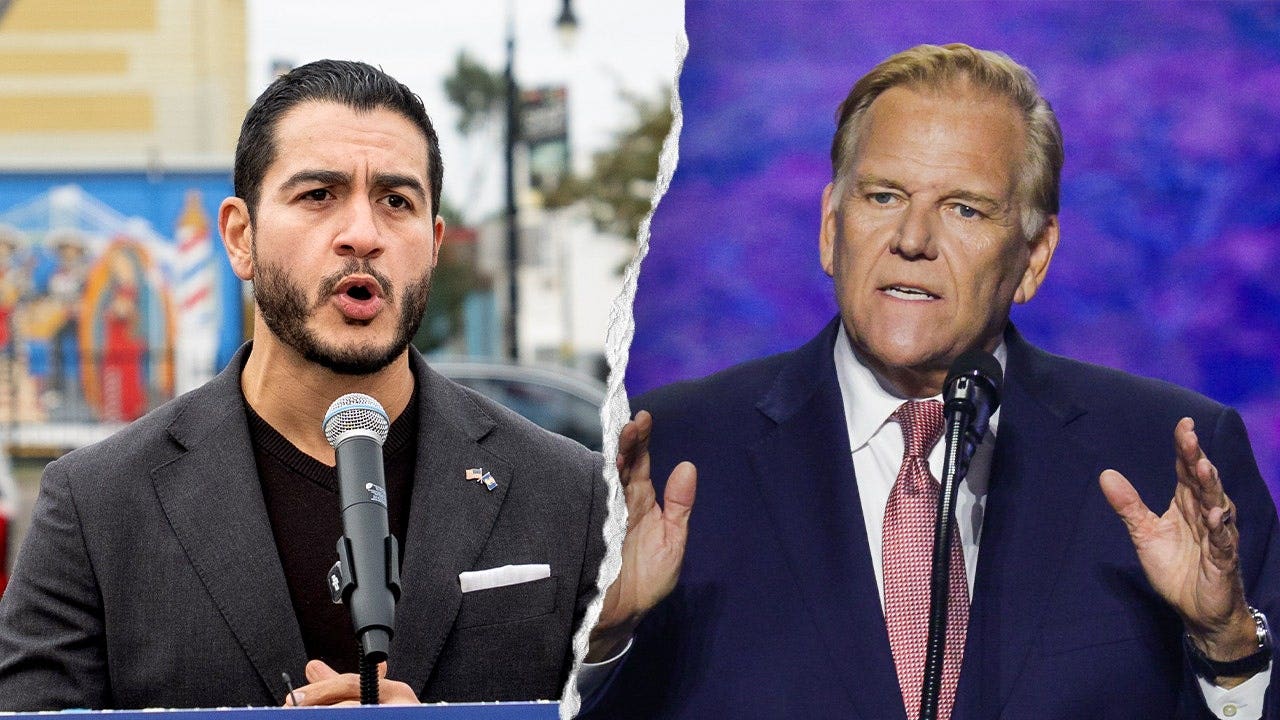
Michigan’s closely watched Senate race got ugly fast in Grand Rapids, where Mike Rogers and Abdul El-Sayed spent much of the night trading accusations instead of sticking to polite debate. The match-up ran through Israel, Iran, gas prices, Medicare-for-all, and claims about money and personal conduct, with both candidates trying to land the sharper blow while the moderator struggled to keep order.
The first sparks flew almost immediately when the conversation shifted from affordability to character. Rogers went after El-Sayed’s medical background and accused him of bending the truth, while El-Sayed hit back by painting Rogers as too cozy with corporate power.
“He’s lying. So, he lied about being a physician. He lied now about being an Egyptian citizen or not being an Egyptian citizen,” Rogers charged during one particularly heated exchange. “That’s a con man.”
El-Sayed, who holds a medical degree from Columbia University, brushed off the personal shots and tried to pull the discussion back to issues voters feel in their daily lives. He argued that Rogers was trying to make the debate about personality instead of the cost of living, especially gas and groceries.
“He wanted to make this about him or me. But the question is about you,” El-Sayed responded. “Can you afford your gas? Can you afford your groceries under this guy who’s going to rubber stamp everything Donald Trump tells him to rubber stamp?”
Money became another hot flash point, with El-Sayed accusing Rogers of cashing in after leaving Congress and pointing to claims about property and yacht ownership. Rogers denied owning a yacht and turned the spotlight back on El-Sayed, questioning his own investments and alleged overseas ties.
That back-and-forth set the tone for the evening, and even the moderator had to step in as the interruptions piled up. At one point, Rick Albin warned both candidates that they could not keep chasing every point with endless rebuttals.
“Look, here’s the situation. We’ve got dozens of questions we want to get to. You can’t litigate all of these with 14 different rebuttals,” Albin told the candidates. After a commercial break, he added that in three decades of moderating debates, he had never seen candidates keep arguing through the break like that.
Foreign policy brought some of the sharpest splits, especially on Israel and Iran. When asked about providing defensive weapons to Israel if it came under attack, El-Sayed said he would not support using taxpayer money to arm other countries, a stance Rogers treated as dangerously out of step.
“I don’t want our tax dollars buying weapons for other countries. I don’t know what’s so hard about that,” El-Sayed said. Rogers countered by stressing his support for Israel and by accusing El-Sayed of being linked to people and groups sympathetic to terrorist organizations, a charge El-Sayed rejected.
The two also clashed over whether the war involving Iran could be handled without dragging the United States deeper into another conflict. El-Sayed tied the fighting to higher fuel costs and said diplomacy could still work, even if Iran retained nuclear ambitions, while Rogers said Tehran’s capabilities had been weakened and insisted Iran must never get a nuclear weapon.
“I think both of them have proven dangerous in their own way. One at risk of attacking us, one getting us into wars. We have no business fighting,” El-Sayed said when pressed to choose which side posed the bigger danger. Rogers, meanwhile, warned that weakness abroad has real consequences at home and kept arguing that deterrence matters.
Gas prices were never far from the conversation, and El-Sayed even floated federal price controls on domestically produced oil, saying the situation had become an emergency. Rogers rejected that approach and pushed instead for temporary gas tax relief, diesel rebates, and a pause on diesel exports, framing his plan as more practical and less heavy-handed.
Healthcare turned into another clean split. El-Sayed defended Medicare-for-all and said people could keep private coverage if they wanted, while Rogers argued the proposal would crowd out private insurance and hit families with higher taxes.
The bitterness onstage reflected just how tight the race has become. A late-September Fox News poll showed El-Sayed leading Rogers 50% to 49% among likely voters, a margin so thin it barely registers as daylight.
Both men are fighting for the seat now held by retiring Democratic Sen. Gary Peters, and neither side can afford a sleepy night or a wasted line. Every answer seemed loaded, every pause felt tactical, and the tension in the room kept rising right alongside the stakes in Michigan.
