
Checklist: electric Mercedes expedition truck, world trip plan, 621-mile range target, charging strategy, self-contained living setup, electric motorcycle backup.
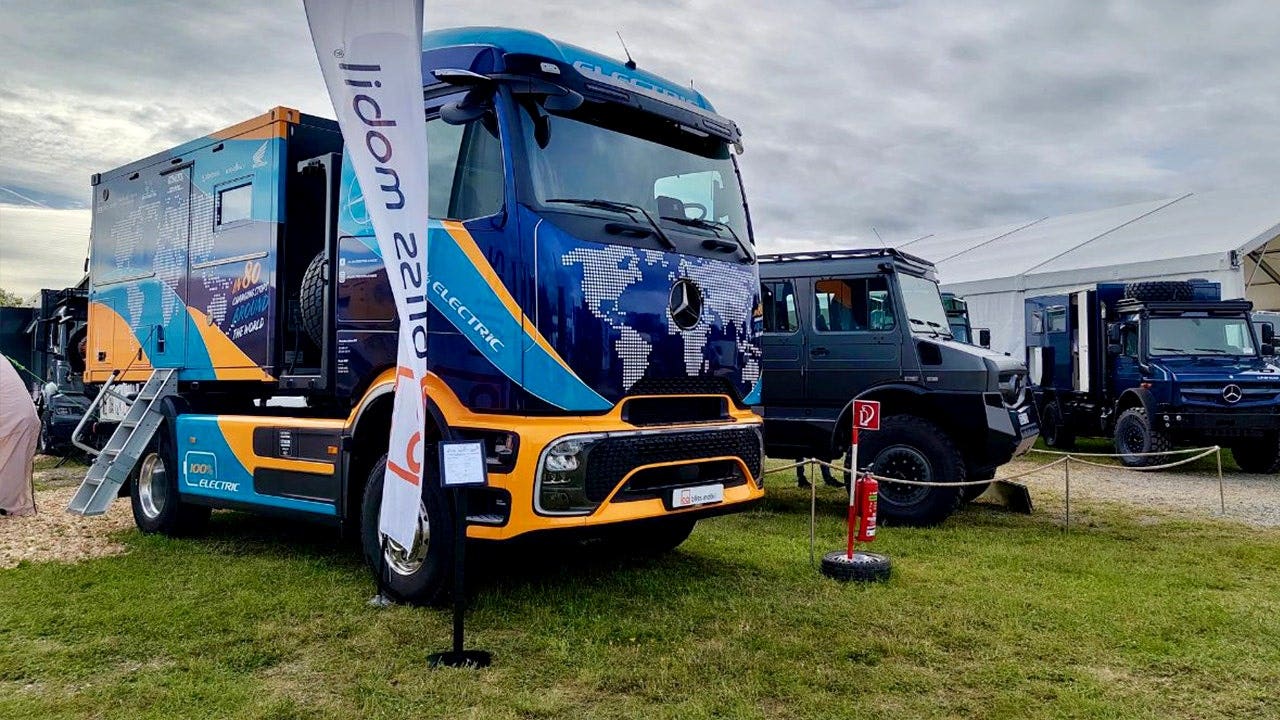
If a motorhome can cross continents without burning a drop of diesel, that turns heads fast. That is the promise behind a one-off Mercedes-Benz eActros 600 expedition rig built for Tobias Wagner, the German truck driver and creator known as Elektrotrucker. The machine is set up to function as both a long-haul hauler and a moving home, with a full living module mounted behind the cab and a plan to run the whole journey on battery power.
The route is no small stunt. Mercedes-Benz Trucks says the trip will stretch about 28,000 miles, pass through more than 30 countries, and take roughly a year, with the goal of keeping charging stops to 80 or fewer. If that sounds ambitious, it is, especially since the company says this would be the first known circumnavigation of the globe in a fully battery-electric truck.
At the core of the build is the eActros 600, a battery-electric long-haul truck designed for commercial freight. It carries three lithium iron phosphate battery packs with a combined installed capacity of 621 kWh, and Mercedes normally rates it for about 310 miles under demanding fully loaded test conditions.
Wagner’s version has a very different mission. Instead of hauling freight, it carries a custom expedition module, single rear tires, and other weight-saving tweaks that should help cut rolling resistance. The finished setup reportedly tops out around 34,170 pounds, which is still hefty, but not as punishing as a fully loaded freight configuration.
The big question is the range claim. Mercedes and Wagner believe the lighter camper-style setup, paired with careful driving, could stretch to as much as 621 miles on a single charge. That would be about double the truck’s standard long-haul figure, and it would need a lot to go right, from weather and terrain to speed and traffic.
That range matters because the trip is built around limited charging opportunities. Wagner wants to cover the globe with no more than 80 stops to recharge, which means some legs will have to be significantly longer than the kind of daily plug-in routine most EV drivers know. In parts of Central Asia, East Asia, Australia, the United States, and Latin America, finding fast truck charging can be tough, and that is where a long-range setup starts to look more like a necessity than a flex.
Recharging a battery this large is its own challenge. The eActros 600 supports CCS2 fast charging at up to 400 kW, and Mercedes says that can take the battery from 10% to 80% in about 70 minutes under the right conditions. The company has also shown Megawatt Charging System capability at up to 1,000 kW, which could dramatically reduce wait times when the hardware lines up.
To keep moving across different regions, the truck has been equipped with charging connections on both sides, plus adapters for China and North America. Wagner has also added his own Alpitronic DC charging station, giving him another option for situations where the public network falls short. That kind of flexibility could matter almost as much as the battery itself once the trip gets far from Europe.
Behind the cab, the Bliss Mobil module turns the truck into a proper living space. It includes a U-shaped dining area, a kitchen, a bathroom, and a drop-down bed that can sleep up to four people, though Wagner will mostly be sharing the space with his dog, Krümelix. It is the kind of setup that makes the rig feel less like a truck and more like a compact apartment rolling down the highway.
The camper side runs on its own 400-Ah lithium battery and 1,000 watts of solar power, which supports the induction cooktop, refrigerator, air conditioning, and other onboard gear. It also carries about 106 gallons of fresh water, along with a multistage filtration system to stretch supply between stops. The whole module is designed to operate largely on its own, though it can draw from the truck when needed through a 24-volt connection.
There is even a smaller electric backup for tight spots. A motorcycle carrier on the rear holds a Honda WN7 electric motorcycle, giving Wagner a way to continue when the truck simply is too big for the road ahead. That extra layer of mobility makes sense on a journey built to wander through places where size, access, and charging all become part of the adventure.
The price tag is just as eye-catching as the engineering. Mercedes says the truck, camper, and extra equipment add up to about $796,600 including tax, with the motorcycle not included in that figure. It is a wild number, but the real story is not luxury, it is testing how far today’s electric heavy-duty technology can be pushed when the route gets messy and the charger is never guaranteed to be around the corner.
Mercedes-Benz Trucks says the departure is planned for IAA Transportation 2026 in Hanover, Germany, on Sept. 20, and the route could still change as the journey unfolds. The trip will put weight, range, charging, and real-world endurance under a harsh spotlight, with every mile revealing something about what electric trucking can and cannot do. For a machine this big, the road ahead is going to be the real proving ground.
