
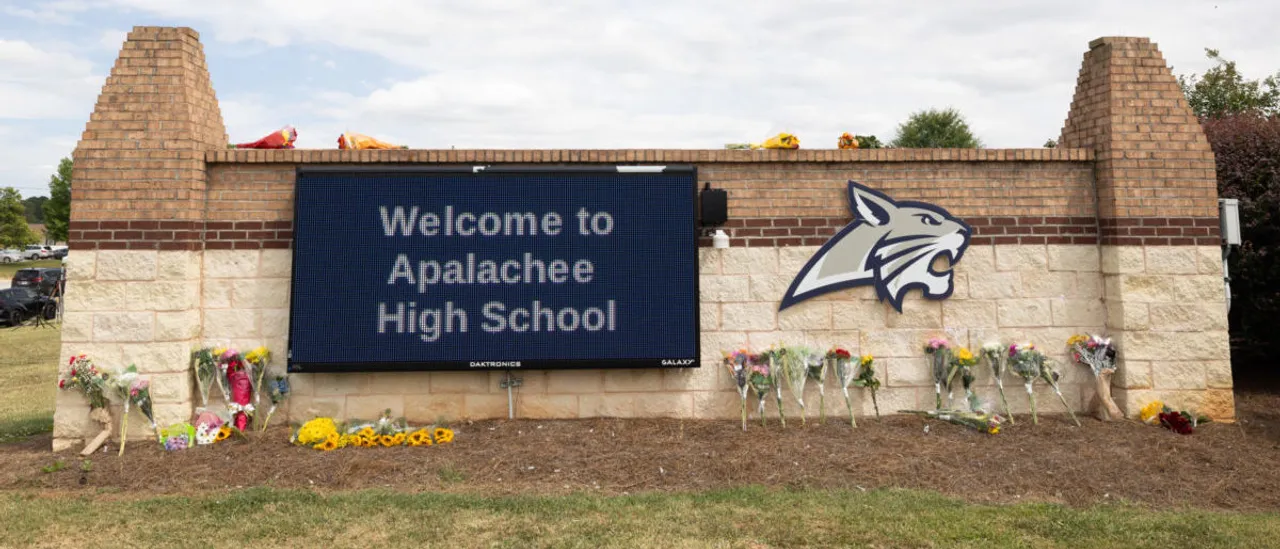
The father of a teenager accused in the deadly Apalachee High School shooting was convicted Tuesday on second-degree murder and cruelty-to-children charges after a jury concluded he allowed access to the AR-style rifle used in the attack. The case centers on what family members knew and when they tried to intervene, and it raises questions about parental responsibility, warning signs, and legal consequences. Sentencing has been deferred, and the community is still grappling with how a stored weapon became the instrument of a school shooting that left four people dead.
A jury found Colin Gray, 55, guilty of second-degree murder and cruelty to children after prosecutors said his son used an AR-style rifle kept at home to carry out the September 4, 2024 shooting at Apalachee High School. Authorities say the weapon was purchased and presented to the teenager as a Christmas gift in December 2023, and that Gray had custody and control over access to firearms in the household. Prosecutors argued the family had warning signs and that the father failed to act to prevent the violence.
Before the attack, the teen’s mother reportedly warned others and asked that her son’s access to guns be cut off, trying to head off a potential tragedy. Barrow County officials described the mother’s actions as an attempt to intervene after reviewing similar events elsewhere. Those efforts did not stop the shooting, and the jury ultimately held the father criminally responsible for enabling access to the weapon used in the crime.
“I think you saw in this case that the mother actually reviewed what happened in Michigan … and she then, as a result of that, asked her husband to remove the weapons,” Brad Smith said when reacting to the verdict. “It could have ended this tragedy. So Michigan was able to move the needle to the point that almost stopped this tragedy,” he said. “How many tragedies it did stop? We hope we move the needle a little further,” he continued.
The implications are severe: Gray faces dozens of felony counts that together carry a potential prison term measured in decades, and his sentencing will be determined at a later date. The legal theory pursued by prosecutors focuses on custody, access and the foreseeability of harm when a minor is allowed to touch or possess a high-powered firearm while showing troubling behavior. Defense teams typically press back that criminal liability for a parent in such cases must meet a high bar, but the jury sided with the prosecution’s view of responsibility in this instance.
Community reaction has been raw, with grief and anger mixed together as residents and families try to make sense of what happened. Schools and local leaders are revisiting emergency protocols and mental health resources, while debates continue about parental accountability and the role of the criminal justice system when families fail to act. For many, the hardest part is reconciling the idea of a parent as protector with the reality of a weapon kept in the home that was used to kill students and teachers.
Legal commentators note that this conviction follows a line of cases where parents were held responsible after a child carried out mass violence, and those precedents were part of the prosecutor’s narrative at trial. The similarity to earlier incidents in other states was emphasized by family members who tried to prevent another copycat outcome, and by prosecutors who argued those warnings should have prompted decisive action. The court’s verdict signals prosecutors and juries may be willing to attach criminal consequences to parental decisions in these high-profile tragedies.
As for the suspect, the teen remains in custody and his trial date is not yet set, leaving open the separate legal process that will determine his fate. The community remains focused on healing and on preventing further loss, while legal teams prepare for the complex appeals and motions that often follow convictions in emotionally charged cases. The full consequences, both legal and social, will continue to unfold as sentencing and any future proceedings move forward.
