
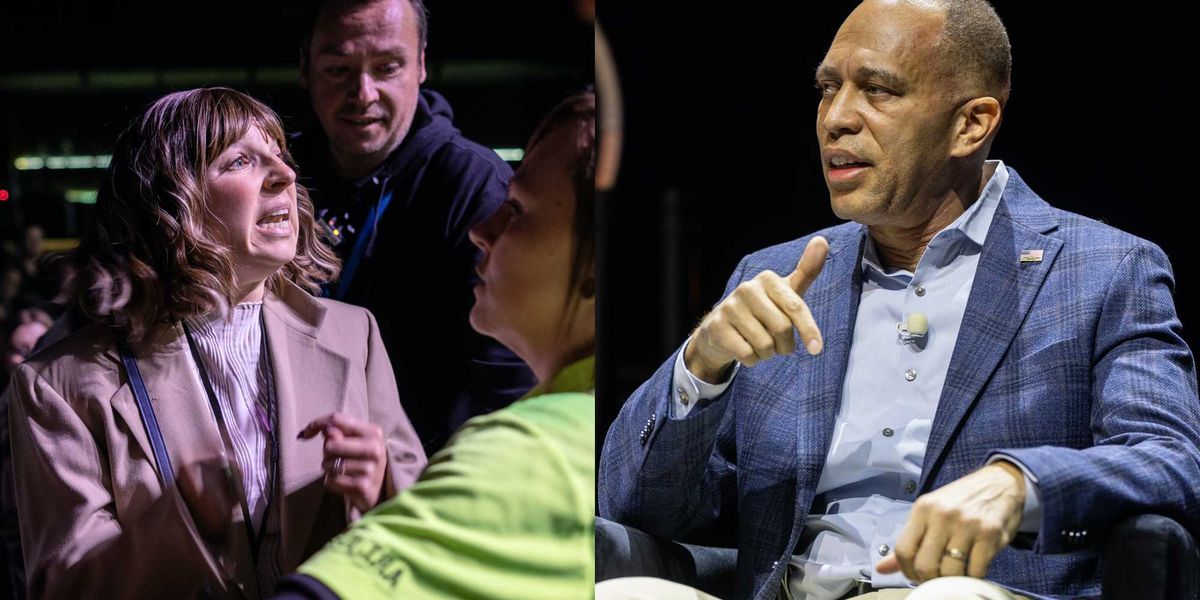
Democratic leadership walked into a room already buzzing with frustration, and it did not take long for the mood to turn ugly. Hakeem Jeffries found himself at the center of a hostile scene after being confronted by angry left-wing attendees at a Democrat conference, where the room’s tension spilled out in a way that was impossible to miss.
What should have been a routine appearance instead became a loud reminder that the party’s internal divide is getting harder to hide. The heckling, the profanity, and the open anger all pointed to a deeper problem that goes beyond one speech or one politician.
Jeffries was interrupted by protesters who made clear they were not interested in polite disagreement. One person shouted, “You’re a f***ing traitor,” a line that captured just how raw the frustration had become inside the gathering.
The moment landed hard because it exposed a split that Democrats keep trying to paper over. On one side are the party elites who want discipline, messaging, and control, while on the other are activists and hard-left voices who seem increasingly fed up with being told to wait their turn.
That kind of blowup rarely comes out of nowhere. It usually builds after months of disappointment, blurred promises, and a growing sense that the people at the top are not listening to the base that got them there in the first place.
James Talarico was also part of the political backdrop surrounding the event, adding another layer to the already tense atmosphere. The broader scene reflected a party trying to hold itself together while factions pull in different directions, each convinced the others are dragging the whole operation off course.
For Democrats, the awkward part is not that disagreement exists. Every major party deals with internal fights, but this one keeps becoming public, loud, and messy, which makes it harder to pretend everything is under control.
Jeffries has often been presented as someone meant to steady the ship, but moments like this show how rough the waters really are. When a party leader cannot even make it through an appearance without being shouted down by his own side, the problem is bigger than one hostile audience.
The fallout from scenes like this tends to linger because they tell voters something simple and blunt. If a party cannot keep its own activists aligned in a room full of cameras and tension, convincing the public it has a clear path forward gets a lot tougher.
That is the kind of image Democrats would rather avoid, especially when frustration is already running high across the political map. Instead, the conference turned into another snapshot of a party stuck between its leadership and its loudest critics, with neither side looking eager to back down.
