
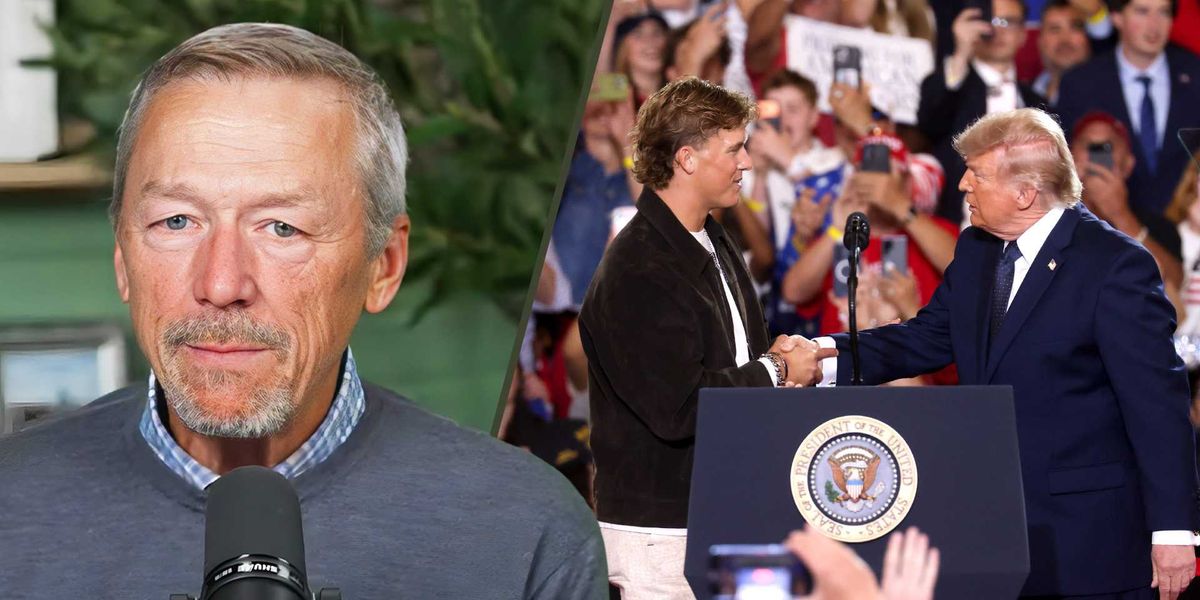
Jaxson Dart, a New York Giants quarterback, stepped up to introduce President Donald Trump at a rally, and the moment exposed the predictable divide between celebrity endorsements and media reaction. BlazeTV commentator Ron Simmons called out the double standard, while hosts from The View attacked the choice and questioned the motives and character of anyone who supports Trump. The exchange highlights how athlete endorsements are treated differently depending on politics and how quick some on TV are to label dissenters with heavy accusations.
At the rally, Dart addressed the crowd with a clear and respectful introduction, saying, “What an honor, what a privilege it is to be here. And without further ado, I’m grateful, I’m honored, I’m pleasured to introduce the 45th and 47th president of the United States of America, President Donald J. Trump.” The line landed in a simple way: a public figure showing support for a candidate, nothing theatrical, just straightforward backing. That kind of public political expression from athletes has become more visible lately, and not always for controversial reasons.
Ron Simmons, hosting on BlazeTV’s “Relatable,” pointed out that athletes and celebrities often introduce and endorse politicians, particularly on the left, without facing the same outrage. “Athletes and celebrities do this all the time. They do it all the time,” he observed, noting the double standard when the roles are reversed. His take was that this should be seen as normal civic participation, not an invitation to personal attacks.
Not everyone saw it that way. On The View, Joy Behar framed the act as something more sinister, referencing a long history she associates with President Trump. She said, “For somebody to back a guy like Trump, whose history in discrimination and racism goes back to housing discrimination in the ’70s; DEI attacks and posting pictures of the Obamas as apes when he’s on a team that’s 55% to 60%, the NFL, is that many people, that much percentage of black people.” Those are sharp words that tie an athlete’s endorsement to a much larger and older narrative.
Behar added, “That is just the definition of stupidity and racist in my opinion,” a blunt condemnation that leaves little room for nuance. Comments like that reduce a complex personal choice to a moral judgment, and they reflect a media instinct to conflate individual actions with institutional guilt. When a media personality uses such sweeping language, it invites pushback rather than dialogue.
Simmons didn’t just let the line slide. He joked, “I don’t think Joy Behar has any joy. She might want to change her first name,” and asked a pointed question directly aimed at the panel’s assumptions: “Do they believe every person of color hates Trump? Do they believe that? Is that what they really believe?” Those questions force the conversation back to common sense and challenge the idea that political support can be reduced to group identity alone.
The moment underscores how polarized public reactions have become whenever athletes step into politics. Some see it as an honest expression from a public figure; others immediately label it as proof of deeper biases. Either way, the gut reaction from different media corners shows how little ground there is for calm discussion when celebrity endorsements cross into charged political territory.
What these exchanges reveal is not just the split on the field of public opinion, but how media framing can turn a brief introduction into a headline about character. For those who support free speech in civic life, a player saying a few sentences at a rally should be unremarkable. For critics who see symbolism everywhere, it becomes a provocation demanding moral condemnation.
At the end of the day, the short exchange between an athlete, a president, and television hosts turned into a reminder: partisan reactions will color nearly any public move, and the conversation about athletes in politics is far from settled. The quick blowback from certain media figures shows how high emotions run when politics and celebrity intersect, and why these moments keep drawing attention.
