
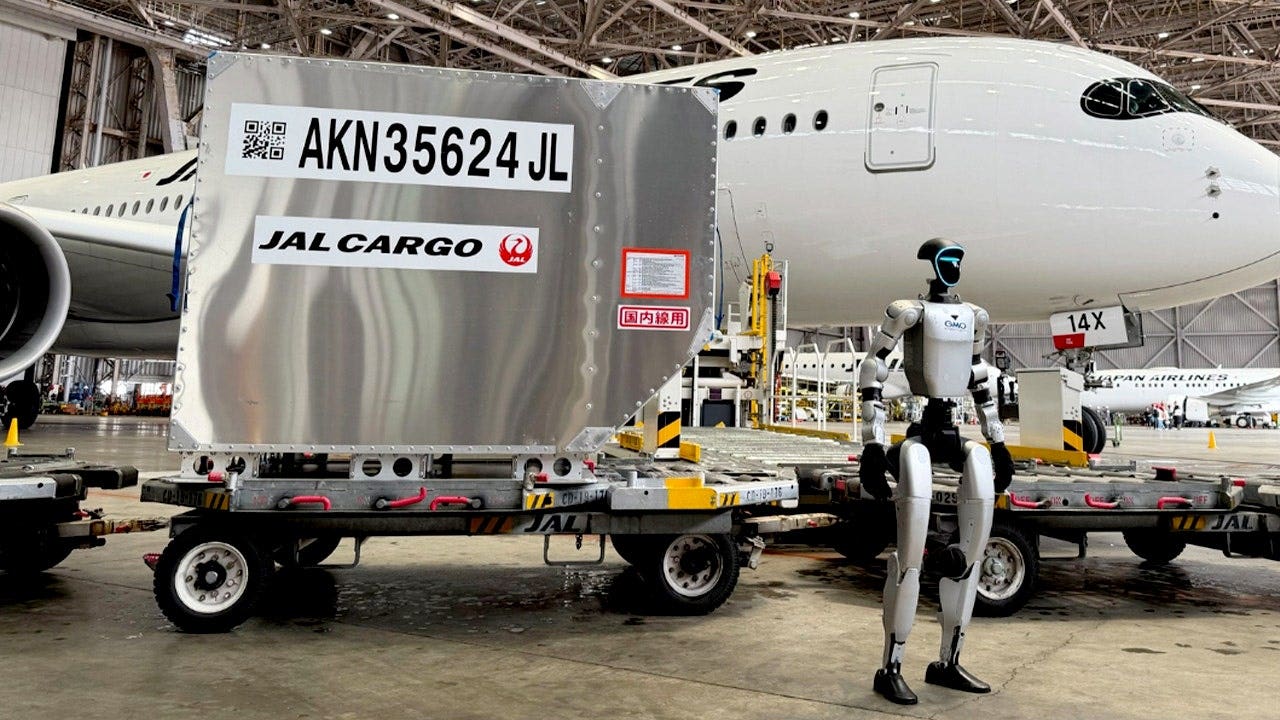
Airports are starting to test humanoid robots on the tarmac to help with baggage and cargo, a trial led by Japan Airlines and a robotics division of a tech group at Haneda Airport that aims to ease labor shortages, lift heavy work off crews, and refine how human workers and machines coordinate in real airport conditions.
Modern air travel already feels automated in parts, but the hard, physical jobs on the ground remain human-heavy and exhausting. At Haneda, engineers and ground teams are running real-world tests to see whether humanoid machines can slot into existing workflows without massive infrastructure changes. The goal is straightforward: relieve strain on workers while keeping operations smooth and safe.
Japan Airlines partnered with GMO AI & Robotics to trial these machines where the action happens—on the tarmac and at cargo transfer points. The idea is not to replace people overnight but to find repetitive, heavy tasks robots can take on so human staff can focus on oversight and decisions. Trials like this give airlines a chance to spot safety gaps early and shape how robots are used.
AI ROBOT NOW HELPS TRAVELERS AT SAN JOSÉ AIRPORT
The devices being tested include compact humanoid models from Unitree Robotics, such as the G1, built to move through tight spaces and handle luggage-like loads. It stands a bit over four feet tall and folds for storage, which matters on crowded ramps and in cramped service corridors. Built-in sensors like 3D LiDAR and depth cameras let the robot perceive obstacles, detect humans, and navigate uneven ground.
Sensors are only one piece of the puzzle; training in virtual environments is crucial before any metal hits the real world. Engineers use simulators to rehearse thousands of scenarios, letting robots learn motion patterns and responses without risk. That Sim2Real pipeline, often supported by industry tools, reduces surprises when the robot moves from practice to actual ramp work.
HUMANOID ROBOTS HIT MASS PRODUCTION IN CHINA
Demonstrations have shown robots pushing cargo onto conveyors and signaling nearby workers, proof of concept for cooperative tasks that require timing and human awareness. Those interactions are small but important: they show a path where machines assist, not act alone. The emphasis in tests is clear—evaluate how robots can safely augment crews, not run independently in chaotic zones.
Airlines are clear about where automation fits: repetitive, heavy, or ergonomically risky tasks are prime candidates. That includes moving baggage, shifting cargo, and handling service equipment—jobs that cause injuries and strain over time. As robots mature, roles could expand to cleaning, basic equipment operation, or other support functions that free staff for more complex decisions.
JOB-KILLING ROBOT LEARNS AT WORK, AND IT’S COMING TO THE FACTORY FLOOR
Even with promising tech, humans still carry the most sensitive responsibilities because airports are dynamic and unpredictable. People manage airside safety, react to sudden problems, and coordinate many moving parts that are hard to script. For now, trials prioritize cooperation and worker supervision, with staff shifting toward robot management and decision-making as the technology proves itself.
Japan’s phased trial is scheduled through 2028, letting airlines test performance over seasons and busy travel spikes. If results are strong, similar systems could appear in airports beyond Japan, potentially easing peak-period bottlenecks and cutting injury risks. The real verdict will come when people and machines have to perform together under pressure, minute by minute, flight by flight.
