
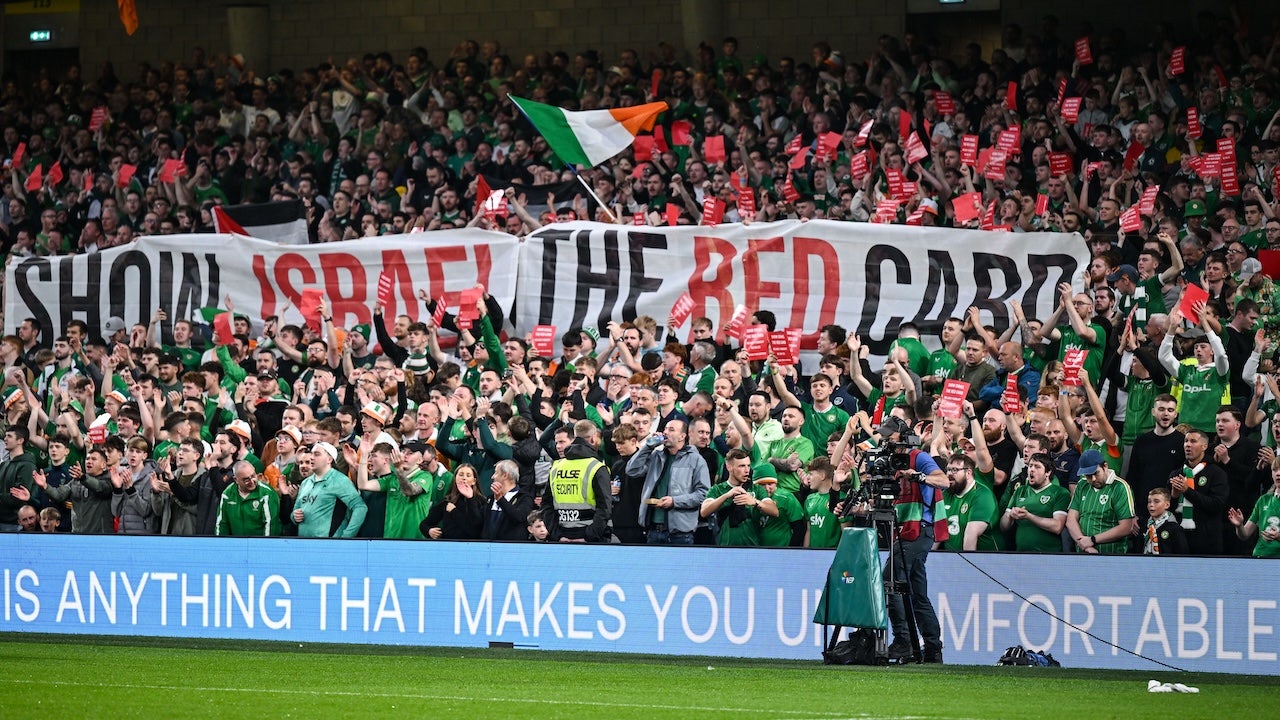
Ireland’s public life has become tangled up in a hard-edged hostility toward Israel, and the recent soccer fallout only threw a bright light on it. What should have been a routine sporting event instead turned into a loud display of outrage, political theater, and cultural posturing. The result is a country that looks less like the welcoming place it once projected and more like a stage for obsessive anti-Israel sentiment.
The anger around the UEFA Nations League matchup was immediate and intense. Before the game even took place, activists, commentators, athletes, and politicians piled on, pushing calls to stop the match and framing contact with Israeli players as some kind of moral contamination. The whole spectacle had a feverish edge to it, with Dublin’s loudest voices acting as if a soccer field had become a battlefield.
What made the episode so jarring was how widely the mood spread. Fans gathered outside the Irish team’s hotel, protests built pressure around the fixture, and the match eventually had to be moved behind closed doors in Hungary for security reasons. Even then, the behavior inside the stadium told its own story, from the refusal to shake hands to the black armbands and the deliberate show of contempt during the Israeli anthem.
That kind of conduct does not come out of nowhere. Ireland’s media landscape has spent months treating the Israel-Gaza conflict as its favorite obsession, and political language has followed the same path. Israel is not being discussed with balance or even much restraint, but with a kind of emotional saturation that leaves little room for nuance or ordinary human decency.
The cultural side of this is no better. Public figures, writers, musicians, and commentators have turned anti-Israel language into a badge of moral purity, as though the louder the condemnation, the cleaner the conscience. In that atmosphere, criticism no longer sounds like criticism. It starts to feel like a club, with membership granted to whoever can condemn Israel the hardest.
That fixation has also pushed Ireland into some ugly territory. When political leaders and media voices start tossing around language that compares Israel to Nazi-era evil or treats the Jewish state as uniquely monstrous, the line between critique and prejudice gets crossed fast. It is one thing to argue over policy. It is another to build a public mood that treats Jews, Zionism, and Israel as interchangeable targets.
The numbers make the obsession hard to ignore. Israel is far away, there are only a few thousand Jews in Ireland, and yet the country’s public debate keeps circling back to this same subject as if nothing else matters. When a small nation becomes the center of so much anger from a place with almost no direct stake in the conflict, the energy behind it starts to look less political and more emotional, even tribal.
That helps explain why this hostility feels so out of proportion. The old Ireland was associated with hospitality, warmth, and a certain easy generosity toward outsiders. Today, too many of its elites seem eager to prove their moral seriousness by turning Israel into the villain of every script, while pretending that this has nothing to do with something older and darker.
The deeper problem is that a lot of this anger seems to fill a vacuum. As older religious authority faded, the search for a replacement moral framework did not create clarity, it created a hunger for new absolutes. For some in Ireland, Israel has become the substitute target, the place where all their certainty, righteousness, and grievance can land at once.
That is why the soccer incident mattered so much. It was not just about a game, and it was not just about one protest. It exposed a wider mood in which hatred has been dressed up as virtue, and in which the loudest public voices have decided that hostility toward Israel is the easiest way to look principled. The danger is not only to Jewish life, but to the country’s own sense of proportion, honesty, and self-respect.
