
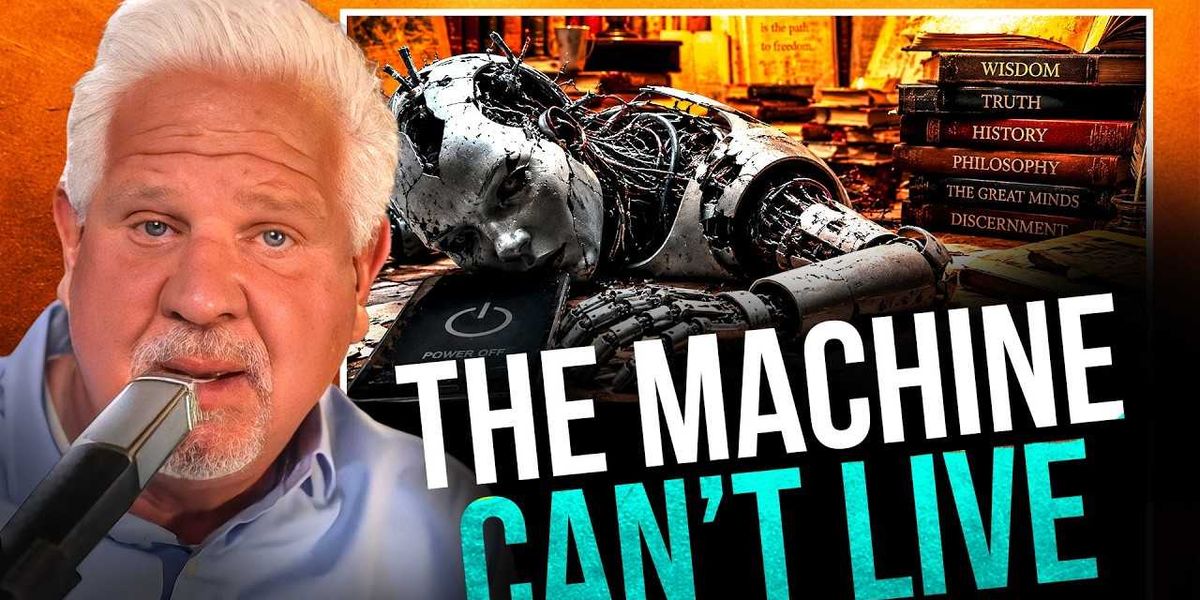
Glenn Beck pushes back against a culture selling despair, urging young people to hold onto purpose and not surrender their reasons for living to panic, products, or machines. He argues that while life has real weight, the narrative of hopelessness is manufactured, and he frames artificial intelligence as a tool that can never replace the human soul and the reasons that get us out of bed.
Young people are surrounded by a steady drumbeat that life today is uniquely terrible, and Glenn Beck calls that drum a marketing campaign. He warns that voices profiting from fear try to convince you that existence itself is an unbearable burden. His message is simple: acknowledge the struggle, but refuse the sales pitch that turns hardship into hopelessness.
“I think for a lot of you, there is this quiet voice that has been whispering to you for a while now. And it says the world’s broken and somebody’s handing it to me, and I don’t know what to do,” he says. That whisper can feel like truth when you’re overloaded with bad news, but Beck wants listeners to separate the noise from the reality they can act on. He treats that whisper as a starting point, not a destination.
“Let me start with the hard truth here. Life is hard. It is. It’s just not as hard as people profiting from your panic need you to believe. Okay? It’s not. The hardness is real. The hopelessness is a product. Don’t buy in to that. There’s an entire industry whose only job is to convince you that just being alive right now is the heaviest thing a human has ever carried,” he continues. He doesn’t deny pain, but he rejects the idea that pain must be converted into permanent despair for someone else’s gain. That distinction matters, and it’s the core of his argument.
“The weight is real, but the despair is a sales pitch,” he adds. Those words land because they redraw the battlefield: weight is part of life, despair is a marketed commodity. Once you see despair as a product, you can refuse to be its customer and start looking for practical ways to move forward instead of lying down under the headline of hopelessness.
Artificial intelligence looms large in the anxieties of many young people, and Beck addresses that fear head-on by separating function from being. He points out the impressive abilities of modern tech but insists those abilities are not the same as human life. The conversation turns to what computers do well and what they can never replicate.
“The machine that we have right now, in your pocket, that can read every book ever written, but it has never once been afraid of the dark. It can know everything and understand nothing. It will know more about you by Tuesday. Yet it will never really know what it’s like to be you,” he says. Beck uses that contrast to remind listeners that intimate, interior experience is not a data point for an algorithm. A machine can predict behavior, not inhabit a heart.
“And that’s not your weakness. That’s the entire point of you. It has all of the answers, but not a single reason to get out of bed. You have all of the reasons. You may not have the answers, but you have the reasons. Don’t trade those away,” he continues. This is a direct appeal to value the motives and attachments that define a life, even when technology can outpace us at tasks and facts.
“Don’t confuse the two, and don’t worship either one of them,” he says, before pointing out that human beings were created by God — and AI was not. Beck pivots from the secular realm of data and devices to a spiritual claim about origin and intention, asking listeners to anchor their worth in something beyond algorithms. That move reframes anxiety as something that can be met with faith and purpose, not surrendered to novelty or panic.
“A universe of cold math does not produce a soul that weeps at music by accident. You were made. And you were made on purpose. You, not just man — you,” he continues. “And somewhere underneath all that noise, purpose is still waiting for you to get quiet enough to hear it. I’m telling you: You will find it.” Those sentences are an insistence that meaning exists and that a person can discover it by stepping away from the commerce of fear and toward stillness and intention.
The practical takeaway is straightforward: listen to the hard truths without buying the hopeless narrative that turns struggle into industry. Hold fast to the reasons that move you, question the markets built on panic, and remember that tools are tools — they do not replace the human story. Beck’s appeal is to reclaim agency and to resist the idea that modern life has no purpose left to discover.
