
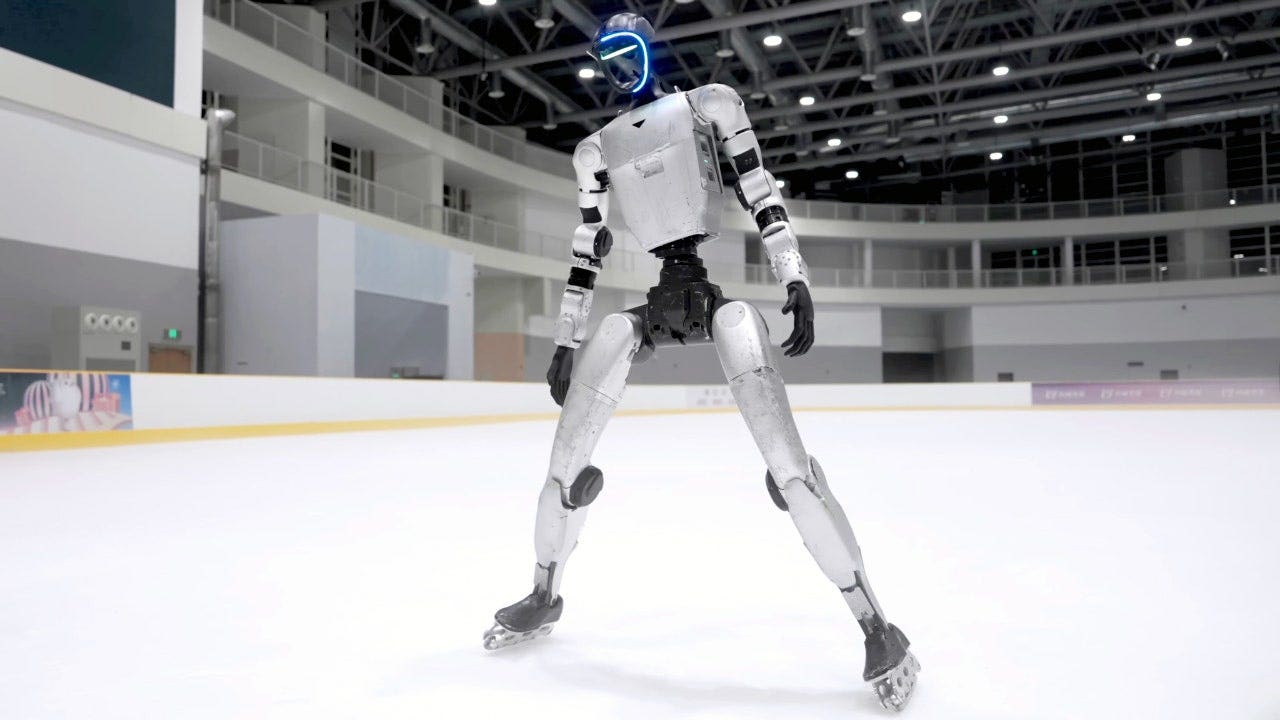
The new Unitree G1 humanoid stunned viewers by skating, spinning and even flipping while staying balanced on wheels, Rollerblades and ice, showcasing a hybrid wheel-and-leg architecture and stronger real-time control. This article walks through the standout moments, the hardware and software that make the feats possible, and the practical implications for robots moving beyond stop-and-go motion. The focus is on how a blended mobility approach changes what robots can do in real spaces today.
Watch the footage and the first impression is pure disbelief. The G1 leans into motion like a skater, shifting weight from side to side while two wheels handle propulsion. Its arm movements aren’t decorative; they’re active balance tools, giving the machine a rhythm that reads as deliberate and humanlike.
Moments later the robot executes spins and a clean flip, landing on its wheels and continuing forward without pause. Those transitions—spin, flip, roll—happen in sequence with no visible hesitation. That continuous motion is the kind of fluidity robotics teams have chased for years.
Switching to Rollerblades, the robot performs the same controlled choreography: glides, direction changes and single-leg spins that stay upright. The trick isn’t showmanship alone; it’s precise coordination between wheel dynamics and joint-level control. That coordination turns rolling into a native mode of movement rather than a fallback.
The finale on ice is the most revealing. The G1 twirls with steady posture and minimal slip, demonstrating that balance systems can translate across radically different contact surfaces. Ice skating poses unique friction challenges and the robot’s success there points to robust sensor fusion and fast corrective algorithms. It’s a practical demonstration that motion planning is getting much better at handling low-friction environments.
At the core of this capability is a hybrid design philosophy. Wheels bring energy efficiency and speed while articulated limbs provide adaptability when terrain or tasks demand it. Stitching those two worlds together requires more than mechanical cleverness; it needs high-bandwidth sensing, prediction and control loops that operate in real time.
Unitree’s platform reportedly collects data, learns in simulation and fine-tunes behavior in the real world, which accelerates how quickly new skills emerge. The Flagship variant adds a wheeled base capable of notable speeds, and both versions keep a humanoid frame for manipulation tasks. That layout supports moving across floors quickly, then switching to precise interactions at a workstation without losing momentum.
Mechanically, the G1 packs up to 19 degrees of freedom with seven degrees in each arm, offering a wide envelope for balance adjustments and object handling. Wrist cameras and a head binocular camera provide layered vision for both navigation and close-up work. The result is a system that can perceive where it is and what to do next without constant human babysitting.
Compute plays a major role. Onboard processing strong enough for real-time inference lets the robot decide and react locally rather than always relying on a remote server. That latency advantage shows up as smoother balance corrections and more confident maneuvers during dynamic movement. Longer battery runtimes make sustained tasks feasible in real environments.
Hybrid mobility also changes maintenance and wear considerations. Using wheels for long transits reduces joint stress and saves energy, while legs and arms handle complexity when needed. For facilities that mix flat corridors with cluttered workstations, that combination could cut operating costs and extend component life.
The potential applications are obvious and practical: warehouses that need speed and dexterity, delivery units that must traverse mixed surfaces, and service robots that can move quickly between stations while performing precise tasks. This kind of versatility shortens task cycles and lets a single platform cover roles that previously required multiple specialized robots.
Human-robot interaction will be the next hurdle. When robots move with this kind of confidence in shared spaces, safety protocols and behavioral norms become essential. Designers must ensure predictable motion patterns and clear signaling so people can anticipate robot behavior and coexist safely.
What we’re seeing is less about gimmicks and more about a shift in capability: motion that is continuous, reactive and efficient. The G1’s demo highlights how tighter integration of locomotion modes unlocks new real-world roles for humanoid platforms without sacrificing stability. As these systems mature, expect them to appear more often in places where movement and manipulation need to happen in the same continuous workflow.

1 Comment
Humans will become obsolete as robots replace US in manufacturing and building machines and homes.