
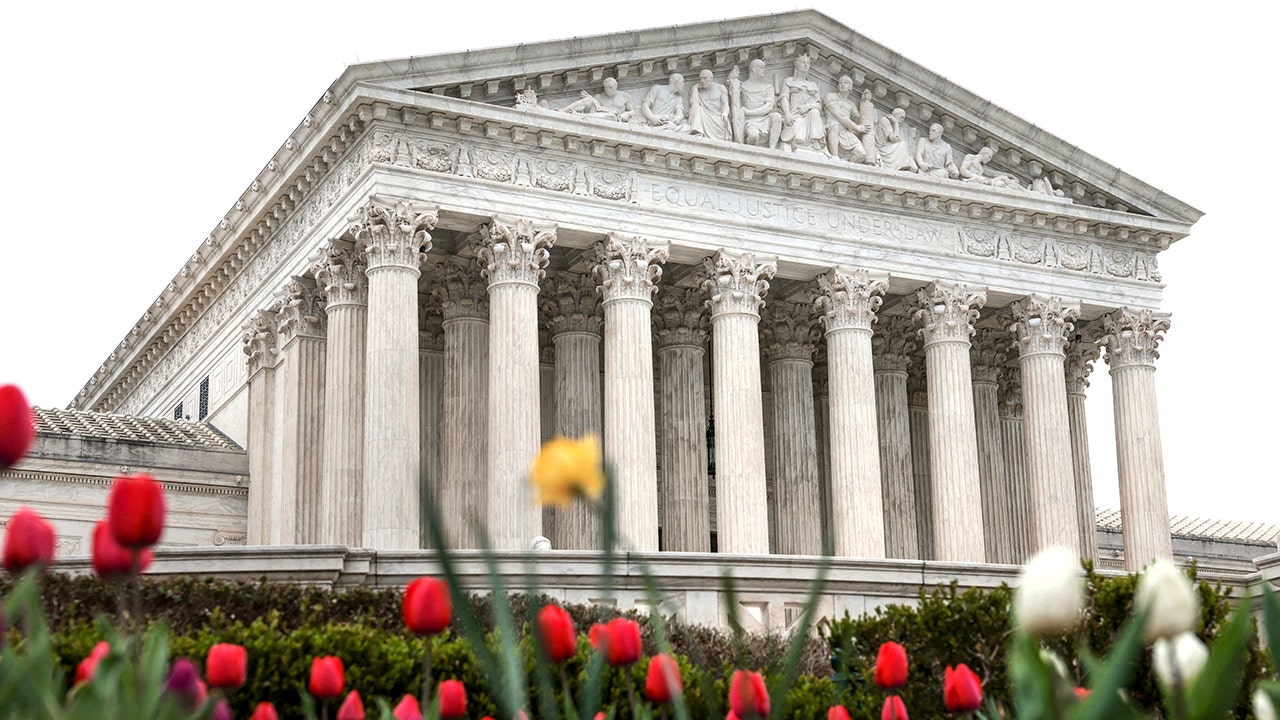
Republicans are sounding the alarm: Democrats want to break the Senate filibuster and expand the Supreme Court, and that plan would upend constitutional stability. This piece lays out why court-packing is a threat to “due process of law”, how historical practice and recent Senate maneuvers matter, and what conservatives should do to stop a radical rewrite of the judiciary. The core argument is simple — preserve the filibuster, keep the court at nine, and defend the rule of law.
Democratic talk of enlarging the court aims to lock in a permanent policy majority, not to fix a broken system. President Joe Biden signaled support for expansion, and figures like Senator Ed Markey have championed increasing justices to 14. That kind of move would change the judiciary into a political arm for whoever controls Congress and the White House.
Justice Ketanji Brown Jackson has become a focal point of this fight, both for her judicial approach and for how she is viewed by critics. She was noted for speaking more from the bench than any other justice in a recent term, with “78,215 words from the bench” recorded in one tally. Whether you view that as vigor or overreach, the larger worry is turning the court into a predictable voting bloc.
TRUMP BLASTS KETANJI BROWN JACKSON AS ‘LOW IQ PERSON’ IN SUPREME COURT TIRADE The headline reflected a fierce partisan reaction that only underscores how heated this debate has become. Heated rhetoric does not change the constitutional stakes, but it does signal how polarized confirmation fights and potential expansions would be.
History shows Congress has adjusted the number of justices in the past, but modern practice settled on nine with the Judiciary Act of 1869. That moment followed the 14th Amendment’s ratification in 1868, which paired its guarantee of “due process of law” with the Fifth Amendment’s similar protection. Changing long-settled institutional arrangements for short-term political gain would break an important consensus Americans have relied on for generations.
JUSTICE THOMAS WARNS PROGRESSIVISM IS A THREAT TO AMERICA IN RARE PUBLIC REMARKS Comments like Justice Thomas’s reflect a real legal and cultural tug-of-war within the judiciary. Those concerns are not abstract: packing the court would make precedent vulnerable to rapid reversal and turn lifetime judicial independence into a political contest.
Court-packing is not merely partisan maneuvers; it is a direct threat to the rule of law and to the public’s trust in impartial justice. Add five ideologically aligned justices and you convert the judiciary into what the critics call “the Fourteen” — a majority stacked to enforce a political agenda from the bench. Once that tactic is normalized, there is no clean way to prevent retaliation when power shifts.
Senate precedents already show how fragile norms can be. The “nuclear option” eliminated a filibuster for certain judicial confirmations in 2013, and later majorities used similar tactics to confirm Supreme Court nominees with bare majorities. Those moves produced immediate political consequences and a cycle of escalation that the country should avoid repeating on a larger scale.
WHY JUSTICE JACKSON IS A FISH OUT OF WATER ON THE SUPREME COURT That critique, offered by opponents, signals deeper discomfort about jurisprudential fit and institutional balance. Whether or not you agree with that take, it points to the larger problem: court composition matters and voters respond when they think a branch is being weaponized.
There are real legal hurdles to challenging a court-expansion law, including whether anyone has standing and whether a claim would be ripe for adjudication. Plaintiffs must show a “concrete and particularized” injury traceable to the expansion and likely redressable by the courts. Those requirements make litigation a shaky safeguard against a political restructuring of the judiciary.
DEM SENATE CANDIDATE CALLS TO ‘SHUT THE WHITE HOUSE DOWN,’ IMPEACH 2 SUPREME COURT JUSTICES Rhetoric like this illustrates the escalating tactics some on the left consider acceptable when they see a path to power. For Republicans, the practical response is clear: defend the legislative filibuster, protect the court at nine members, and make the constitutional argument forcefully in public and in the Senate.
If conservatives want to preserve judicial stability and protect “due process of law”, they need to lead with principle and strategy. The filibuster is the most immediate firewall against court-packing and should be defended on the Senate floor and in the court of public opinion. Fighting now, before rules are broken and precedent shredded, is the responsible course for those who believe in constitutional government.

3 Comments
I’ve given much thought and prayer to all of these facts you bring out now and over time but I’ve come to the conclusion that things have been allowed to slide and sink into such a deep evil quagmire of ugliness and destruction because either the old “passing the buck” went full tilt into total all out greed or these people have literally sold their souls and are owned by Satan. So much changed in America all the way back in 1913 when the Federal Reserve was created by some of the most diabolical filthy rich elites, and that got coupled with a most diabolical anti-God and human ideology which was spawned and founded just previously by Karl Marx (who openly worshiped Satan and talked his own two daughters into committing suicide) he and Friedrich Engels, who both developed its core principles and published “The Communist Manifesto” in 1848 which was then able to flourish during the Industrial Revolution, as the stage was being set for the future of totalitarianism and the prophesied future arrival of the the Antichrist with the Globalist Beast System!
Look what communism has done to whatever countries its been manifested in as for example Communist China, or then spreading into Southeast Asia, as in “Cambodia when Pol Pot the leader of the Khmer Rouge from 1975 to 1979, when he was responsible for the deaths of approximately 1.5 to 2.8 million people, through executions, forced labor, and starvation. His regime aimed to create an agrarian socialist society, leading to one of the worst genocides in history.” As you know they called it the Killing Fields during the Viet Nam War Era and I say these subhuman devils we mention that now infest America, even our government; would not hesitate to bring those same techniques of total control here to our beloved former Constitutional Republic of the People the first chance they get to seize total control; which they’ve been pushing to do for decades now!
That Globalist shill Spanberger in Virginia is pushing that agenda for sure with changing or redistricting the voting landscape there as is also happening in many other states throughout, even as I’ve read in Texas from some reliable data I’ve come upon! How else but by an evil full blown greed and hate of what’s good or right can this be happening; and what’s very telling is how Spanberger came from within the ranks of the FBI!!! All I see in her is a witch from hell, and who is owned by the father of all lies! Soros is pure evil and should have been executed many decades ago but somehow remained untouchable; but now sorry to say that old almost silly adage at one time used jokingly; “money talks and bullshit walks” is now a reality for sure in America! You know how they say “everybody has a price” or for these power mongers its “name your price,” as they seem to buy just about anyone! It sure looks to me like the human race has arrived at this prophesied point mentioned in Scriptures that speaks to End Time!
Isaiah 5:19-21 to those who say, “Let Him hurry and hasten His work so that we may see it! Let the plan of the Holy One of Israel come so that we may know it! 20Woe to those who call evil good and good evil, who turn darkness to light and light to darkness, who replace bitter with sweet and sweet with bitter. 21Woe to those who are wise in their own eyes and clever in their own sight.”
And here isn’t this pointing out exactly what we are saying!
2 Timothy 3:1-4 “But understand this: In the last days terrible times will come. 2For men will be lovers of themselves, lovers of money, boastful, arrogant, abusive, disobedient to their parents, ungrateful, unholy, 3unloving, unforgiving, slanderous, without self-control, brutal, without love of good, 4traitorous, reckless, conceited, lovers of pleasure rather than lovers of God,…”
All so true and to the point Michael! The Muslims worship Satan and Muhammad admitted when in the desert who he actually spoke to was Satan, so they and the Hindi’s from India all worship false god’s or Satan and that is a blaspheme to God Almighty starting with the Ten Commandments; with this brief explanation.
“The first commandment, often understood as “You shall have no other gods before Me,” holds profound significance in the Christian faith. Found in Exodus 20:3 and Deuteronomy 5:7, this commandment goes beyond a simple prohibition against idolatry; it encapsulates fundamental principles about the nature of God, the relationship between God and humanity, and the ethical implications for believers.”
Historical and Cultural Context
The Revelation at Sinai
“The Ten Commandments, including the first commandment, were given to God’s people at Mount Sinai following their liberation from slavery in Egypt. This pivotal event is recounted in Exodus 19-20 and Deuteronomy 5, where God establishes the covenant with His chosen people. The commandments were a moral and spiritual framework for God’s children, setting them apart as a holy nation dedicated to the worship and service of Yahweh alone.” ://bibleask.org/what-does-the-first-commandment-mean/
I’m sure most of you already know most of this but I repeat that Islam is nothing but a political ideology to conquer and destroy! Muslims await not Jesus Christ but rather their so called Mahdi who will appear on earth and lead them all to conquer all infidels and destroy them! These Muslims and Hindi’s are nothing but terrible invaders who have been allowed to attack and ruin America from within as they’ve been sent to do that by the Devil himself!
If you will take the time read here further explanation of the truth about Muhammad.
From an Islamic perspective, Deuteronomy 18:20 is unassailable and Deuteronomy 18:20 gives us two criteria for spotting a false prophet. If someone speaks in the names of other gods, he’s a false prophet. If he delivers a false revelation, he’s a false prophet. Interestingly, Muhammad did both when he delivered the infamous Satanic verses. We learn about the Satanic verses not from Jewish or Christian sources but from early Muslim writings. Let’s read a passage from the history of al-TabarI to see what happened.
The history of al-TabarI volume 6 page 108
When the messenger of God saw how his tribe turned their backs on him and was grieved to see them shunning the message he had brought to them from God, he longed in his soul that something would come to him from God which would reconcile him with his tribe. With his love for his tribe and his eagerness for their welfare, it would have delighted him if some of the difficulties which they had made for him could have been smoothed out, and he debated with himself and fervently desired such an outcome. Then God revealed: By the star when it sets, your comrade does not err, nor is he deceived, nor does he speak out of (his own) desire (that’s the beginning of Surah 53 of the Quran.) and when he came to the words “Have you thought upon al-Lat and al-Uzza and Manat, the third, the other?” (that’s Surah 53:19-20), Satan cast on his tongue because of his inner debates and what he desired to bring to his people, the words “These are the high flying cranes, verily their intercession is accepted with approval” (that last part was originally the next verse of Surah 53).
Al-Lat, al-Uzza and Manat were three pagan goddesses. When Surah 53 was revealed, the Quran called them the high-flying cranes whose intercession is accepted with approval, meaning that Al-Lat, al-Uzza and Manat were like birds that could carry your prayers to Allah. Muhammad bowed down in honor of this revelation and as usual his followers bowed down with him but the polytheists were so delighted that Muhammad had finally approved of their gods, they joined in and prostrated themselves because of the reference to their gods, which they had heard, so that there was no one in the mosque, believer or unbeliever, who did not prostrate himself. So the pagans were bowing down in worship with Muhammad and his followers because Muhammad and the Quran had shown respect for their goddesses.
But Muhammad’s friendly relations with the polytheists didn’t last long. He soon learned that his verses praising pagan goddesses didn’t come from Allah, they came from Satan. Gabriel visited Muhammad and said “Muhammad, what have you done? You have recited to the people that which I did not bring to you from God and you have said that which was not said to you.” This is the angel Gabriel telling Muhammad that he delivered a revelation that didn’t come from God. Saddened to recognize his treachery against Allah, Muhammad lamented “I have fabricated things against God and have imputed to him words which he has not spoken.” Both Gabriel and Muhammad plainly state that Muhammad meets the criteria of a false prophet in Deuteronomy 18:20.
There is more to read from this above text source here. ://muslimseekers.com/proof-that-muhammad-spoke-from-the-devil-quran-verses-from-satan/
Allowing all of this madness to continue in America is worse than playing with fire; it’s inviting Satan to destroy America and so far he has way more than a leg up! These agents of these pagan religions are all over our government and social system having a field day! Obama serves Satan directly and he paved the way for much of this so that now all the fools that feel for the political correctness jive-ass propaganda have opened a hellish Pandora’s box of lies and deceptions straight from hell! If this all isn’t abated or totally stopped America is finished!
Lawrence, I guess my comment was removed again since I tell the truth just like my comments were removed last month ago.
If this goes one more time I’ll have no other choice but to boycott this site and spam it.