
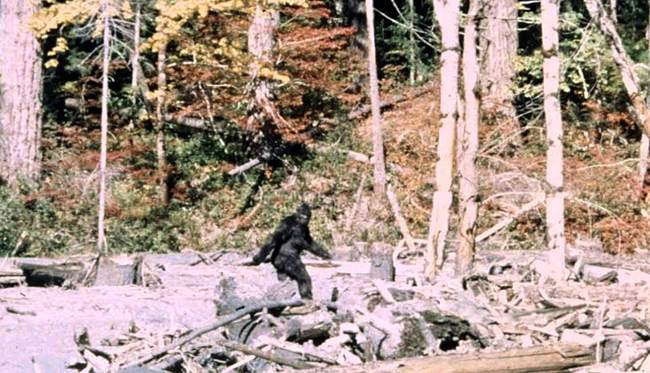
Standing at the edge of the Rocky Mountains, one is reminded of the vast, untapped wilderness that stretches before us. It’s a reminder of the uncharted territories that still exist, raising questions about what we truly know. Despite the claims of some skeptics, the wilderness still holds secrets waiting to be uncovered.
Ward Clark of Townhall Media recently dismissed a Bigfoot sighting in Monroe County, Michigan. His skepticism is shared by many who doubt the existence of undiscovered species in well-explored areas. However, this rebuttal seeks to reignite the curiosity that drives scientific discovery.
Forests cover about 36% of the United States, offering over 800 million acres of potential mystery. The Rocky Mountains alone contain peaks and valleys that remain out of reach, except by air. Glasgow, Montana, known as the most isolated town in the contiguous U.S., exemplifies how much of the country remains unexplored.
States like Michigan, Wisconsin, Minnesota, and even Texas boast significant forest coverage. These are not just wooded areas within urban parks but vast expanses of dense, wild forests. It’s scientifically reckless to assume that every inch of these lands has been cataloged.
Consider the Tongass National Forest in Alaska, sprawling across 16.7 million acres. It’s larger than West Virginia, yet the hubris to believe all its creatures are known is astounding. Even in such expansive landscapes, the potential for undiscovered species is often met with ridicule.
The coelacanth, once thought extinct for 65 million years, was rediscovered alive in 1938. Yet, the possibility of an undocumented primate in North America is often dismissed. The scientific community has room for exploration beyond the mainstream narrative.
Dr. John Bindernagel, a Canadian wildlife biologist, dedicated his career to studying Sasquatch evidence. His work included collecting eyewitness accounts and examining physical evidence like tracks and hair samples. His 1998 book remains a significant contribution to the field.
Dr. Jeff Meldrum, a professor at Idaho State University, specializes in primate foot morphology. His extensive research includes over 300 footprint casts with details consistent with primate anatomy. Meldrum’s work challenges conventional skepticism and invites serious scientific inquiry.
Both Bindernagel and Meldrum have faced criticism for their work. Yet, they persist not out of zealotry but in the spirit of scientific inquiry. Their efforts raise uncomfortable questions that the mainstream often avoids.
Eyewitness accounts, often dismissed by skeptics, come from credible sources. Hunters, law enforcement officers, and veterans have shared their encounters on podcasts like “Sasquatch Chronicles.” These are serious individuals, not prone to fabricating tales for attention.
The question arises: Are these witnesses, including military officers and wildlife biologists, suddenly unreliable when discussing Bigfoot? Their stories deserve attention, not derision. Listening to their accounts can offer new insights into the mysteries of the natural world.
The Bigfoot Field Researchers Organization (BFRO) and the North American Wood Ape Conservancy (NAWAC) work tirelessly in this field. These organizations, composed of professionals, document sightings and conduct expeditions. They aim to verify and understand, not to entertain.
Other groups, like the Olympic Project in Washington and the Texas Bigfoot Research Center, use advanced technology in their research. While none claim to have captured a living specimen, their dedication to scientific rigor is undeniable. They offer a model for inquiry in unexplored territories.
Skepticism is a valuable scientific tool, but condescension is not. Ward Clark’s mockery does little to advance understanding. True progress requires an open mind and a willingness to explore the unknown.
History teaches us that many scientific advancements were met with skepticism and ridicule. Figures like Galileo and Ignaz Semmelweis faced similar challenges. Yet, their persistence paved the way for monumental discoveries.
In the realm of unexplained phenomena, the journey is just as important as the destination. Acknowledging the mysteries we haven’t solved invites a deeper understanding of the world. The search for answers continues, driven by curiosity and a passion for discovery.
