
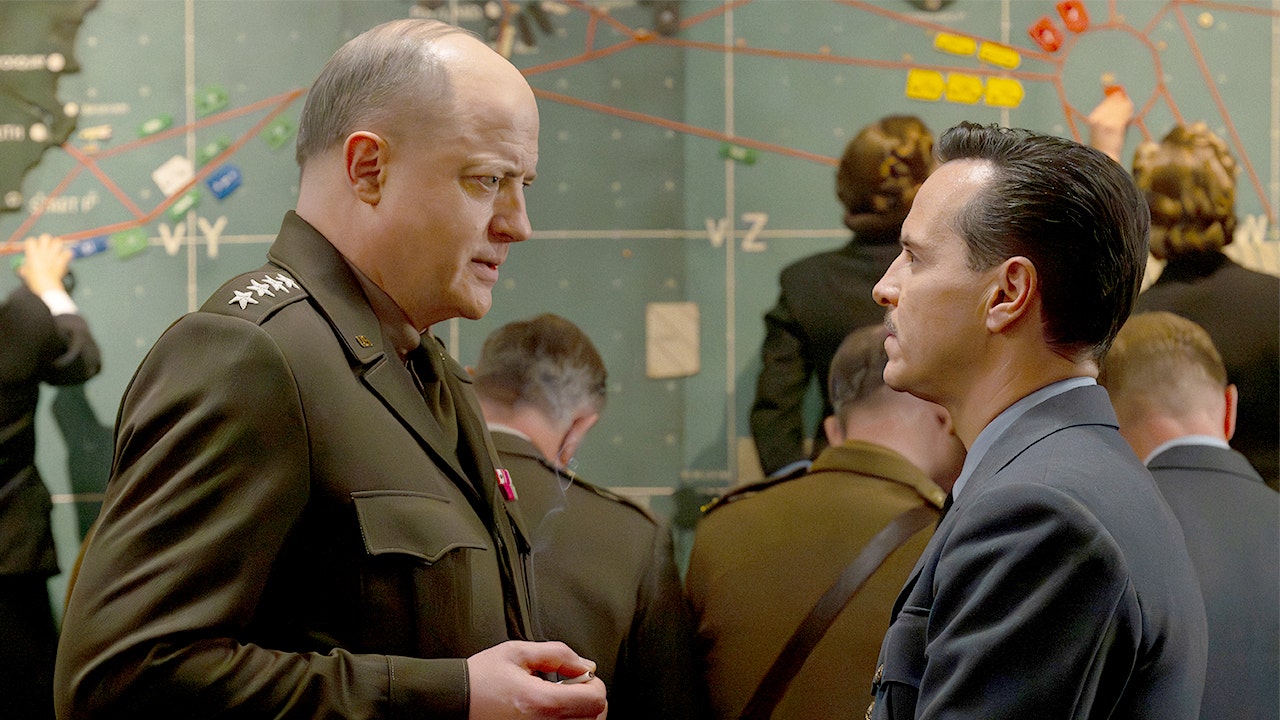
“Pressure” pulls a fresh angle out of the crowded World War II movie shelf by zeroing in on the weather fight behind D-Day, a human-sized thriller built around one impossible forecast and the people who had to make sense of it. The film tightens around British meteorologist Captain James Stagg and Gen. Dwight D. Eisenhower as a ticking clock and clashing egos force a life-or-death decision. Strong performances, a tidy screenplay and a director who knows how to stage tension make the procedural drama feel immediate and urgent.
Captain James Stagg, played by Andrew Scott, is the film’s nervous core, a man whose expertise comes with a stiff social awkwardness that makes collaboration difficult. He is brought in specifically to advise Eisenhower, and the moment of focus lands on a single, blunt order: “I need a forecast,” Eisenhower tells Stagg. That line sets the stakes plainly and the movie never forgets that weather here is as strategic as ammo or intelligence.
The central conflict is gloriously simple and terrifying: Stagg sees storms, while Irving Krick, the American meteorologist handpicked by Eisenhower, predicts clear skies. Krick’s methods and optimism clash with Stagg’s caution, and within 72 hours the two men must reconcile their forecasts or force a commander to gamble with lives. The dispute becomes a study in temperament as much as technique, with each forecast carrying enormous consequences.
Brendan Fraser portrays Eisenhower as a leader who can flip from disarming humor to bone-deep anxiety, haunted by the memory of Exercise Tiger, the rehearsal that turned deadly for hundreds of servicemen. That memory hangs over his choices and makes every consultation feel like another ledger line in a ledger the whole world is watching. Fraser’s presence gives the film a steady, human center amid the rising stakes.
The supporting cast sharpens the picture. Kerry Condon plays Captain Kay Summersby, Eisenhower’s secretary and confidant, a voice of calm and pragmatic insight who quietly shapes conversations when officers can’t. Damian Lewis appears as Bernard Montgomery, eager to press the attack regardless of conditions, adding political and military pressure that complicates the meteorological debate.
Writer-director Anthony Maras adapts the story from David Haig’s 2014 play and reminds viewers why a tight script matters in a procedural drama. Maras, coming off his intense work in Hotel Mumbai, keeps the scenes compact and the tension focused so the mechanics of forecasting never become dull. The screenplay smartly translates technical talk into human choices, so even viewers who don’t know a barometer from a briefing chart can feel the cost of being wrong.
Andrew Scott’s rigid but quietly charming Stagg anchors the film, and Chris Messina’s Krick makes for a convincing contrast in style and temperament. The ensemble work makes the forecasting duel more than a classroom exercise and turns it into a moral puzzle about certainty, responsibility and trust between allies. The movie lands as a gripping wartime drama that invites viewers into the nerve center of a historic decision.
“Pressure” is rated PG-13 for war violence, bloody images, some strong language and smoking. Running time: 1 hour, 40 minutes. In theaters now.
