
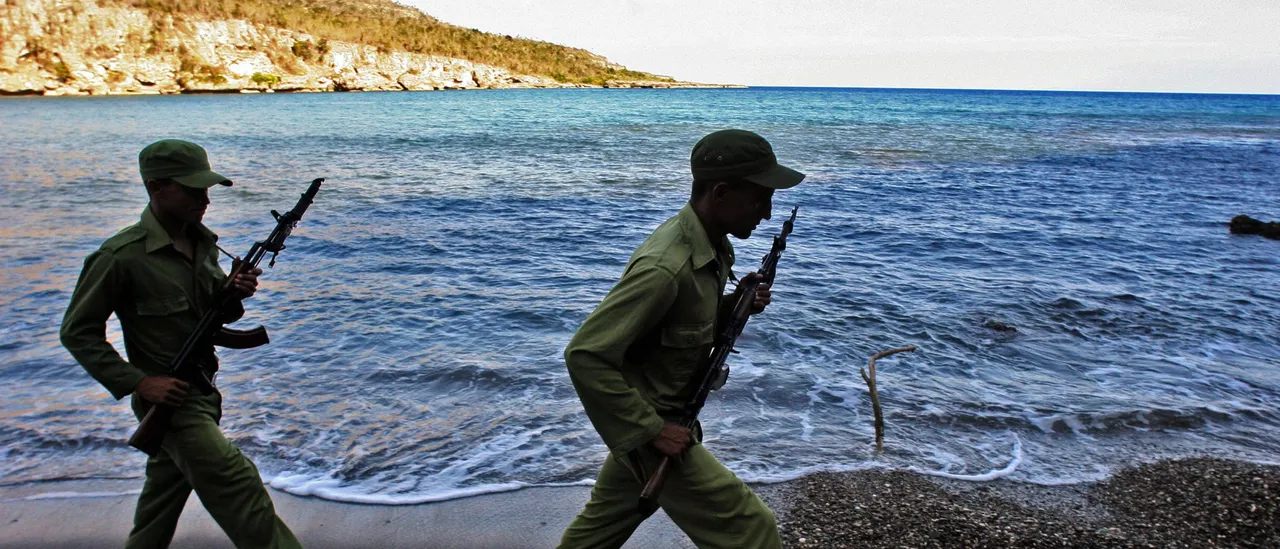
The Communist regime in Cuba says its border guards shot and killed four people after a Florida-registered speedboat allegedly entered Cuban waters and opened fire, according to an official statement and follow-up reports. U.S. officials, Republican lawmakers and military contacts are demanding answers as Washington sorts through conflicting accounts and the obvious diplomatic consequences. This article lays out the known timeline, the Cuban government’s public claim, the U.S. reaction, and the broader regional context shaping how Americans should see the incident.
Early Wednesday, Cuban border guards intercepted a Florida-registered speedboat near the El Pino channel in Cayo Falcones, Villa Clara province, according to Havana’s account. The Cuban statement says the vessel entered Cuban territorial waters and was approached by a Border Guard surface unit for identification. That encounter reportedly turned violent and led to the deaths of four people aboard the speedboat.
The Cuban Embassy in the US in a statement posted to X that the violating speedboat entered Cuban territorial waters and was approached by a Border Guard surface unit for identification purposes. The embassy said the speedboat crew opened fire on the border guards, injuring the Cuban vessel commander, which resulted in border guards killing four and injured six of the crew members. “In the face of current challenges, Cuba reaffirms its determination to protect its territorial waters, based on the principle that national defense is a fundamental pillar of the Cuban State in safeguarding its sovereignty and ensuring stability in the region,” said the Cuban Embassy in the US on X.
That quote from Havana reads like a prepared line from a government that treats force as a first resort, and Republicans in Washington are rightly skeptical. Florida’s Republican delegation, in particular, has a constituency that demands toughness and accountability when American-flagged boats are involved. The political instincts are clear: defend American citizens, call out authoritarian aggression, and push for full transparency from both Havana and U.S. agencies.
The scene on paper is ugly and messy, with competing narratives and lives lost. U.S. Southern Command directed questions to the State Department, which leaves a diplomatic gap while investigations are underway. That delay only fuels calls from Republican lawmakers for immediate answers and a clear response posture to deter further incidents.
Republican Florida Rep. Carlos Gimenez released a blistering public reaction, calling into question Cuba’s version of events and accusing the regime of “attacking a boat from Florida” and murdering those on board. His tone reflects a broader GOP perspective that views the Cuban government as a hostile, repressive actor whose explanations demand strong scrutiny. Lawmakers are pressing for evidence, witness interviews, and accountability rather than accepting Havana’s claim at face value.
The episode arrives amid growing regional strain: American officials note changing flows of oil, political alliances, and the fallout from recent upheavals in Venezuela. President Donald Trump’s earlier messaging is now part of the context, where he warned that “THERE WILL BE NO MORE OIL OR MONEY GOING TO CUBA – ZERO! I strongly suggest they make a deal, BEFORE IT IS TOO LATE.” That public posture signals potential economic pressure as a lever the U.S. might consider alongside diplomatic and military measures.
International reactions vary, but the practical reality on the water is stark: sailors, migrants or smugglers in small boats face lethal enforcement from a Cuban state that claims it must protect its sovereignty. The U.S. must sort the facts, but a clear Republican priority is ensuring Americans are protected and that regimes that kill citizens of other countries face consequences. For now, questions outnumber answers and the political stakes in Miami, Congress and the Pentagon are only rising.
Investigators will need to reconstruct the approach, the use of force, and whether the speedboat was genuinely a threat or a victim of an overzealous blockade. Whatever the forensic results, Republican leaders will press for policy changes that deter future tragedies and defend maritime freedom near the Western Hemisphere. The incident is a test of American resolve and an example of how state aggression can quickly turn into a diplomatic crisis requiring a firm response.
