
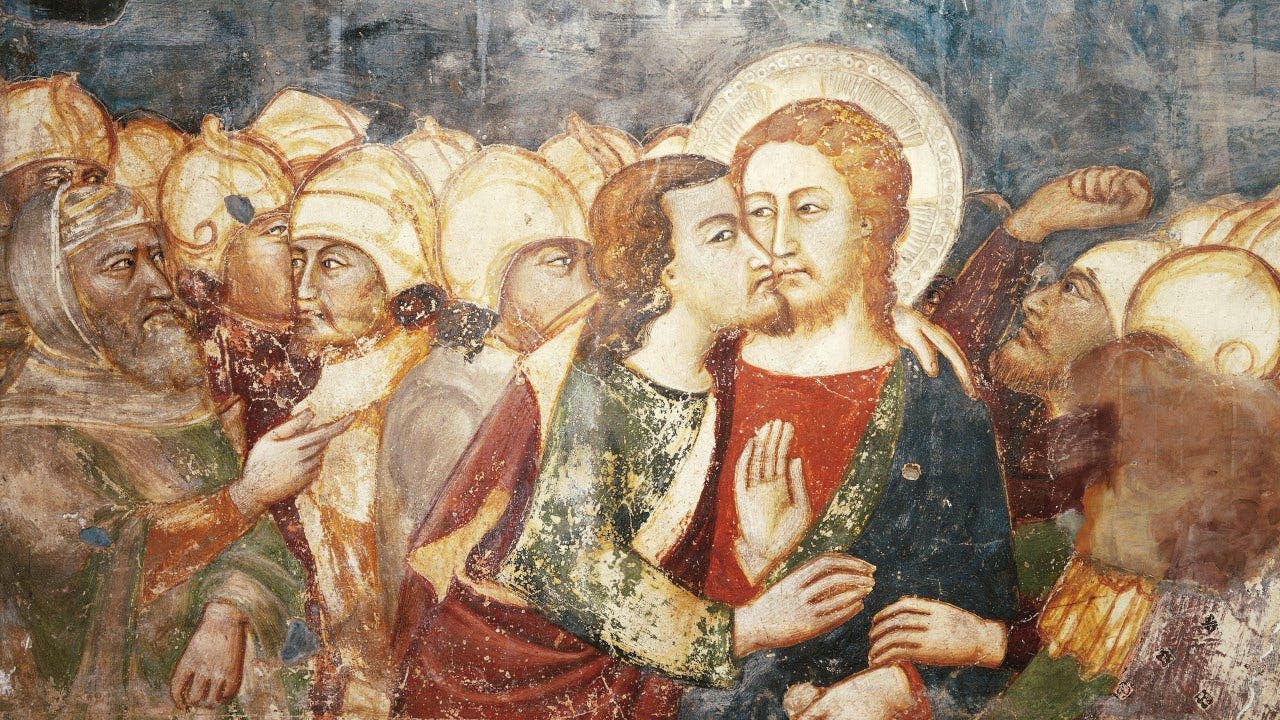
Palm Sunday always brings us back to the Passion, and this year Matthew’s version draws particular attention to Judas and the hard questions his story raises about guilt, despair, and mercy. I’ll walk through Matthew’s portrayal, medieval art that offers a surprising counterpoint, the Catechism’s pastoral stance on suicide, and a striking 19th-century anecdote about repentance in a last moment. Expect a clear, conversational look at why mercy remains central, even at the darkest edges of human failure.
Matthew’s Passion is raw and specific about Judas. “Then Judas, his betrayer, seeing that Jesus had been condemned, deeply regretted what he had done. He returned the thirty pieces of silver to the chief priests and elders, saying, ‘I have sinned in betraying innocent blood.'” That admission reads like nothing less than honest remorse, not a shrug or an attempt to excuse himself.
Matthew then reports that Judas flung the money into the temple and “went off and hanged himself.” It is a bleak end and the kind of detail that pushed many theologians to conclude that Judas had no hope. Augustine and Aquinas assumed condemnation, and Dante famously placed Judas at the absolute bottom.
Yet art and devotion sometimes whisper a different possibility. On a capital at Vézelay Basilica in France, the sculptor carved two scenes facing one another: a violent depiction of Judas’s hanging and a peaceful image of the Good Shepherd carrying that same man like a lost sheep. In that stone relief the dead figure even appears to be smiling, offering a provocative counterimage to the usual verdict.
The Catechism speaks into this tension with surprising pastoral breadth: “We should not despair of the eternal salvation of persons who have taken their own lives. By ways known to him alone, God can provide the opportunity for salutary repentance. The Church prays for persons who have taken their own lives” (2283). That language refuses easy presumptions about final judgment and insists prayer and hope remain appropriate responses.
When Matthew gives us Jesus crying out, “God, my God, why have you abandoned me?” he is, in the gospel’s logic, entering the extremity of human despair. Jesus does not become sinful, but he embraces the psychological and spiritual condition of abandonment, making mercy present precisely where we imagine God absent. That theological move matters for how we read Judas and those who despair.
I do not want to downplay sin’s seriousness; the betrayal and destruction are real and tragic. Still, the apostle Paul’s note stands as a corrective: “Where sin abounds, grace abounds the more.” That is not a platitude but a theological claim that God’s mercy can reach into places we assume irretrievable.
There’s a small, powerful story about a 19th-century French couple that illustrates this in human terms. The wife was devout and wanted a picture of the Sacred Heart placed over their bed; the husband agreed halfheartedly. After business failures he fell into deep depression and threw himself from a building, leaving his wife destroyed and convinced she had no answer for his end.
In her grief she traveled to see John Vianney, the priest of Ars, and found a mile-long line waiting for him. Kneeling at the rail, she wept until the priest called her name. “How did you know my name?” she asked. He answered, “It doesn’t matter.” He went on: “You are in despair over the death of your husband. I want you to understand that as he was hurtling to his death, God showed him that image of the Sacred Heart that he had hung over your bed.” “How could you possibly know such a thing?” she gasped. “It doesn’t matter,” he replied. “What matters is that upon seeing it, he repented.”
Even Dante, who consigns Judas to the deepest pit, also suggested that a single tear of repentance could meet the mercy of God. That tension is uncomfortable but real: tradition wrestles with judgment, art imagines rescue, and pastoral wisdom urges prayer rather than certain despair. The story of Judas and these later reflections keep insisting on one stubbornly difficult point: mercy is never fully exhausted where human brokenness is deepest.
