
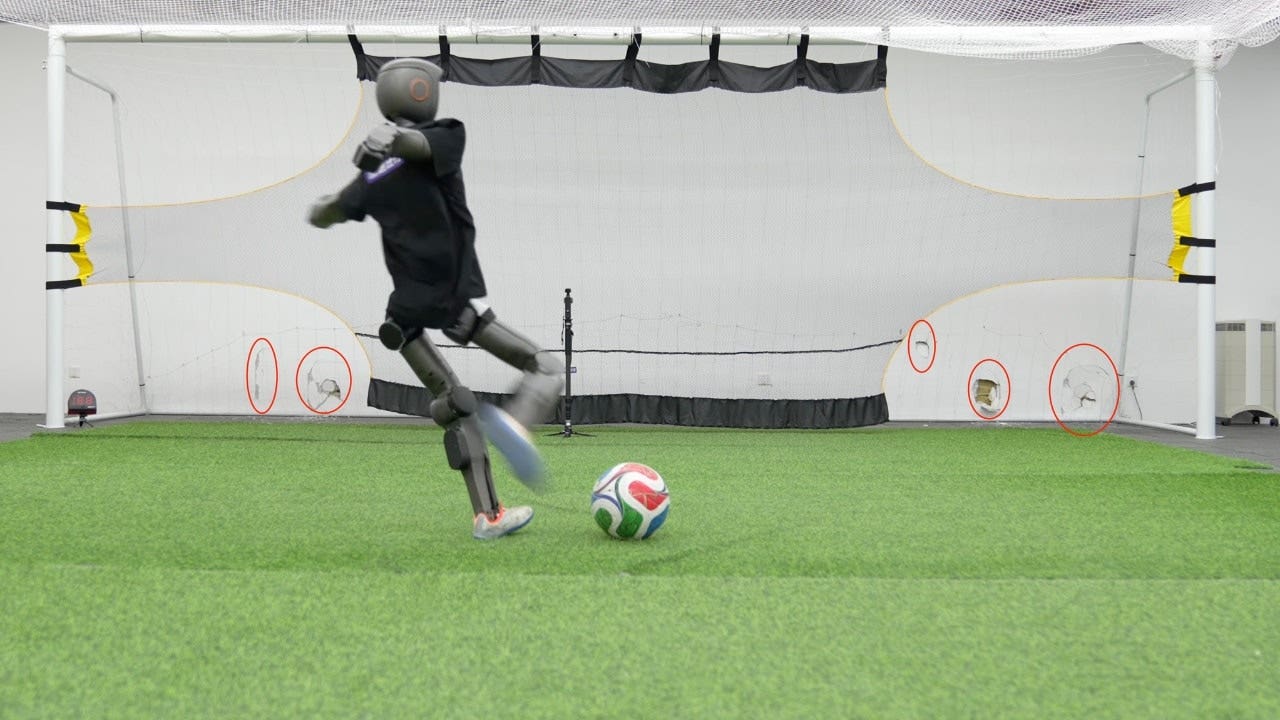
The video of Booster Robotics’ T1 humanoid launching soccer shots that dent a practice wall has sparked a sharp conversation about capability and safety, showing both why robot soccer matters for technical progress and why stronger humanoids demand stricter guardrails around people and property.
Booster’s T1 is a compact humanoid with enough joints and torque to move like an athlete, which is exactly why engineers put it through soccer drills. Seeing a machine repeatedly power a ball into a curtain and leave visible marks makes the tech feel immediate and a little unnerving. The demonstration underscores how motion, balance and force combine in ways that matter far beyond a lab setting.
Soccer is an unforgiving test bed because the ball forces constant adjustments, split-second decisions and recovery from unexpected nudges. Those challenges push teams to refine perception, locomotion and control systems so a robot can stay upright and respond to a moving object. In short, the sport squeezes the weak points out of a design, revealing both strengths and dangerous blind spots.
On the technical side, the T1 platform is built to support research teams, providing an open framework for training motion models and experimenting with behaviors. That makes it useful for universities, labs and competitive groups aiming to teach robots how to act in dynamic spaces. The same systems that enable a confident kick also form the backbone for tasks like lifting, navigating cluttered environments and helping in logistics scenarios.
But raw power comes with tradeoffs. A foot or hand that can dent drywall can also break equipment or cause real injuries if something goes wrong. That risk is not theoretical: fail states in joints, sensors or decision logic can turn a showcase into a hazard. Practical safety demands hardware limits, clear emergency cutoffs and careful separation between test grounds and public spaces.
Regulation and testing protocols will need to match how capable these robots become, because lab safety does not automatically carry over to workplaces or homes. Force thresholds, reliable stop functions and transparent testing records should be standard for any robot expected to operate near people. Without those safeguards, demonstrations of strength feel less like progress and more like a warning sign.
RoboCup and similar competitions play a big role in advancing the underlying tech, driving teams to solve perception, balance and autonomy under pressure. The long-term research goal is bold: build humanoids that can handle the chaos of real soccer and, eventually, the chaos of messy human environments. That ambition accelerates useful capabilities, but it also raises questions about oversight and responsibility as robots leave controlled arenas.
Engineers see value in these drills because lessons carry over to warehouses, disaster zones and even elder care, where recovery from slips and adapting to moving objects is critical. If a robot can regain balance after a shove and then perform a precise task, that skill becomes a genuine asset. Still, the environments where that value shows up are often populated by people who cannot predict or control a robot’s actions.
Who sets the rules when a machine causes damage or injury? Who enforces force caps and certifies emergency systems? These are not just academic questions but urgent policy issues as humanoids gain strength and mobility. Industry standards, public transparency and accountability frameworks will be necessary to keep pace with what these machines can do.
Watching a robot kick a ball hard enough to leave dents is an attention-grabber, and for good reason: it shows rapid progress and clear limits that must be managed. The same demonstrations that excite engineers also remind everyone that capability without careful controls is a risk. As humanoid robots move from labs to real-world roles, practical safety engineering and clear rules will determine whether that transition helps people or creates new hazards.
