
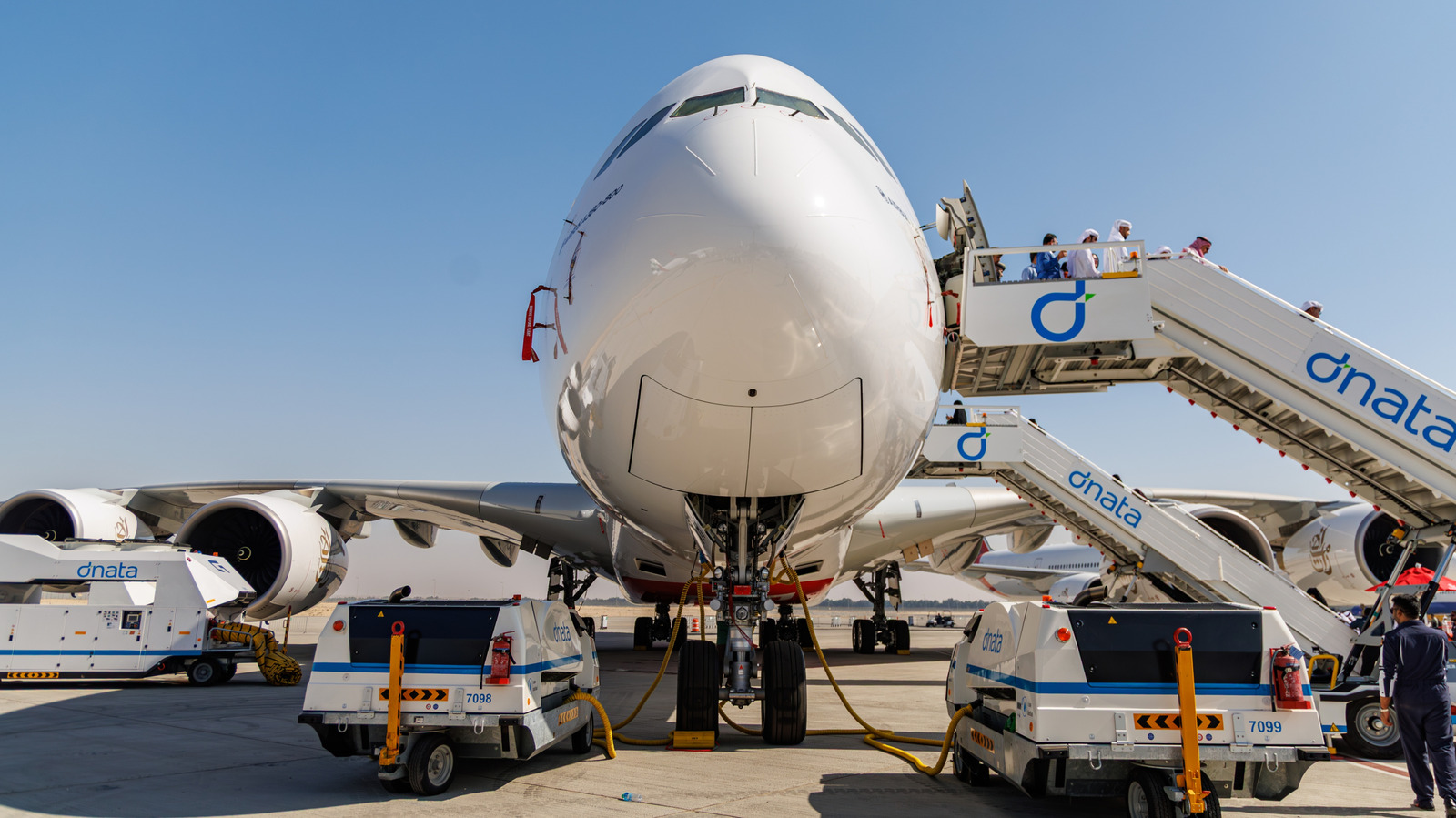
This article explains which passenger airliner takes the crown for sheer size, why it earned that title, and what makes it different from other big planes on the tarmac. We’ll look at capacity, key dimensions, who flew it the most, and why its story still matters for commercial aviation.
The title of world’s largest passenger airplane belongs to the Airbus A380, the full-length double-decker that redefined long-haul travel when it arrived. It was built to carry more people in comfort on popular hub-to-hub routes, stacking cabins one above the other for a capacity no single-aisle jet could match. Its sheer scale was meant to change how airlines moved masses between busy airports without adding more takeoffs and landings.
The A380 measures about 72.7 meters in length and spreads its wings roughly 79.8 meters across, creating a presence on the runway that is unmistakable. Internal volume is massive compared with standard widebodies, and the full-length upper deck gives airlines flexibility to install lounges, bars, or premium cabins along with standard economy seating. Designers focused on a roomy feel as much as on moving large numbers of passengers efficiently.
When it entered service, the aircraft’s typical seating ranged widely depending on airline layouts, from about 500 passengers in two-class configurations up to more than 800 in high-density formats. That range showed how adaptable the platform could be, appealing to carriers that wanted to maximize revenue on high-demand routes and those that aimed to provide premium comfort on flagship services. Emirates became the most visible operator by far, placing large orders and shaping public perception of the jet as a luxury workhorse.
Technically, the A380 is notable not just for size but for engineering choices that supported those dimensions. Four high-bypass turbofan engines give it the thrust needed for heavy takeoffs, while modern materials and systems kept weight and maintenance more manageable than older behemoths. Cabin pressurization, environmental controls, and structural design all had to scale up to keep the passenger experience consistent from front to back of the airplane.
Its arrival forced airports and ground handlers to adapt: jetways, gate spacing, baggage systems, and even taxiways needed upgrades at some hubs to handle the giant. That infrastructure requirement became a two-edged sword. While some airports embraced the upgrade to accommodate the A380 and future growth, others hesitated because the investment only made sense on routes with sustained, heavy demand. That reality shaped where the aircraft ended up flying most often.
Market dynamics eventually influenced the plane’s commercial fortunes. Airlines shifted toward more frequent, point-to-point flights using long-range twinjets that offered flexibility and lower operating costs, especially in a market that favors direct nonstop service between secondary cities. Those twinjets put pressure on the A380’s business case, which relied on densely packed corridors between major hubs to shine. Even so, the airplane kept a loyal following where passenger volume and brand positioning justified size.
From a passenger viewpoint, the A380 became famous for quiet cabins and a smooth ride, thanks in part to its size and four-engine layout. Many operators used the extra room for onboard amenities that you rarely find on smaller jets, turning long-haul segments into distinct experiences rather than mere transit. These comforts helped the A380 craft a public image that outlived the initial hype and kept it prominent in aviation conversations.
While production has ended and some airlines are retiring their fleets, the A380 remains the benchmark for what a passenger superjumbo can be. It proved that transporting large crowds across continents could be done in style, and it left an imprint on airport design, airline strategy, and passenger expectations. The aircraft’s era may be winding down, but its role as the largest passenger jet in history is secure.
