
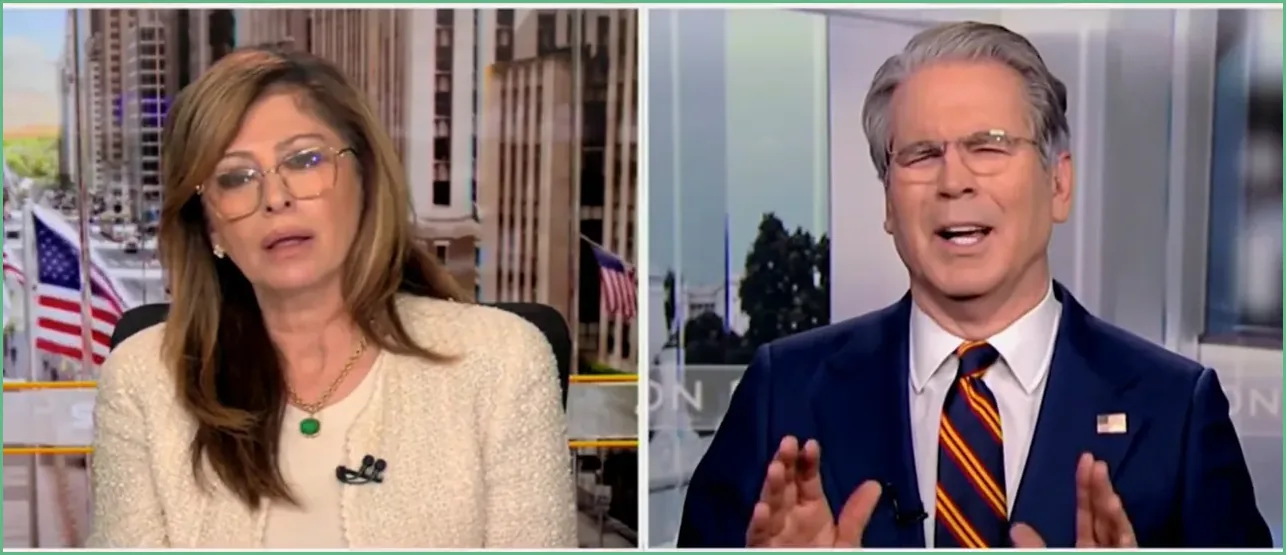
Scott Bessent, Treasury Secretary, told Maria Bartiromo that the administration will keep tariff revenue intact and press on with layered trade measures after the Supreme Court limited the president’s powers under IEEPA, and he defended the plan as a straightforward tool to shrink the trade deficit and revive U.S. manufacturing.
The Supreme Court ruling narrowed one legal path the president used, but it did not remove other strong authorities the administration plans to use, and Treasury makes clear revenue won’t vanish. Bessent pushed back hard on critics who said the decision would blow a hole in federal receipts, calling those warnings politically motivated and off the mark. He framed tariffs as negotiation leverage the country can’t afford to give up when reshoring industry is on the line.
Bessent didn’t mince words about the fiscal hawks who panicked over the short-term accounting. “Yes, so, Maria, let’s take a step back here. And Maya MacGuineas should be ashamed, and they should take the word ‘responsible’ out of her organization’s name,” Bessent responded. “Everything she told you was completely irresponsible and, look, where were they when the Biden administration blew out the deficit that we had a fiscal contraction last year? So she should be ashamed.”
He explained the ruling was narrow and left the president with the most severe tools for negotiations, including the ability to impose a full embargo even if one authority was curtailed. “So let me tell you what’s going to happen first, this ruling was a very narrow ruling in terms of the president’s ability to use IEEPA to collect revenues. The Supreme Court said the president can put in a full embargo, but he cannot collect one dollar,” Bessent continued. Treasury plans to move quickly to reauthorize tariff measures under alternative statutes.
To bridge the gap, administration officials said they will deploy Sections 232 and 301 along with Section 122 measures, and they expect those layers to preserve or even raise revenue. “So the president still has the most draconian measure for negotiations, and you know that under Sections 232, Sections 301, we’re already collecting substantial tariff revenue. The IEEPA tariffs are going to be replaced in three days with the Section 122, and I can tell you at Treasury, contrary to what the ‘Committee for an Irresponsible Budget,’ or whatever it’s called, says, tariff revenue will be unchanged this year and will be unchanged in the future.” That is a confident forecast from the administration.
These moves follow last year’s push to confront unfair trade and large bilateral imbalances head-on, and they reflect a broader Republican view that America must use every tool to restore manufacturing and correct trade theft. “The president announced on Friday and amended over the weekend [a] 15% global tariff using a very robust authority from 1974. Those will be layered on with section 232, section 301, and the 122s; they run for 150 days,” Bessent said. The aim is plain: make trade partners negotiate or face real economic consequences.
Officials also stressed the administration is not closing the door to deals; they want reciprocal arrangements that benefit American workers and industries. “And during that time, [the Department of] Commerce, USTR [United States Trade Representative] will be doing studies, and the studies will likely lead to increased tariff revenues,” Bessent explained. Negotiations are the goal, tariffs are the stick to secure a fairer playing field.
https://x.com/katesrichardson/status/2024863197799272485
On outreach to partners, the message was optimistic and tactical—these are not arbitrary punishments but leverage for deals that create jobs at home. “We’ve been in contact with our foreign trading partners, and they like the tariff deals,” Bessent noted. “So, you know, they’re not going to be changed and the president remains undeterred in his determination to lower our trade deficit and bring manufacturing back to the U.S.” That touches the core Republican argument that America must stop being a passive trading target.
Expect a fast follow-up from Treasury and trade agencies to codify the replacement authorities and keep revenue steady while pushing for concrete bilateral wins. The administration’s approach is blunt and unapologetic: use tariffs as powerful bargaining chips, defend revenue projections, and keep pressure on foreign partners until they deliver fairer access and more jobs for Americans.
!function(r,u,m,b,l,e){r._Rumble=b,r[b]||(r[b]=function(){(r[b]._=r[b]._||[]).push(arguments);if(r[b]._.length==1){l=u.createElement(m),e=u.getElementsByTagName(m)[0],l.async=1,l.src=”https://rumble.com/embedJS/u3rtroj”+(arguments[1].video?’.’+arguments[1].video:”)+”/?url=”+encodeURIComponent(location.href)+”&args=”+encodeURIComponent(JSON.stringify([].slice.apply(arguments))),e.parentNode.insertBefore(l,e)}})}(window, document, “script”, “Rumble”);
Rumble(“play”, {“video”:”v73xkie”,”div”:”rumble_v73xkie”});
