
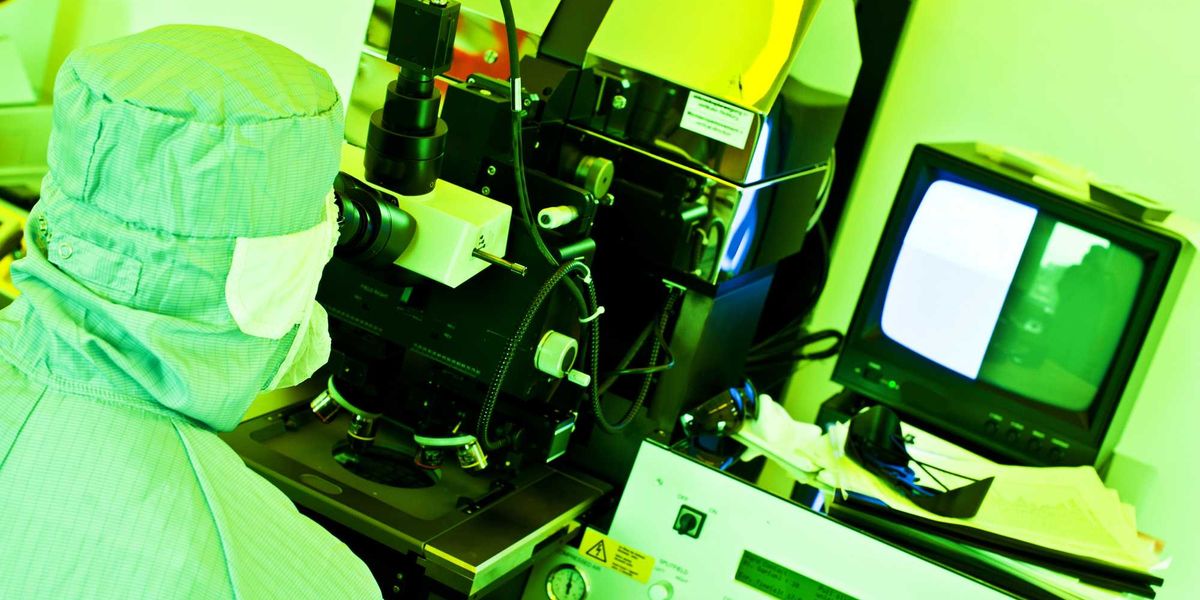
The Veldhoven machine is the quiet beating heart of modern microchips: a colossal EUV lithography scanner that converts molten tin droplets into plasma and sculpts the tiny features inside the silicon brains of our devices. That single tool, built and coordinated by ASML and a global network of suppliers, sits at the intersection of physics, manufacturing, and geopolitics, enforcing a kind of scarcity that shapes where and how computation gets made.
Walk into the factory in Veldhoven and you step into a different scale of engineering. Inside a vacuum chamber engineers shoot molten tin droplets at about 50,000 a second, zap them with lasers and turn them into plasma that emits light at 13.5 nanometers, a wavelength so small it’s less than a thousandth the width of a human hair. The plasma briefly reaches temperatures many times hotter than the sun, all to print features measured in single-digit nanometers on silicon wafers.
The machine that performs this is an extreme ultraviolet lithography scanner, a system that weighs over 150 metric tons and travels in hundreds of crates and dozens of trucks and planes when it moves. It is the product of decades of research, tens of billions of euros in revenue and billions more spent on R and D, and an ecosystem of suppliers and customers who invested early and patiently. That combination is why only one company currently assembles these end-to-end systems into functioning fabs-ready tools.
Making images at 13.5 nanometers demands a different playbook than traditional optics. EUV can’t travel through air and it can’t be focused with glass lenses, so the machines use vacuum chambers and reflective mirrors instead of conventional optics. Those mirrors are polished to near-atomic smoothness, built from more than a hundred alternating layers only a few nanometers thick, and produced by specialized optics firms that themselves are rare and tightly integrated into the supply chain.
ASML’s dominance did not appear overnight. The firm grew from small beginnings in the 1980s, survived early failures, and built a strategy of licensing, acquisitions and close co-development with key customers. That long game pulled in expertise from the United States, Germany and many other places, while customers like chip foundries invested directly in the technology, creating a circle of dependency that makes it hard for rivals to catch up.
The result is more than a single machine; it is a global installed base of scanners humming in fabs across Taiwan, South Korea and the United States, plus a worldwide service operation that racks up billions in recurring revenue. Field engineers rotate around the clock to keep tools running, fixing most issues on site and accumulating tacit knowledge that is as valuable as the hardware itself. That field operation is a kind of guild, a living repository of experience that protects the value of the installed machines.
Geopolitics rides on that technical foundation. Export controls from the Dutch government and pressure from partners have limited where the most advanced systems can be sold, shrinking sales to certain markets and making the machine itself a diplomatic subject. China once accounted for roughly a third of sales, and export restrictions have pushed that share down as governments calibrate technology access against broader national interests.
ASML’s machines are assembled from an intricate web of suppliers: precision optics from Germany, light-source and laser tech from teams in the United States and elsewhere, and components and integration spread across many countries. The company employs tens of thousands of people from scores of nationalities, and roughly 80 percent of its parts come from that global network. The lithography scanner looks like a single artifact, but it is really the outcome of sustained international cooperation and mutual dependency.
“What looks like ubiquitous computation is, underneath, managed scarcity.” That sentence nails the point: our digital lives rest on real factories, rare machines and export permits. The chips in phones, cars and data centers emerge not from some abstract cloud but from a tightly controlled industrial process that only a few actors can run at the frontier.
Thinking of computation as weightless misses how fragile its supply lines can be. Tin plasma, picometer-smooth mirrors, precision vacuum systems and a specific set of permits and service teams keep advanced semiconductors flowing. The Veldhoven choke point is a reminder that next-generation computing is built in particular places by particular people, and that control over those places translates directly into leverage over the hardware that powers modern life.
