
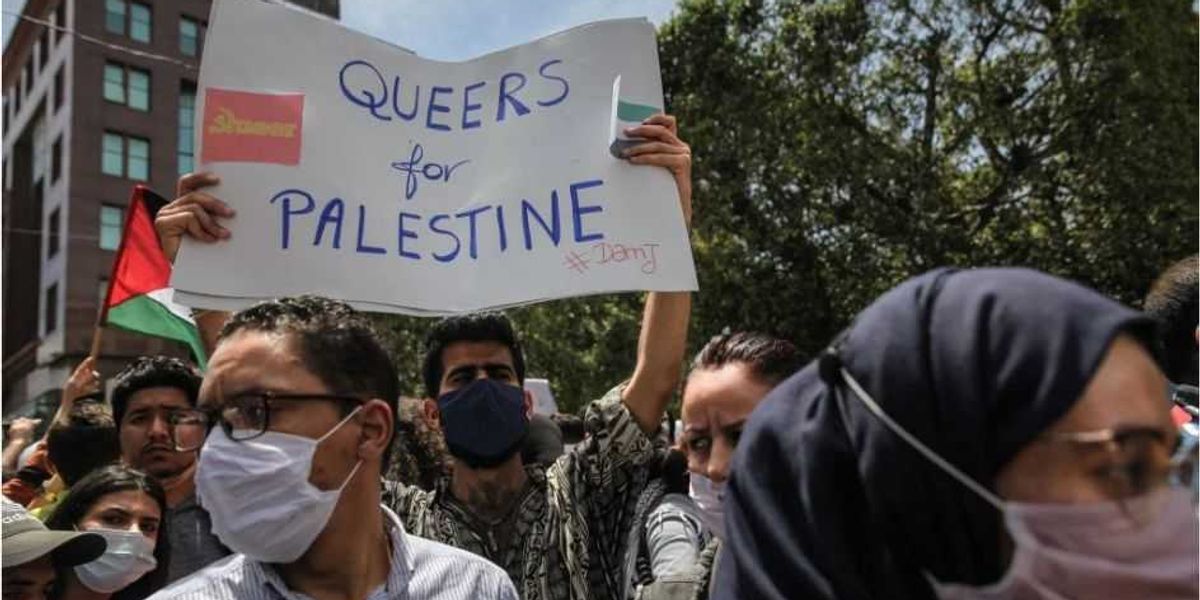
It’s become one of the strangest political mashups in recent memory: activists who build their public identity around LGBTQ causes standing shoulder to shoulder with movements that openly reject those same values. That tension sits at the center of a broader culture clash, where ideology, identity politics, and foreign conflict keep colliding in ways that leave plenty of people shaking their heads.
The phrase “Queers for Palestine” has become shorthand for that contradiction. On one side, there is a movement built around radical personal freedom, sexual expression, and opposition to traditional moral limits. On the other, there is a region where Islamist politics, social conservatism, and hostility toward homosexuality have long been part of the public reality.
That disconnect is not subtle. In much of the activist world, solidarity is driven less by consistency and more by a shared obsession with grievance, anti-Western rhetoric, and the thrill of joining whatever cause is getting the loudest applause. When that mindset takes over, basic questions about values get pushed aside fast.
The same pattern shows up in the way intersectionality gets used. Instead of creating clarity, it often turns into a sorting machine that ranks every issue through a lens of oppression, power, and identity. Once that happens, the details start to matter less than the crowd you’re trying to impress.
That helps explain why some activists excuse or downplay the harsh realities of Islamist ideology. They may talk about human rights in one breath and then cheer for movements that would never tolerate their own worldview in practice. The contradiction is glaring, but in activist circles, consistency is often treated like a luxury.
There is also a larger cultural story here about the collapse of old liberal instincts. Classical liberalism once emphasized free speech, tolerance, and equal treatment under the law, but today’s activist politics often trades those principles for tribal loyalty and emotional spectacle. The result is a movement that loves to talk about liberation while making strange alliances with forces that stand against it.
That tension does not exist in a vacuum. Since the Hamas attacks and the explosion of anti-Israel protests, the public square has been filled with slogans, campus chaos, and a lot of moral confusion. Some of the loudest voices are quick to frame everything as a simple oppressor-versus-oppressed story, even when that story collapses under the weight of reality.
Religion adds another layer to the conflict. Christianity, with its biblical foundations, still teaches a moral order that clashes with sexual revolution politics, but at least the disagreement is open and honest. Islamism, by contrast, can be praised by activists who would instantly recoil from its actual social rules if they were ever forced to live under them.
That’s where the whole arrangement starts to look less like solidarity and more like self-delusion. The language of inclusivity gets turned into a shield for contradictions that would be impossible to defend in plain English. The more intense the moral posturing becomes, the less room there is for honest reflection.
Groups like CAIR and the American Muslim Task Force also sit inside this broader web of influence and messaging, shaping how these debates are framed to the public. Their role in the conversation highlights how quickly activism, religion, and politics can blend into a single pressure campaign. Once that happens, emotional allegiance matters more than principle, and the crowd decides what counts as acceptable truth.
That leaves ordinary people caught between slogans that do not hold up and alliances that make no sense on close inspection. The whole thing keeps revealing the same uncomfortable lesson: when politics becomes a costume party for outrage, even the loudest causes can end up backing the very forces that would deny them a seat at the table.
