
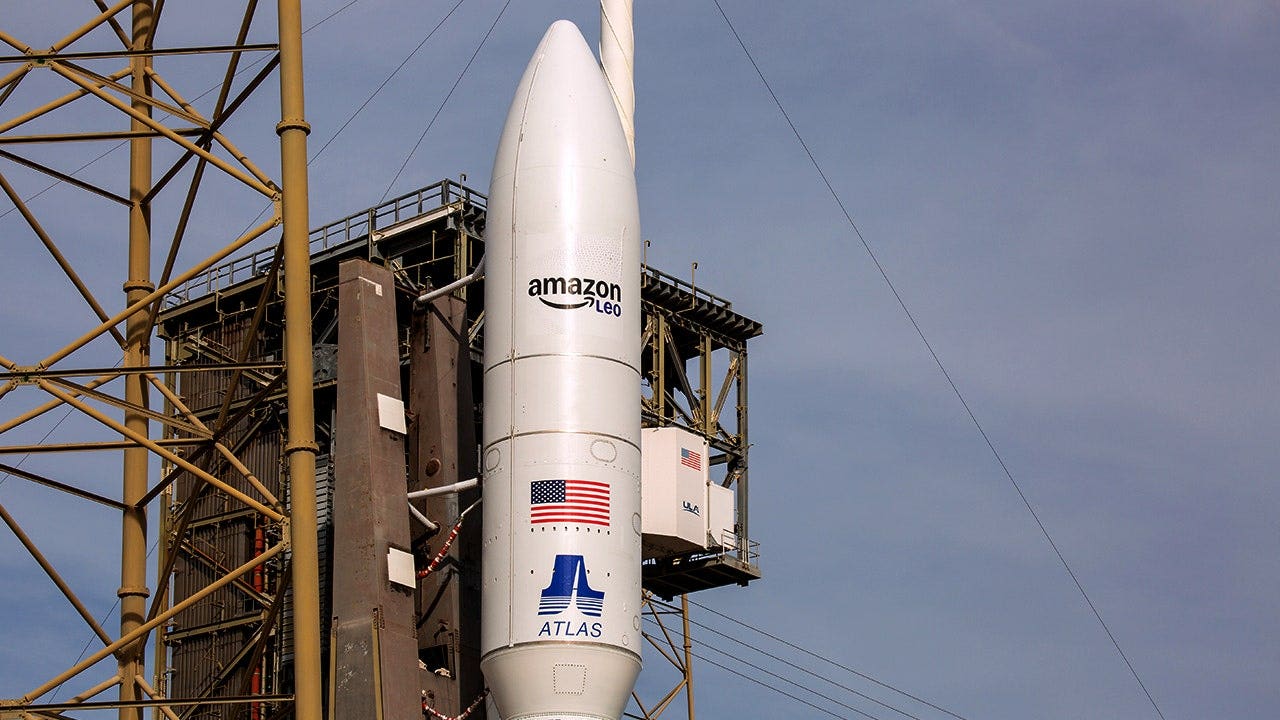
Amazon Leo is getting close to its first real customer rollout, and that puts it squarely in the ring with Starlink. Amazon has now pushed hundreds of satellites into low Earth orbit, lined up airline partners, and signaled that limited service could begin soon. The catch is simple: Starlink already has a giant lead, so Amazon’s big question is not whether it can launch, but whether it can catch up fast enough.
Amazon’s space internet effort started as Project Kuiper, and the new Leo name makes the mission sound a little cleaner and a lot more serious. The idea is to use a fleet of low Earth orbit satellites to deliver internet where wired service is weak, pricey, or just plain unavailable. Because the satellites are closer to Earth than older satellite systems, they can cut down on lag for streaming, video calls, and everyday browsing.
The company says Leo will rely on satellites, ground stations, fiber links, and user antennas to create a full network from space to the ground. It is not just chasing home broadband either, since Amazon wants different equipment for homes, businesses, and mobile use cases. That makes Leo more than a gadget play, and much more like a full-on infrastructure bet.
Recent launches show the project is moving from hype to hardware. Amazon’s July 2 mission added 29 satellites and brought the total deployed count to 396, which is enough for an initial service phase later this year. Even so, those satellites still have to slide into their assigned orbital positions before they can start handling customer traffic.
Amazon also wrapped up its Atlas V launch run with United Launch Alliance, a big milestone in the buildout. Future launches are expected to shift toward Vulcan, which can carry heavier payloads and help Amazon move more satellites at a time. That matters because in this race, pace is everything.
Starlink remains the company to beat, and it is not especially close yet. SpaceX started earlier, launched faster, and already sells satellite internet across more than 150 countries, territories, and markets. Amazon is promising limited service, but Starlink has the coverage, the customer base, and the head start that come from years in the market.
Still, Amazon is not walking into this empty-handed. It has deep pockets, a massive logistics machine, and AWS behind it, which could give Leo a real advantage with business customers and enterprise users. If Amazon uses aggressive pricing or smart bundles, it may not need to beat Starlink everywhere to become a serious alternative.
One of the most visible signs of Amazon’s strategy is aviation. JetBlue and Delta have both lined up to use Amazon’s satellite tech, with JetBlue aiming to improve its free Fly-Fi service starting in 2027. Delta plans a broader rollout across hundreds of aircraft beginning in 2028, with an initial installation on 500 planes.
Amazon says its aviation antenna can support speeds up to 1 Gbps down and 400 Mbps up, which is exactly the kind of number that gets airlines paying attention. A single connection system serving an entire aircraft could make internet access in the sky feel a lot less painful. If Amazon can make that work reliably at cruising altitude, travelers will notice fast.
Leo is also being built with direct-to-device service in mind, which means phones and other cellular devices could eventually tap into the network. Amazon says its planned acquisition of Globalstar will help support that effort, especially for future versions of the system. That opens the door to backup coverage in dead zones, during storms, or in emergency situations where normal towers are out of reach.
That kind of service would not replace your carrier overnight, but it could become a useful safety net. Think of it as the difference between total silence and a lifeline when things go sideways. For people who travel, hike, or live far from strong cell coverage, that is a pretty big deal.
The business case is strong, too. The global satellite internet market is expected to grow sharply over the next several years, and Amazon clearly wants a slice of it. Rural homes, farms, ships, airlines, disaster response teams, and remote businesses all need connectivity that does not depend on a perfect local network.
If you are thinking about satellite internet, the smartest move is to compare the basics and ignore the brand hype. Look at monthly price, equipment fees, installation, speed, latency, data caps, and weather performance before making a switch. Amazon Leo may become a strong option, but the real test will be what customers see on their bills and in their day-to-day connection quality.
For now, the most interesting part may be what comes first. You might see Leo on a plane before you see it at home, and you might hear about it in emergencies before it becomes a mainstream broadband option. That is how these things often start, with one practical use case that quietly turns into a much bigger story.
